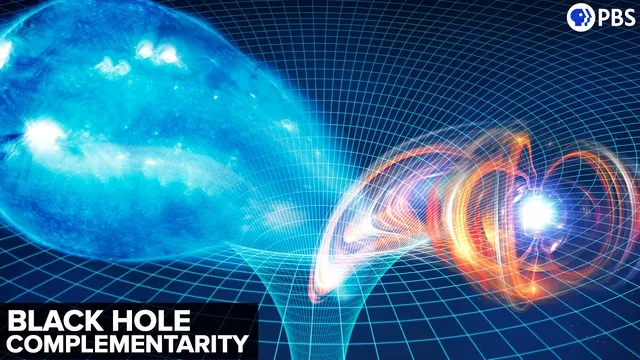
Can Black Holes Unify General Relativity & Quantum Mechanics?
Based on PBS Space Time's video on YouTube. If you like this content, support the original creators by watching, liking and subscribing to their content.
The information paradox arises because the equivalence principle predicts smooth horizon crossing for an infalling observer while Hawking evaporation plus unitarity predicts information must return to the outside.
Briefing
Black holes force a direct collision between general relativity and quantum mechanics: the same quantum information seems to be both destroyed and preserved. The tension centers on the black hole information paradox. In general relativity, an infalling qubit crosses the event horizon without anything locally dramatic happening, consistent with the equivalence principle. From far away, however, the black hole evaporates via Hawking radiation, and quantum mechanics demands that information be conserved (unitarity). If the qubit escapes in the radiation, it appears to be duplicated—once inside the black hole and once outside. If it never escapes, the qubit effectively vanishes, breaking unitarity.
Black hole complementarity was proposed to remove the contradiction by changing what “contradiction” can even mean. The idea is that different observers can assign different, mutually incompatible descriptions to the same event without any single observer ever being able to verify both descriptions at once. In the language of spacetime diagrams (Penrose diagrams), the qubit’s story splits depending on where and when an observer can receive signals. After the qubit crosses the horizon, photons emitted just outside can reach a distant observer only after extremely long delays, while signals from inside can never reach that observer at all. In the evaporation scenario, the qubit’s information can re-emerge in Hawking radiation only after the so-called Page time—when the radiation has accumulated enough structure that the information is no longer hopelessly scrambled.
The complementarity claim hinges on an operational limitation: no observer can ever collect evidence that the qubit exists in two places simultaneously. The transcript sharpens this by noting that “simultaneous” is not absolute in relativity; it can only be confirmed within an observer’s past light cone. For the duplicated qubits, there is no past light cone that contains both relevant events, meaning no one can verify their simultaneous existence. Alice sees one outcome (the qubit falls in), Bob sees another (the qubit’s information returns in the radiation), but the two accounts cannot be stitched together by any single measurement.
To test the boundary of that claim, physicists Bill Hayden and John Preskill designed a best-case thought experiment. Bob drops in after Alice, timed so he can intercept the qubit’s Hawking-radiated version as it emerges near the horizon. The hope is that he can also witness the “swallowed” version inside. Even with exquisite timing, Hayden and Preskill find Bob will miss the interior qubit by a narrow margin—nature seems to enforce the unobservability of duplication.
Complementarity then branches into interpretations. One view treats unitarity and quantum consistency as observer-relative: Alice and Bob each have a complete, contradiction-free quantum description, but they cannot communicate to compare notes. Another view leans toward equivalence of descriptions—interior and exterior accounts are different ways of describing the same underlying quantum system, echoing holographic ideas where boundary and bulk can be dual descriptions. Complementarity is not the only proposed resolution; firewalls, for instance, would prevent duplication by introducing a high-energy barrier near the horizon, but that comes at the cost of violating the equivalence principle. In the end, black holes remain “holes” in both spacetime and understanding—yet they may be the clearest route to a deeper framework that unifies gravity with quantum mechanics.
Cornell Notes
Black hole information paradoxes arise because general relativity and quantum mechanics make incompatible demands about what happens to a falling qubit. An infalling observer sees the qubit cross the event horizon smoothly (equivalence principle), while an outside observer expects the qubit’s information to come back in Hawking radiation after evaporation (unitarity). Naively, that implies either duplication (qubit both inside and outside) or destruction (information disappears). Black hole complementarity resolves the paradox by insisting there is no contradiction because no single observer can ever verify both descriptions: “simultaneous” can only be checked within an observer’s past light cone, and Hayden–Preskill show even an optimally timed attempt to observe both versions fails. The idea may mean quantum consistency is observer-relative or that interior and exterior are complementary descriptions of one underlying system.
Why does the information paradox look like it forces either duplication or information loss?
How do Penrose diagrams make the “frozen on the horizon” picture precise for a distant observer?
What does it mean to say no one can confirm the qubits are duplicated “at the same time”?
What did Hayden and Preskill test, and why does their result matter for complementarity?
How do the two interpretations of black hole complementarity differ?
Review Questions
- In what sense does the Page time determine when information can re-emerge in Hawking radiation?
- Why does the past light cone matter for deciding whether two qubit “copies” can be verified as simultaneous?
- What specific observational strategy did Hayden and Preskill use, and what prevented success?
Key Points
- 1
The information paradox arises because the equivalence principle predicts smooth horizon crossing for an infalling observer while Hawking evaporation plus unitarity predicts information must return to the outside.
- 2
If information returns in Hawking radiation, the qubit appears duplicated—both inside the black hole and encoded in the outgoing radiation.
- 3
If information does not return, the qubit’s information effectively disappears from the outside description, violating unitarity.
- 4
Black hole complementarity removes the contradiction by arguing no observer can ever verify both the “inside” and “outside” accounts at once.
- 5
Relativity makes simultaneity operationally limited: only events within an observer’s past light cone can be checked as simultaneous.
- 6
Hayden and Preskill show that even an optimally timed attempt to observe both versions fails, with the observer missing the interior qubit.
- 7
Complementarity can be interpreted either as observer-relative quantum consistency or as interior/exterior equivalence of descriptions, echoing holographic ideas.