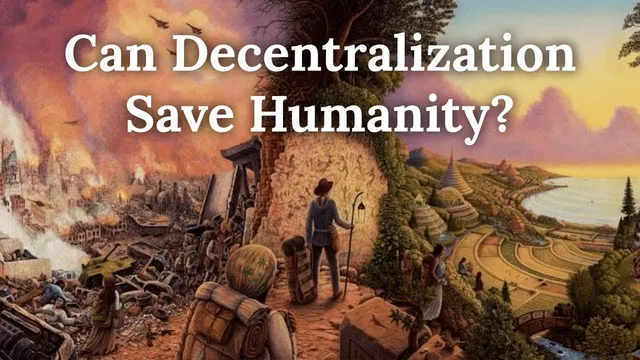
Can Decentralization Save Humanity? - Why Smaller is Better in Politics
Based on Academy of Ideas's video on YouTube. If you like this content, support the original creators by watching, liking and subscribing to their content.
Decentralization is presented as a way to reduce polarization by replacing forced compliance under one national rule with many consent-based governance options.
Briefing
Decentralization—replacing today’s large nation-states with thousands of smaller, autonomous political units—is presented as the most practical route to reducing polarization, improving governance, and lowering the risk of war and tyranny. The core claim is that “bigger” political structures concentrate power, slow responsiveness, and amplify conflict, while smaller states make politics more consent-based, participatory, and manageable.
The argument begins with a historical and philosophical case that large centralized states are the exception, not the norm. Leopold Kohr’s “The Breakdown of Nations” frames global problems as symptoms of “overgrown organisms” called great powers, calling instead for “a healthy system of small and easily manageable states.” The transcript adds anthropological support via Robert Carneiro’s estimate that for 99.8% of human history, small and decentralized political units dominated. It then points to recurring examples—Greek city-states, medieval Europe, early American colonies, and Switzerland—to argue that local self-rule has deep roots in human political life.
From there, decentralization is offered as a remedy for several modern pathologies. Polarization is described as partly driven by forced compliance: regardless of which party wins, minorities (or even majorities) are compelled to live under laws and policies they did not consent to. In a world of many autonomous jurisdictions, the transcript suggests, people could choose governance styles that match their preferences—ranging from free-market experiments to socialist city-states, monarchies in rural areas, democracies in mountain regions, or meritocracies on small islands. More choice, it argues, would reduce culture-war intensity and the risk of civil conflict.
Governance quality is another pillar. Large bureaucracies are portrayed as inherently prone to corruption and inefficiency, with size acting as a decisive variable independent of ideology. The transcript contrasts the sluggishness of massive governments with the responsiveness expected from smaller units, where officials are closer to the people they govern.
Decentralization is also framed as an antidote to civic apathy. Modern citizens, it says, often complain and vote only every few years, then watch wealth and power consolidate among a distant ruling class. Smaller jurisdictions would make political involvement more continuous and consequential, echoing Ancient Athens’ model of assemblies and rotating councils where citizens’ views shaped policy.
Finally, the transcript addresses security and rights. It argues that war becomes less catastrophic when fought among smaller polities with limited resources, citing the contrast between localized medieval conflicts and the destructive scale of nation-state wars. It also claims that conquest of many small states is tactically harder than conquering a few large ones, while defense alliances—like the Hanseatic League—could coordinate resistance. Tyranny, meanwhile, is said to be easier to constrain in smaller populations and to escape through “voting with your feet,” reducing the entrenchment that comes from ruling millions.
The closing message is that globalization and centralization may push societies toward political unification in a universal state—a stage associated with civilizational collapse. Decentralization is presented as a way to avoid that trajectory or to repair damage after political consolidation, with action urged at the local level now rather than later.
Cornell Notes
The transcript argues that replacing large nation-states with many smaller, autonomous political units would improve consent, responsiveness, and civic life while reducing the scale of war and the durability of tyranny. It grounds the case in historical claims that decentralized governance dominated most of human history and that large centralized states are a relatively recent European development. It links polarization and culture wars to forced compliance under distant governments, and it claims smaller jurisdictions would let people choose governance styles that match their values. The transcript also argues that government size worsens corruption and inefficiency, while smaller polities can sustain participation and local accountability. It concludes that decentralization is a safeguard against political unification that could lead to global totalitarianism and societal collapse.
Why does decentralization get framed as a cure for political polarization and culture wars?
What role does government “size” play in claims about corruption and inefficiency?
How does the transcript connect decentralization to civic participation and political apathy?
Why does the transcript think decentralization could reduce the destructiveness of war?
What concerns does the transcript raise about a large aggressive state, and how does it respond?
How does the transcript argue decentralization would affect tyranny and the ability to escape it?
Review Questions
- What mechanisms does the transcript use to link forced compliance under large states to polarization and culture-war escalation?
- How does the transcript justify the claim that smaller polities would be more responsive and less corrupt than large bureaucracies?
- Which historical examples are used to support the idea that decentralized governance can manage defense and resist aggression?
Key Points
- 1
Decentralization is presented as a way to reduce polarization by replacing forced compliance under one national rule with many consent-based governance options.
- 2
Government performance is framed as strongly affected by size, with large bureaucracies portrayed as more prone to corruption and administrative failure.
- 3
Smaller political units are argued to increase civic participation by making citizens’ preferences more directly consequential for local decisions.
- 4
The transcript claims war would be less destructive when fought among smaller polities with limited resources, and that size can deter aggression.
- 5
Defense against large aggressors is supported through the idea that conquest of many small states is harder and that small states can form alliances, such as the Hanseatic League.
- 6
Tyranny is portrayed as more manageable when political power is constrained by smaller populations and when people can escape via mobility across jurisdictions.
- 7
The closing warning is that political unification under global structures could lead toward totalitarianism and civilizational collapse, making local autonomy an urgent alternative.