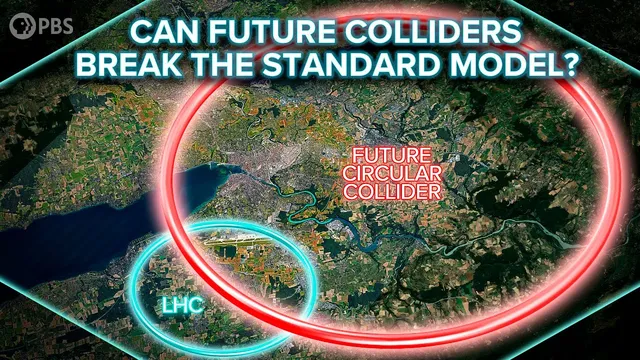
Can Future Colliders Break the Standard Model?
Based on PBS Space Time's video on YouTube. If you like this content, support the original creators by watching, liking and subscribing to their content.
The Standard Model’s success is paired with unresolved problems—neutrino masses, dark matter, and anomalies—so new physics remains necessary.
Briefing
Future colliders are being pitched as the best route to new physics—but the odds hinge on whether nature has been hiding beyond the energy reach of today’s machines. Europe’s proposed Future Circular Collider (FCC) would be a 100-kilometer underground ring near Geneva, designed to collide beams at about 100 TeV—roughly eight times the Large Hadron Collider’s (LHC) energy—and, in its early phase, to run electron–positron collisions as a “Higgs factory.” The motivation is straightforward: the Standard Model is experimentally complete, yet it still fails to account for neutrino masses, dark matter, and several anomalies, and the long-sought supersymmetry (SUSY) has not shown up despite a decade of LHC searches.
The transcript lays out why colliders keep getting bigger. Early accelerators like linear accelerators and cyclotrons could accelerate particles, but fixed-target collisions waste energy because collision energy grows only with the square root of accelerator energy. Beam colliders solved that by storing particles in rings so two counter-rotating beams can collide, extracting the full impact energy. That path—from small electron–positron machines such as AdA and VEP-1, to proton colliders like CERN’s Intersecting Storage Rings, to the Tevatron, and finally to the LHC—culminated in the 2012 discovery of the Higgs boson, the last missing Standard Model particle.
Yet the LHC’s success also sharpened the problem. SUSY was expected to address the hierarchy problem by introducing symmetric partners to known particles, with masses in a target range of roughly 100–1000 GeV. The LHC reaches energies above that window, so SUSY should have appeared if it exists in the simplest form. Instead, searches have found no evidence, leaving physicists with an impasse: the Standard Model works, but it offers no clear next step.
The near-term plan is to squeeze more science out of existing infrastructure. The LHC is undergoing upgrades aimed less at jumping to dramatically higher energies and more at increasing luminosity—about a factor of five—via improved superconducting magnets and other component upgrades. The High-Luminosity LHC is scheduled to come online in 2027 after a series of shutdowns.
For truly new territory, the FCC is the flagship proposal. Its electron–positron phase is chosen because such collisions are cleaner and easier to achieve at high luminosity, enabling high-rate Higgs production and precision studies—such as how often the Higgs interacts with the top quark. Later, the FCC would transition to proton–proton collisions to expand discovery reach. The transcript also weighs cost and uncertainty: the FCC is expected to cost tens of billions over its lifetime, and there is no guarantee that new particles exist in the expanded energy range.
The discussion then contrasts Europe’s collider focus with the United States’ strategy. After the Tevatron’s shutdown in 2011, US efforts shifted toward neutrino physics (including DUNE’s planned neutrino source) and toward a smaller but targeted Electron-Ion Collider (EIC), endorsed by the National Academy of Sciences and projected at about 1.6–2.6 billion. The closing point is that fundamental physics investment can pay off indirectly—through long-range technological and societal value—even when immediate returns are hard to quantify.
After the collider segment, the transcript pivots to astrophysics Q&A, addressing how space behaves at the merger of black holes (including the “pair-of-pants” event-horizon shape), what happens when white dwarfs exceed the Chandrasekhar limit (often leading to thermonuclear explosions rather than neutron stars), and why “sound” can exist in space despite low density. The segment ends with a lighthearted note about modern green-screen production.
Cornell Notes
The Standard Model is experimentally complete, but it still leaves major gaps—neutrino masses, dark matter, and other anomalies—and supersymmetry has not appeared despite extensive LHC searches. Because fixed-target collisions waste energy, modern colliders rely on counter-rotating beams in storage rings, which has driven a decades-long escalation in size and energy from early electron–positron machines to the LHC. The LHC’s High-Luminosity upgrade focuses on higher luminosity (more collisions) to improve sensitivity in the current energy range. For a bigger leap, the proposed Future Circular Collider would use a 100-kilometer ring to reach about 100 TeV and begin with electron–positron “Higgs factory” running before moving to proton–proton collisions. The transcript also contrasts Europe’s FCC priority with the US Electron-Ion Collider strategy and emphasizes that fundamental science can yield long-range technological and societal benefits even when discoveries are uncertain.
Why does moving from fixed-target experiments to colliding beams matter for reaching new physics?
What specific expectation about SUSY made the LHC’s null results feel like a major setback?
What is the High-Luminosity LHC upgrade trying to accomplish, and why isn’t it mainly about higher energy?
Why would the FCC start with electron–positron collisions if the ultimate goal is broader discovery?
How does the transcript connect collider strategy to the broader gaps in the Standard Model?
What determines whether a white dwarf exceeding the Chandrasekhar limit becomes a neutron star or a supernova?
Review Questions
- What tradeoff makes luminosity as important as energy when searching for rare particles?
- Why does the hierarchy problem push many theories toward new physics at the electroweak scale, and how did that shape SUSY expectations for the LHC?
- In the black-hole merger scenario, what does the “pair-of-pants” event-horizon picture imply about where space flows at the seam?
Key Points
- 1
The Standard Model’s success is paired with unresolved problems—neutrino masses, dark matter, and anomalies—so new physics remains necessary.
- 2
Fixed-target collisions are inefficient for high-energy reach because collision energy grows only with the square root of accelerator energy.
- 3
Beam colliders overcame that inefficiency by storing counter-rotating beams in rings, enabling full impact energy in each collision.
- 4
SUSY was expected to appear at roughly 100–1000 GeV, but LHC searches have found no evidence, deepening the search for the next framework.
- 5
The High-Luminosity LHC prioritizes luminosity (about a factor of five) to increase the number of collisions and improve sensitivity in the current energy regime.
- 6
The proposed FCC would reach about 100 TeV in a 100-kilometer ring and begin with electron–positron “Higgs factory” running to enable precision Higgs studies.
- 7
US collider strategy in the US has leaned toward smaller, targeted machines like the Electron-Ion Collider, while Europe’s priority centers on the FCC despite high costs and uncertainty.