Can’t eat the frog? You might have ADHD
Based on Ali Alqaraghuli, PhD's video on YouTube. If you like this content, support the original creators by watching, liking and subscribing to their content.
“Eat the frog” can backfire for ADHD because lower average dopamine and higher distractibility make daunting first tasks harder to start, increasing avoidance and overwhelm.
Briefing
“Eat the frog” productivity advice—doing the hardest, most dreaded task first—often backfires for people with ADHD because it collides with how motivation, attention, and overwhelm work. The core problem isn’t discipline; it’s that ADHD typically comes with lower average dopamine, making daunting tasks less motivating, plus distractibility and mental overload that make starting difficult work feel even more threatening. When the first task is also the hardest, the mind tends to drift to other thoughts and activities, while avoidance quietly grows. Over time, repeated failures can damage self-esteem: the person tries the “frog” routine, sometimes it works, often it doesn’t, and the mismatch between expectations and outcomes turns into chronic frustration.
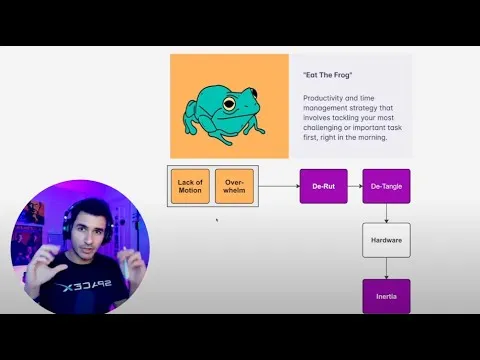
The advice also creates two practical traps that are amplified for ADHD. First is “lack of motion”: starting from a static, no-momentum state is already hard, and demanding that the very first action be difficult makes momentum generation less likely. Second is “overwhelm”: the brain interprets the task as tough and unpleasant, then delays it—while an already long to-do list sits in the background, reinforcing the sense that nothing is moving. The result is a loop of avoidance and distraction, not progress.
Instead of placing the “frog” first, the recommended approach uses a four-step protocol designed to reduce friction before tackling big work. Step one is “DUT,” short for decluttering and getting out of the rut. The method starts with environmental cleanup—clearing a messy desk, making the bed, tidying the room—because physical clutter increases mental clutter and makes task initiation harder. The idea is to create an easier starting line.
Step two is “detangle”: write down everything that needs doing. This is done with pen and paper or a preferred task system, but with one key constraint—keep the phone away. The phone is treated as a high-distraction lure that makes even planning feel less urgent than scrolling.
Step three is “hardware,” an optional physiological boost to raise baseline alertness and focus. Quick movement (a short run, jumping jacks, or a brief cold shower that transitions from warm to cold at the end) is used to shift the body into a more start-ready state. The claim is that improving “hardware” supports better “software” (thought patterns and follow-through).
Step four is “inertia.” Rather than ranking tasks by importance, tasks are ranked by ease—start with the easiest item on the list, even if it’s not the most “important” one. The goal is to build momentum, reduce distractibility, and move into hyperfocus. As tasks get checked off, the list shrinks, overwhelm drops, and the remaining harder items become easier to start and complete. A personal example is cited: when preparing the YouTube video, the instinct was to do the hardest first, but choosing easier tasks first created the groove and led to finishing the work. The takeaway is straightforward: for ADHD brains, the anti-frog strategy—start easy to generate momentum—turns the usual avoidance cycle into a productivity engine.
Cornell Notes
“Eat the frog” (doing the hardest task first) often fails for ADHD because lower average dopamine and heightened distractibility make daunting tasks harder to initiate, and the resulting avoidance increases overwhelm. The approach described replaces the frog-first rule with a four-step protocol: (1) DUT—declutter the environment to reduce mental noise, (2) detangle—write down all tasks while keeping the phone away, (3) hardware—use brief physical activation like a short run, jumping jacks, or a cold-shower finish to boost alertness, and (4) inertia—start with the easiest task rather than the most important one to build momentum and reduce distractibility. The payoff is entering a productive groove and completing even the hardest items later with less stress.
Why does “eat the frog” backfire for ADHD specifically?
What are the two main mechanisms that make frog-first starting especially problematic?
How does the DUT step reduce friction before any big work?
What does “detangle” mean, and why does phone placement matter?
What is the purpose of the “hardware” step, and what examples are given?
Why does the protocol recommend ranking tasks by ease rather than importance?
Review Questions
- How do dopamine, distractibility, and overwhelm combine to make the hardest-first strategy less effective for ADHD?
- Which step in the protocol targets environmental friction, and what specific actions are suggested?
- Why might starting with an “easy but not most important” task improve the odds of completing the hardest task later?
Key Points
- 1
“Eat the frog” can backfire for ADHD because lower average dopamine and higher distractibility make daunting first tasks harder to start, increasing avoidance and overwhelm.
- 2
Frog-first routines create “lack of motion” (zero momentum) and “overwhelm” (difficulty anticipation), both of which intensify for ADHD.
- 3
Decluttering the environment (DUT) is treated as a direct lever for reducing mental noise and improving task initiation.
- 4
Detangling means writing down all tasks while keeping the phone away to prevent planning from turning into distraction.
- 5
Hardware boosts—quick movement or a cold-shower finish—are used to raise alertness and make starting more likely.
- 6
Inertia is built by starting with the easiest task, not the most important one, so momentum and hyperfocus become more attainable.
- 7
Completing easier tasks first shrinks the to-do list, lowering overwhelm and making later tasks faster to finish.