Can The Crisis in Cosmology Be SOLVED With Cosmic Voids?
Based on PBS Space Time's video on YouTube. If you like this content, support the original creators by watching, liking and subscribing to their content.
ΛCDM’s success depends on treating matter as smooth at large scales, but real cosmic structure is clumpy enough to bias local expansion measurements.
Briefing
Cosmic voids may be able to reshape two of cosmology’s biggest headaches at once: the “Hubble tension” (a roughly 10% mismatch between the universe’s expansion rate inferred from the early cosmos versus the rate measured nearby) and the need for dark energy as a separate ingredient in the standard model. The core idea is that the universe is not smooth on the scales assumed by Friedmann–Lemaître cosmology. Once the real clumpiness of matter—overdense superclusters and underdense voids—is treated more carefully, local motions can bias how the Hubble constant is measured, and in more ambitious proposals, the cumulative effect of voids could mimic the negative pressure usually attributed to dark energy.
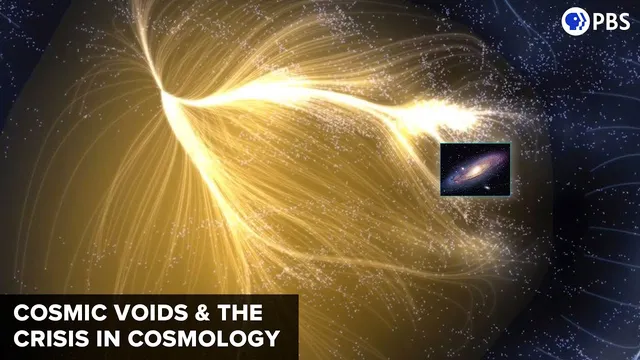
The standard ΛCDM framework starts from Einstein’s general relativity and assumes matter is evenly distributed on large scales. That approximation works well for many predictions, but it hides how gravity actually behaves when matter is lumpy. On the local scale, the Milky Way sits in the Laniakea supercluster, a loose association of roughly 100,000 galaxies spanning about half a billion light-years. Because superclusters are not gravitationally bound, dark energy–driven expansion eventually disperses them. That environment should slow the outward recession of nearby galaxies relative to pure expansion, meaning a Hubble-constant measurement based on Laniakea galaxies would come out too low.
A study by Leonardo Giani and collaborators quantifies how much that local environment could bias measurements: the local Hubble constant could be more than 1% too low because of Laniakea’s gravitational influence. That matters because it makes it harder to dismiss the Hubble tension as purely a local artifact—though it doesn’t automatically solve the problem.
Zooming outward introduces the opposite effect. The Milky Way lies near the center of a large underdense region sometimes called the Local Hole (the Keenan-Barger-Lenox Void), roughly 2 billion light-years across. Inside a void, gravity pulls outward toward the void’s denser boundary, boosting galaxy velocities above what uniform expansion predicts. If that boost is not properly accounted for, the inferred Hubble constant can look too large—potentially easing the tension by bringing the modern measurement closer to the value expected from the cosmic microwave background under ΛCDM.
One claim comes from Shanks, Hogarth, and Metcalf (2019), who combine distance calibrations using Cepheid variables from the Gaia satellite with measurements of outflow velocities within the Local Hole. They report a “true” modern Hubble constant around 69 rather than 73.5, aligning more closely with early-universe expectations. But the void picture is contested. Building a reliable three-dimensional map of matter and velocities at gigaparsec scales is difficult, and different distance and velocity datasets can disagree. Adam Reiss and collaborators, using supernova-based atlases, argue the Local Hole is barely present. Others question whether ΛCDM can even generate such a huge void given the tiny initial fluctuations seen in the cosmic microwave background.
At the farthest extreme, an Iranian team proposes that dark energy itself could be the net effect of cosmic voids. In their model, voids behave like “bubbles” whose expanding surfaces—formed by galaxy sheets and filaments—create an effective negative pressure analogous to the surface tension effect in fluid bubbles. If void-driven negative pressure is large enough, it could reproduce the acceleration usually attributed to vacuum energy. The hypothesis is speculative, and the transcript emphasizes that dark energy could still be a simple vacuum property, leaving the Hubble tension to local measurement bias—possibly tied to voids.
Either way, the takeaway is clear: understanding the universe’s least populated regions—cosmic voids—may be essential, not peripheral, to resolving both the expansion-rate mismatch and the physical origin of cosmic acceleration.
Cornell Notes
Cosmology’s biggest tensions may be influenced by the universe’s uneven structure. ΛCDM assumes matter is smooth, but real space contains overdense superclusters and underdense voids that alter galaxy motions and can bias local measurements of the Hubble constant. The Milky Way’s location in the Laniakea supercluster could make the locally measured Hubble constant slightly too low (by more than 1% in one analysis). Conversely, being near the center of the Local Hole/void could make the Hubble constant look too high, with one study suggesting a shift from about 73.5 down to ~69. More speculative work proposes that the combined negative pressure from void “bubbles” could mimic dark energy, potentially changing how acceleration is explained.
What is the Hubble tension, and why does it matter for cosmology?
How could the Laniakea supercluster bias a local Hubble-constant measurement?
Why would a cosmic void like the Local Hole push the inferred Hubble constant in the opposite direction?
What evidence supports the Local Hole helping resolve the Hubble tension, and what challenges remain?
How could voids be more than a measurement bias—potentially a source of dark energy?
Review Questions
- What physical mechanism makes overdense regions like superclusters bias Hubble-constant measurements downward, and what mechanism makes voids bias them upward?
- Why is it difficult to determine whether the Local Hole exists and how large its effect is on the Hubble constant?
- If voids were responsible for dark energy through an effective negative pressure, what observational consequence would that suggest for how dark energy behaves over time?
Key Points
- 1
ΛCDM’s success depends on treating matter as smooth at large scales, but real cosmic structure is clumpy enough to bias local expansion measurements.
- 2
The Milky Way’s environment in the Laniakea supercluster can make locally inferred expansion rates slightly too low because superclusters are loosely bound and dispersing under accelerated expansion.
- 3
Large underdense regions like the Local Hole can increase galaxy recession velocities beyond uniform-expansion expectations, making the inferred Hubble constant too high if uncorrected.
- 4
One analysis (Shanks, Hogarth, and Metcalf, 2019) claims the Local Hole could shift the modern Hubble constant from ~73.5 down to ~69, closer to cosmic microwave background expectations.
- 5
Competing studies disagree on whether the Local Hole is real or significant, highlighting the difficulty of building accurate 3D distance–velocity maps at gigaparsec scales.
- 6
A more speculative model proposes that the combined negative pressure from expanding void “bubbles” could account for dark energy, implying acceleration might evolve as voids form and later dissolve.
- 7
Even if dark energy is not caused by voids, voids remain important because they can act as local biases in how the Hubble constant is measured.