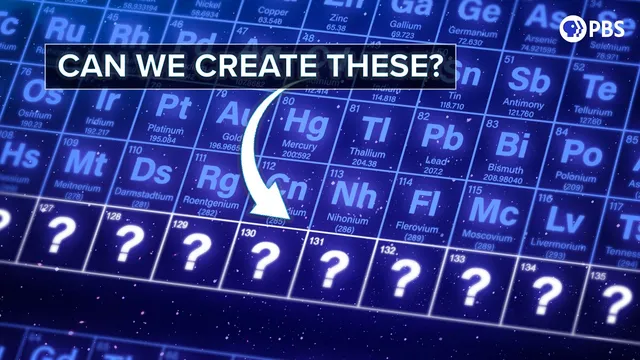
Can We Create New Elements Beyond the Periodic Table?
Based on PBS Space Time's video on YouTube. If you like this content, support the original creators by watching, liking and subscribing to their content.
Lead-208 is the heaviest stable element because filled nuclear shells at magic numbers (“doubly magic”) resist decay, but nuclei beyond lead become unstable as Coulomb repulsion overwhelms binding.
Briefing
The most promising path to elements beyond the periodic table’s current frontier may not be faster particle accelerators—it may be the cosmos. Neutron star mergers, which hurl neutron-rich debris into space, are expected to forge heavy nuclei through rapid neutron capture (the r-process) and then let radioactive decay chains “stall” in the theoretically predicted Island of Stability, where certain superheavy isotopes could survive long enough to leave detectable signatures.
The stability problem starts with nuclear physics. A nucleus balances the electromagnetic repulsion between protons against the strong nuclear force that binds protons and neutrons together. As atomic number rises, the Coulomb repulsion grows, forcing heavier elements to carry an increasing “neutron excess” to keep protons from destabilizing the nucleus. Lead-208 (82 protons, 126 neutrons) is the heaviest truly stable element and is especially robust because it is “doubly magic”—its proton and neutron counts fill quantum nuclear shells at magic numbers, reducing the likelihood of decay. Past lead, even filled shells can’t prevent breakdown: excess repulsion drives radioactive decay, often via alpha emission (a helium-4 nucleus) or beta decay (turning a neutron into a proton), and the larger the nucleus, the faster the decay.
In laboratories, superheavy elements are made by smashing nuclei together, but the process runs into two constraints: production rates and neutron-to-proton ratios. Current methods can reach elements up to Oganesson (atomic number 118), yet the resulting isotopes tend to be neutron-poor and extremely short-lived—half-lives ranging from milliseconds to minutes. The theoretical Island of Stability is thought to occur around atomic number 110–114 (from darmstadtium to Flerovium) for isotopes with roughly 180 neutrons. Hitting that neutron “sweet spot” with accelerator fusion is difficult because combining two lighter nuclei tends to preserve the neutron-to-proton ratio of the inputs, leaving the product with too few neutrons. Adding neutrons directly before decay is also challenging.
Astrophysics offers a different route. Neutron star mergers create conditions where enormous numbers of neutrons are available. When two city-sized neutron stars collide, gravitational waves and gamma rays mark the event, followed by a kilonova powered by radioactive decay. In the ejecta, neutrons rapidly build heavy nuclei via the r-process, potentially producing elements all the way to the end of the naturally occurring periodic table. As the neutron-rich environment relaxes, beta decays and subsequent alpha decay or fission drive a cascade toward more stable nuclei. If the decay chain passes through the Island of Stability, it could slow there—potentially for hours to years—creating a measurable “pause” in the decay sequence.
Evidence so far supports neutron star mergers as a heavy-element factory. The landmark event GW170817 in 2017 produced a kilonova and helped establish that such mergers generate heavy elements. Additional clues come from ancient stars: stars formed soon after mergers show spectral excesses of stable r-process decay products such as ruthenium, rhodium, palladium, and silver, implying large production of transuranics like californium. Direct confirmation of Island of Stability isotopes remains elusive, but researchers are looking for two observational strategies: (1) more ancient stars with merger-specific abundance patterns and (2) early-time kilonova light-curve features. Because Island isotopes might have half-lives from hours to years, the earliest hours after the gravitational-wave trigger could reveal a brightness “bump” tied to slower decays—yet fast follow-up is crucial, and GW170817’s electromagnetic counterpart was identified about 11 hours later, likely after the most short-lived superheavy nuclei had already decayed.
If neutron star mergers can indeed populate the Island of Stability, astronomy could provide the missing proof that nuclear theory predicts—and laboratories could then focus on synthesizing those isotopes on Earth with more targeted methods.
Cornell Notes
Neutron star mergers may be the best way to create superheavy isotopes in the theoretically predicted Island of Stability. Nuclear stability depends on a balance between proton repulsion (Coulomb force) and the strong nuclear force; beyond lead, nuclei become radioactive quickly, often with alpha or beta decay. In labs, superheavy elements are produced by fusing smaller nuclei, but the products are typically neutron-poor and decay within milliseconds to minutes, making the Island of Stability hard to reach. Neutron star mergers eject neutron-rich material where the r-process can build very heavy nuclei, and decay chains may slow or “stall” in the Island of Stability for hours to years. Observational evidence already links mergers to heavy-element production (e.g., GW170817 and abundance patterns in old stars), but detecting the Island directly likely requires rapid kilonova follow-up and/or more ancient-star chemical signatures.
Why does the periodic table effectively “end” for lab-made elements, and what role do neutrons play?
What makes lead-208 special, and what does “doubly magic” mean in this context?
Why do accelerator fusion methods struggle to reach the Island of Stability?
How do neutron star mergers create conditions favorable for building very heavy nuclei?
What observational evidence supports neutron star mergers as heavy-element sources, and what’s missing for the Island of Stability?
Review Questions
- What nuclear-force balance determines whether a heavy nucleus is stable, and how does neutron excess change with atomic number?
- Why does the neutron-to-proton ratio problem arise when building superheavy elements in accelerators?
- What two kinds of astronomical evidence could, in principle, reveal the Island of Stability, and why does timing matter for kilonova observations?
Key Points
- 1
Lead-208 is the heaviest stable element because filled nuclear shells at magic numbers (“doubly magic”) resist decay, but nuclei beyond lead become unstable as Coulomb repulsion overwhelms binding.
- 2
As atomic number increases, stable isotopes require a growing neutron excess; examples include iron-56, gold-179, and lead-208.
- 3
Accelerator-made superheavy elements reach up to Oganesson (118) but are typically neutron-poor and decay extremely fast (milliseconds to minutes), limiting access to the predicted Island of Stability.
- 4
The Island of Stability is expected near atomic number 110–114 (darmstadtium through Flerovium) for isotopes with roughly 180 neutrons, where half-lives could extend from hours to years.
- 5
Neutron star mergers provide a neutron-rich environment where the r-process can build very heavy nuclei, and decay chains may stall in the Island of Stability.
- 6
Evidence for merger-produced heavy elements includes GW170817’s kilonova and abundance patterns in old stars, but direct Island-of-stability signatures remain unconfirmed.
- 7
Detecting Island isotopes via kilonovae likely requires extremely rapid follow-up after gravitational-wave detection to catch early-time brightness changes.