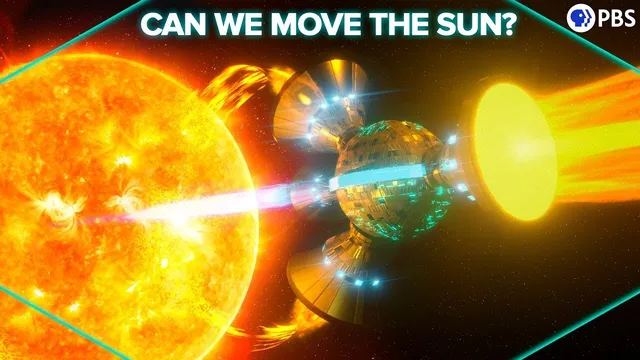
Can We Move THE SUN?
Based on PBS Space Time's video on YouTube. If you like this content, support the original creators by watching, liking and subscribing to their content.
Stellar engines rely on momentum conservation by redirecting photons and/or ejecting mass so the star gains net momentum in the opposite direction.
Briefing
Moving the Sun is framed as a “maybe” rather than a fantasy: the underlying physics is straightforward (momentum exchange), but the required engineering would demand Kardashev–II–level infrastructure. The payoff would be enormous—turning a star into a controllable engine to tweak its galactic orbit, avoid catastrophic encounters, or even enable long-range intergalactic travel.
At the core is Newtonian momentum. An object naturally coasts unless an external force acts on it, and propulsion works by ejecting mass or radiation so momentum is carried away in the opposite direction. A stellar engine scales that idea up to solar-system size: instead of a rocket, the Sun itself becomes both the energy source and the “propellant reservoir,” with the challenge shifting to building structures large enough to redirect energy and momentum.
The first serious concept credited here is Fritz Zwicky’s 1961 proposal: a space-based particle accelerator would fire pellets at near-light speeds into the Sun. The impacts would ignite fusion and blast jets of matter outward, pushing the Sun in the opposite direction. The scheme’s appeal is its direct momentum transfer; its weakness is that Zwicky never pinned down the fuel and acceleration requirements, leaving the feasibility unclear.
Two decades later, Leonid Shkadov offered a design that avoids external energy and propellant. Light carries momentum, so photons streaming out of the Sun exert a tiny recoil. Shkadov’s thruster amplifies that effect by using a giant parabolic mirror made from super-thin foil—sized to span an orbit’s scale. Reflected photons transfer momentum to the mirror, and if the mirror is positioned correctly, outward radiation pressure can balance the Sun’s gravity so the mirror stays fixed relative to the star. The same mechanism can be described two ways: as a single Sun–mirror system radiating preferentially, or as a “gravitational tugboat” where the mirror’s gravity couples to the Sun while radiation pushes the mirror.
The resulting acceleration is extremely small—on the order of less than a trillionth of Earth’s surface gravity for the Shkadov thruster. That means the Sun wouldn’t “zoom” across the galaxy; it would only nudge its orbit over long timescales. Even so, the cumulative effect could shift a Sun-like star by tens of lightyears over a galactic orbit. In optimistic scenarios, that could help a civilization narrowly avoid a collision with another star or a black hole, or enable slow migration and planetary transfer as neighboring systems evolve.
For urgent threats like an approaching supernova, the Shkadov approach is too weak. A more forceful alternative is attributed to the Caplan thruster, commissioned by Kurzgesagt in 2019. It begins with a Dyson sphere (or swarm) of many mirrors that reflect sunlight to a specific solar surface region, heating it and boosting solar wind. Momentum transfer from the wind alone is still weak, so the design adds collection cones that funnel the ejected material into a fusion reactor, fusing helium into carbon and oxygen. The energy powers jets that eject fusion products for thrust and also sends a hydrogen beam back into the Sun—an adaptation of ideas like the “fusion candle” and the Bussard ramjet, but with the star as both fuel source and target.
Beyond orbit changes, the concept hints at “star-lifting” and even star lifespan management: advanced civilizations might remove some stellar mass to extend longevity, using reflected energy to control how much mass is shed. In the most extreme variant, burning hydrogen could in principle reach speeds up to about 10% of light speed, enabling faster catch-up to distant galaxies—though it risks turning the Sun into a dim brown dwarf–like object.
The transcript closes on feasibility and detection. Building any stellar engine would likely require self-replicating mining and construction robots capable of disassembling planetary bodies—centuries to millennia away. Still, understanding these possibilities could help search for technosignatures: Dyson-like infrared excess, flickering from orbiting panels, or unusual stellar motion patterns. So far, searches using methods like Dyson-sphere infrared signatures, Gaia data, and models for Shkadov-induced dimming have found nothing definitive. The conclusion is cautious: stellar engines remain speculative, but the fact that they’re physically conceivable is itself a meaningful scientific prompt—especially if it guides both long-term imagination and near-term priorities like planetary survival.
Cornell Notes
Stellar engines are presented as physically plausible because they rely on momentum conservation: redirecting radiation and/or ejecting mass changes a star’s motion. The Shkadov thruster uses a planet-orbit–scale parabolic mirror to create a controlled radiation-pressure imbalance, producing accelerations far smaller than rocket propulsion but potentially enough to shift a star’s galactic orbit over millions to billions of years. Zwicky’s earlier idea used a space particle accelerator to drive fusion impacts and blast jets from the Sun, but feasibility depends on energy and “fuel” requirements that were never fully worked out. The Caplan thruster concept combines Dyson-sphere-style mirrors with fusion-powered jets fed by enhanced solar wind, aiming for much larger acceleration and even potential star-lifespan management. Detecting such engineering would be difficult, and current observational searches have not found clear evidence.
How does a stellar engine move a star without “pushing” it like a rocket?
What makes the Shkadov thruster different from earlier propulsion ideas?
Why doesn’t the Shkadov thruster let a civilization “escape the galaxy” quickly?
What is the Caplan thruster trying to improve over the Shkadov thruster?
How could stellar engines affect the star’s lifetime?
What observational signatures might reveal stellar engineering, and what have searches found?
Review Questions
- Compare the momentum sources in the Zwicky, Shkadov, and Caplan concepts. What is being accelerated in each case?
- Why can a tiny acceleration still matter over a galactic orbit, and what timescale does that imply for practical outcomes?
- What tradeoffs appear when considering hydrogen-burning variants that could reach ~10% of light speed?
Key Points
- 1
Stellar engines rely on momentum conservation by redirecting photons and/or ejecting mass so the star gains net momentum in the opposite direction.
- 2
Zwicky’s 1961 concept uses a space particle accelerator to drive fusion impacts on the Sun, producing jets that could push the star, but it lacks worked-out feasibility calculations.
- 3
Shkadov’s thruster uses a planet-orbit–scale parabolic mirror to harness radiation pressure without external energy or propellant, producing extremely small accelerations.
- 4
Even with tiny acceleration, long-duration effects could shift a star’s galactic orbit by tens of lightyears over a galactic orbit, enabling slow avoidance or migration.
- 5
The Caplan thruster concept boosts thrust by combining Dyson-sphere-style light concentration, solar-wind collection, and fusion-powered jets, potentially increasing acceleration by orders of magnitude.
- 6
Using these methods could also support “star-lifting,” potentially extending a star’s lifespan by reducing its mass.
- 7
Detecting stellar engines remains challenging; searches for Dyson-like infrared signatures, flickering, Shkadov-related dimming, and anomalous stellar motion have not found clear evidence yet.