Can We Survive Curiosity?
Based on minutephysics's video on YouTube. If you like this content, support the original creators by watching, liking and subscribing to their content.
Curiosity is portrayed as morally indifferent: it can produce both life-improving knowledge and destructive capability.
Briefing
Curiosity is portrayed as both humanity’s engine of progress and a force with no built-in ethics—capable of delivering life-changing breakthroughs alongside tools for harm. The core claim is blunt: curiosity has no moral compass, so the same drive that helps people learn, build, and understand also enables arson, conquest, environmental destabilization, surveillance, and mass destruction. That duality matters because it reframes “curiosity” from a purely virtuous trait into a powerful capability whose outcomes depend on human choices.
The transcript opens with a personal, almost comedic “breakup” with Curiosity, treating it like an intrusive partner that won’t stop asking questions and delivering unwanted truths. Curiosity is credited with major intellectual and scientific milestones—learning language, fueling excitement around gravitational-wave detection, experimenting with paper airplanes, and even supporting education through calculus and practical problem-solving like how jigsaw work and how to unclog a toilet. It also pushes learning beyond comfort, from reading an entire Harry Potter book in one sitting to confronting uncomfortable facts such as limits on lifespan, differences in how toddlers learn languages, and the nuanced reality that genetic modification can be beneficial.
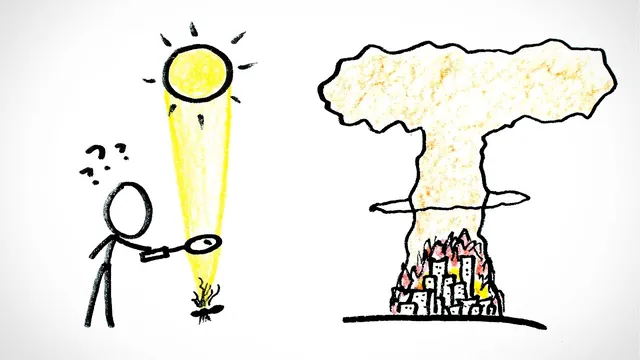
But the transcript pivots from playful frustration to moral concern. Curiosity is described as “a jerk” not because it lacks intelligence, but because it lacks loyalty and ethics. The examples escalate from everyday curiosity to civilization-scale consequences: mastering fire for cooking and warmth also enables destroying villages; developing metalworking yields plows and scythes for food, but also swords for killing; using ancient biological materials to power civilization also drives global temperature increases. The same pattern repeats with nuclear technology—splitting and fusing atomic nuclei can generate electricity and medicine while also enabling city-destroying weapons. Even modern technology is folded into the critique: portable computer-camera-communicators make it easier to spy on each other.
The transcript’s most pointed line of reasoning is that curiosity’s outputs are morally indifferent. It can teach someone to focus sunlight with a magnifying glass to burn insects, and it can teach societies to build systems that harm at scale. The implication is not that curiosity should be suppressed, but that people must learn to live with it and steer it.
The closing lesson lands on agency. Curiosity opens “lots and lots of doors,” including doors to good and bad futures. If people listen, curiosity helps lay out facts about what each door leads to. Ultimately, however, the decision to walk through those doors—and how to apply knowledge—belongs to humans, not to curiosity itself. In that sense, survival of curiosity isn’t about breaking up with it; it’s about building moral and practical guardrails around it.
Cornell Notes
The transcript frames curiosity as a double-edged force: it drives learning and discovery while lacking any moral compass. Curiosity helps people gain language, pursue scientific breakthroughs like gravitational-wave detection, and solve everyday problems, but it also enables destructive capabilities—from fire-setting and weapon-making to nuclear power and surveillance. The key takeaway is that curiosity is morally indifferent; its outcomes depend on human choices. Rather than rejecting curiosity, the message argues for living with it and using it to understand the consequences of the “doors” it opens, then deciding which futures to pursue.
Why does the transcript treat curiosity as both valuable and dangerous?
What examples show curiosity’s “no moral compass” claim?
How does the transcript portray curiosity as intrusive or emotionally disruptive?
What does “survive curiosity” mean in the transcript’s conclusion?
What role do facts play according to the transcript?
Review Questions
- What are two examples from the transcript where curiosity leads to both beneficial and harmful outcomes?
- How does the transcript connect curiosity’s lack of a moral compass to the need for human decision-making?
- In what way does the transcript suggest curiosity should be “managed” rather than rejected?
Key Points
- 1
Curiosity is portrayed as morally indifferent: it can produce both life-improving knowledge and destructive capability.
- 2
Uncomfortable truths and persistent questioning are framed as part of curiosity’s disruptive power, not just its intellectual value.
- 3
Fire, metalworking, and nuclear science are used to illustrate how the same knowledge can serve protection or violence.
- 4
Modern technology is included in the critique, with portable camera-computers enabling surveillance as well as communication.
- 5
Curiosity opens many possible “doors” to the future, including harmful ones, so outcomes depend on how humans apply knowledge.
- 6
The transcript’s central prescription is to live with curiosity, use it to gather facts about consequences, and then choose which paths to pursue.