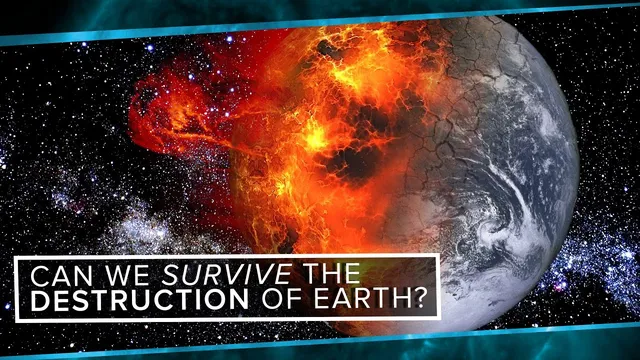
Can We Survive the Destruction of the Earth? ft. Neal Stephenson
Based on PBS Space Time's video on YouTube. If you like this content, support the original creators by watching, liking and subscribing to their content.
Mass extinction threats come from multiple sources—asteroids, volcanism, and nearby stellar events—so survival requires more than one plan.
Briefing
Survival planning for humanity can’t rely on a single “end-of-the-world” fix, because Earth faces multiple extinction pathways—some with long lead times, others with none. The core takeaway is that the odds of enduring millions of years depend less on one grand technological miracle and more on building layered defenses: better detection, redundancy across locations, and shelter strategies that match the specific physics of each threat.
From deep time, mass extinctions appear repeatedly in the fossil record—at least five major events over the past 500 million years, with patterns suggesting roughly 100-million-year spacing. The best-known example is the Cretaceous-Paleogene (K-T) event, linked to a giant asteroid impact near the Chicxulub peninsula in modern Mexico. That scenario involved global firestorms and severe climate change, wiping out up to three-quarters of species and ending the 80-million-year Cretaceous period. But impacts aren’t the only driver. Large volcanic episodes, major evolutionary upheavals, and even nearby exploding stars have all been proposed as causes of other extinction pulses.
The discussion then pivots to what would matter most for survival: warning time. For large asteroids and comets—those bigger than a few kilometers—extreme climate change and mass extinction are plausible. Yet current monitoring is relatively strong for the biggest objects: NASA’s Near-Earth Object Program, working with international search efforts, has found about 90% of near-Earth objects larger than one kilometer that cross Earth’s orbit, and none are expected to hit soon. The remaining gap is smaller rocks, which can still devastate regions even if they may not wipe out an entire species. That leads to a practical priority: expand detection so the “big ones” are truly accounted for and the smaller threats aren’t underestimated.
Other catastrophes may come with more notice. Massive volcanism, for instance, is not random in the way an impact is; the Yellowstone supervolcano is monitored and not considered a current extinction-level threat. Still, long-term survival depends on continuity of vigilance—“a couple of lazy generations” could miss the next major warning sign.
Because no single plan covers everything, the argument for redundancy grows stronger. Multiple independent human bases—on Mars, Venus, the Moon, or in artificial “space arks”—would reduce the risk that one global disaster ends the species. But there is one threat that space settlements can’t fully neutralize: exploding stars. A supernova within about 30 light years could destroy the ozone layer, trigger harmful ultraviolet radiation, and alter atmospheric chemistry, producing effects like “supernova winter” from nitrogen-oxide smog. Gamma ray bursts pose an even nastier challenge: powerful jets could deliver similar damage from roughly 6,500 light years away, potentially without any advance warning. The transcript notes at least one star currently within a danger zone for gamma ray burst production, and emphasizes that detection might only happen after the event.
Against supernovae and gamma ray bursts, the proposed options narrow to two extremes: build deep underground arks or permanently occupied underground cities, or push beyond the solar system to reduce exposure to the relevant distances and beam widths. Interstellar travel is acknowledged as difficult, raising the final question of whether humanity would be willing to invest in survival for descendants far beyond today’s definition of “human.”
Cornell Notes
Human survival planning can’t hinge on one doomsday scenario because extinction threats come from different mechanisms and sometimes with little or no warning. Repeated mass extinctions in Earth’s history—linked to asteroid impacts, volcanism, and even nearby stellar explosions—suggest future catastrophes are likely. For space rocks, current surveys (via NASA’s Near-Earth Object Program) have identified about 90% of objects larger than one kilometer, but smaller impacts still require better detection. For stellar threats like supernovae and gamma ray bursts, even off-world settlements may not help, since ozone destruction and high-energy radiation can reach Earth from tens to thousands of light years away. Long-term resilience therefore points toward layered strategies: redundancy across locations, continuous monitoring, and either deep underground shelter or expansion beyond the solar system.
Why does warning time dominate the survival strategy for different extinction threats?
What does the K-T (Cretaceous-Paleogene) event illustrate about how extinction can happen?
How does current asteroid detection shape the perceived risk?
Why might off-world colonies fail against supernovae and gamma ray bursts?
What two survival options are proposed for gamma ray burst and supernova risk?
Review Questions
- What evidence from Earth’s fossil record is used to argue that mass extinctions recur on long timescales?
- How do the transcript’s distance estimates (30 light years for supernovae; ~6,500 light years for gamma ray burst jets) change the value of off-world colonies?
- Why is continuous monitoring framed as a vulnerability even when current threats like Yellowstone are not immediate?
Key Points
- 1
Mass extinction threats come from multiple sources—asteroids, volcanism, and nearby stellar events—so survival requires more than one plan.
- 2
Warning time is the deciding factor: some threats may arrive too quickly for reactive engineering, pushing defenses toward pre-built redundancy.
- 3
NASA’s Near-Earth Object Program has identified about 90% of near-Earth objects larger than one kilometer that cross Earth’s orbit, reducing near-term risk from the biggest impactors.
- 4
Smaller asteroids and comets still pose serious regional devastation, making expanded detection a priority even if they may not be species-ending.
- 5
Long-term vigilance is fragile; even well-monitored systems could be neglected across generations, increasing the chance of missing future warnings.
- 6
Multiple independent human settlements (Mars, Venus, the Moon, or space arks) can reduce risk from Earth-bound disasters and human self-destruction.
- 7
Supernovae and gamma ray bursts may bypass local shelter, making deep underground habitation or expansion beyond the solar system the most relevant long-term options.