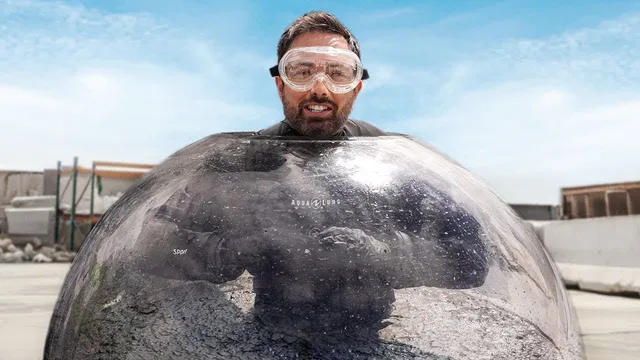
Can you float in concrete?
Based on Veritasium's video on YouTube. If you like this content, support the original creators by watching, liking and subscribing to their content.
Cement is the binder; concrete is cement plus aggregate (sand and gravel), and the aggregate strongly influences strength and cohesion.
Briefing
Concrete is “liquid rock” made from cement plus aggregate—and its density, chemistry, and manufacturing choices explain both why it’s so important and why it’s harder to “float in” than most people expect. Cement is the glue-like binder, while concrete is the poured material: cement mixed with sand and gravel. Cement production is massive—about 500 kilograms of cement per person per year worldwide—because concrete is cheap, moldable, strong, and durable. That combination has made cementitious materials the most widely used solid product on Earth, surpassing many other major materials by volume.
The buoyancy test drives home a counterintuitive physical point: concrete is roughly three times as dense as water, so a person can float only up to around the waist. As the body rises, pressure increases against the chest, raising the practical concern that breathing could become difficult if the concrete reached the lungs. In the stunt, the key takeaway is that buoyancy prevents full burial—pushing down meets an upward force, and getting “stuck” isn’t as straightforward as the premise suggests.
From there, the chemistry of hardening explains why concrete can set in different environments and why Roman structures lasted. Primitive cement came from heating limestone (calcium carbonate) to drive off CO2, producing quicklime, then mixing it with water to form calcium hydroxide that later reabsorbs CO2 from air. That approach struggles for large molds and fails underwater because it depends on CO2 to harden. The Romans solved the underwater problem by adding volcanic ash (pozzolana) to limestone before heating. Pozzolana—and later, modern equivalents like clay or shale rich in silica—changes the reaction pathway so the material hardens without needing to dry. Water becomes part of the solid structure, enabling maximum strength even when submerged.
Concrete strength is then tied to testing and mix design. Suppliers cast compressive cylinders from each batch and break them at set ages—commonly 7, 14, and 28 days—using hydraulic presses that load samples at controlled rates to measure failure in psi. The transcript also contrasts cement-only paste with mixes containing sand and gravel. Pure cement fractures more readily under load, while adding sand and then gravel increases cohesion and yields higher compressive strengths, even though cement is the most expensive ingredient. The practical implication: reducing cement content can be feasible if aggregate and formulation preserve strength.
Roman concrete’s edge is described as real but not absolute. Its durability and underwater setting are linked to pozzolana-driven chemistry and later silica-rich additives, including the ability to “self-heal” cracks via leftover quicklime that can dissolve and regrow calcium carbonate when water enters. Still, modern concrete generally wins on predictability and cost, and only the Roman survivors remain visible.
Finally, the hardening mechanism—cement hydration—shows why fresh concrete must stay damp: water dissolves cement grains, enabling calcium silicate hydrate crystals to grow and interlock. Concrete’s global impact is double-edged: it underpins skyscrapers and infrastructure, yet cement production contributes an estimated 8% of global CO2 emissions. The transcript ends by pushing for systemic emissions cuts, including carbon-offset support via Wren, alongside broader policy and technology change.
Cornell Notes
Concrete is cement plus aggregate, and its scale of use comes from being cheap, strong, and easy to pour into shapes. Cement hardens through hydration: water dissolves cement compounds and enables calcium silicate hydrate crystals to grow and interlock, with water becoming part of the solid rather than simply evaporating. Roman concrete could set underwater because silica-rich pozzolana (and later clay/shale) changes the chemistry so drying and CO2 penetration aren’t required. Compressive strength is verified by casting and breaking standard cylinders at ages like 7, 14, and 28 days, and mix design matters—cement-only paste fractures more, while adding sand and gravel improves cohesion and strength. Despite Roman advantages like crack self-healing, modern concrete remains dominant due to cost and practicality.
What’s the difference between cement and concrete, and why does that distinction matter for strength?
Why can’t primitive limestone-based cement harden underwater or in very large molds?
How did Roman concrete harden underwater, and what chemistry made it possible?
How is concrete compressive strength measured in practice?
Why does adding aggregate (sand and gravel) improve performance compared with cement paste alone?
What is cement hydration, and why does it require keeping fresh concrete damp?
Review Questions
- How does silica-rich pozzolana (or clay/shale) change the hardening mechanism compared with primitive limestone cement?
- Why does cement-only paste tend to fail differently under compressive loading than cement with sand and gravel?
- What role does water play during cement hydration, and how does that affect curing practices like humidity control?
Key Points
- 1
Cement is the binder; concrete is cement plus aggregate (sand and gravel), and the aggregate strongly influences strength and cohesion.
- 2
Concrete is about three times as dense as water, so buoyancy can prevent full burial—typically allowing flotation only up to around the waist.
- 3
Roman concrete’s underwater durability traces to silica-rich pozzolana (volcanic ash), which enables hardening without relying on drying or CO2 penetration.
- 4
Concrete compressive strength is validated by casting standard cylinders and testing them at set ages (often 7, 14, and 28 days) in a hydraulic press.
- 5
Mix design matters: cement-only paste fractures more readily, while adding sand and gravel improves cohesion and raises compressive strength.
- 6
Cement hydration is the core hardening process: water dissolves cement compounds and enables calcium silicate hydrate crystals to grow and interlock, so curing requires high humidity.
- 7
Cement production is a major CO2 source (estimated ~8% of global total), making emissions reduction and systemic policy change central to the material’s future.