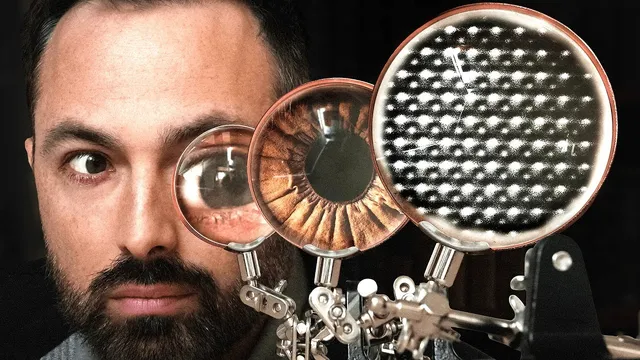
Can You Keep Zooming In Infinitely?
Based on Veritasium's video on YouTube. If you like this content, support the original creators by watching, liking and subscribing to their content.
Visible light can’t resolve atoms because its wavelength is orders of magnitude larger than atomic dimensions, causing diffraction rather than sharp imaging.
Briefing
The central breakthrough behind modern “atom-seeing” electron microscopes is not simply stronger magnification—it’s the ability to correct a fundamental blur called spherical aberration. For decades, transmission electron microscopes (TEMs) could get close to atomic resolution, but a built-in flaw in radially symmetric electromagnetic lenses spread the focus, preventing electrons from landing sharply enough to distinguish individual atoms. That limit shaped the field until researchers found a way to cancel the aberration rather than fight it head-on.
The path to this solution starts with why atoms are hard to view at all. Visible light can’t resolve atoms because its wavelength (380–750 nanometers) is vastly larger than atomic dimensions (about 0.1 nanometers). The workaround is to use matter waves: in 1924, Louis de Broglie showed that particles have wavelengths inversely related to momentum. Accelerated electrons at 300 kilovolts move at roughly 80% of the speed of light, giving them wavelengths on the order of 2–3 picometers—over 100,000 times smaller than visible light—making far finer resolution theoretically possible.
Early electron microscopes followed quickly. Hans Busch proposed electromagnetic lenses in 1926, and Ernst Ruska built prototypes that steered electron beams using magnetic fields shaped by a coil and a gap. By 1931, Ruska and Max Knoll produced the first working TEM design: electrons pass through an ultra-thin sample (around 100 nanometers thick), and a second lens projects the resulting imprint onto a detector. Magnification rose rapidly—by the mid-1930s, TEMs surpassed 10,000× and could image insects, bacteria, and viruses.
Then Otto Scherzer’s 1936 analysis landed like a ceiling. In a radially symmetric magnetic lens, the magnetic field strengthens near the edges, causing electrons farther from the optical axis to over-deflect. Instead of focusing into a single point, the beam spreads along the axis, producing spherical aberration. The same issue exists in ordinary spherical lenses, but for TEMs it became a persistent, unavoidable roadblock because magnetic lenses inherently converge rather than diverge.
Progress stalled for years, and alternative approaches emerged. Field ion microscopy achieved early accepted atomic images by ionizing helium or neon atoms near a sharp needle tip, but it mainly revealed the very surface of the tip. Probe microscopes later mapped surfaces using quantum or nanoscale force interactions, producing 3D images without lens-based spherical aberration—yet they often “felt” atoms rather than directly imaging them.
The decisive fix came from breaking symmetry. Scherzer’s theorem said a diverging radially symmetric lens can’t be made, but it doesn’t apply if the lens isn’t radially symmetric. Knut Urban, Max Haider, and Harold Rose built a system using multipole magnetic elements—hexapole, octopole, and decapole magnets—to intentionally distort the beam into a saddle-like shape, then pass it through a second, oppositely configured multipole that restores circular symmetry while leaving behind a tiny effective divergence. When tuned correctly, the residual divergence cancels the original spherical aberration.
After years of skepticism and funding pressure, their lens stabilized in July 1997, producing clear atomic images. The corrected TEM reached about 0.13 nanometers resolution, and the method spread quickly. Independent work by Orndrej Krivanek extended aberration correction to scanning TEM, and in 2020 Urban, Rose, Haider, and Krivanek received the Kavli Prize in Nanoscience. Today, aberration-corrected electron microscopy is widely treated as essential for materials science because atomic-scale structure is required to connect observed properties to the underlying arrangement of atoms.
Cornell Notes
Atom-level imaging with transmission electron microscopes became practical once spherical aberration was effectively canceled. Visible light can’t resolve atoms because its wavelength is far larger than atomic spacing, so electron microscopes rely on de Broglie wavelengths of fast electrons (e.g., ~2–3 picometers at 300 kV). Early TEMs advanced quickly, but Otto Scherzer showed that radially symmetric electromagnetic lenses inevitably over-deflect off-axis electrons, spreading the focus. Urban, Haider, and Rose overcame this by breaking radial symmetry using multipole magnetic lenses (hexapole/octopole/decapole), creating a controlled residual divergence that counteracts the original aberration. Their approach cut resolution to about 0.13 nm and made atomic imaging routine enough that modern universities increasingly treat it as standard equipment.
Why can’t visible light directly image atoms, and what replaces it in electron microscopy?
How did the earliest transmission electron microscope work, and what sample constraint did it require?
What exactly is spherical aberration in electromagnetic lenses, and why did it cap TEM resolution?
Why can’t TEMs simply add a diverging magnetic lens to cancel aberration?
How did Urban, Haider, and Rose cancel spherical aberration by breaking symmetry?
What resolution improvement and recognition followed the aberration-correction breakthrough?
Review Questions
- What physical mismatch between light wavelength and atomic size prevents direct optical imaging, and how do electron microscopes overcome it?
- Describe Scherzer’s spherical aberration mechanism in terms of off-axis electron deflection and the resulting blur.
- How does breaking radial symmetry with multipole magnetic lenses allow aberration cancellation when radially symmetric diverging lenses are forbidden?
Key Points
- 1
Visible light can’t resolve atoms because its wavelength is orders of magnitude larger than atomic dimensions, causing diffraction rather than sharp imaging.
- 2
Electron microscopes exploit de Broglie wavelengths of fast electrons; at 300 kV, electron wavelengths fall to a few picometers, enabling atomic-scale resolution.
- 3
Early TEMs advanced quickly using electromagnetic lenses, but they required ultra-thin samples (about 100 nanometers thick) so electrons could transmit through the specimen.
- 4
Spherical aberration in radially symmetric magnetic lenses comes from stronger edge fields that over-deflect off-axis electrons, spreading the focus along the optical axis.
- 5
Magnetic lenses can’t be made radially symmetric and diverging because magnetic field lines must form closed loops between North and South poles.
- 6
Urban, Haider, and Rose achieved aberration correction by using non-radially symmetric multipole magnets to create a controlled residual divergence that cancels the original spherical aberration.
- 7
Aberration-corrected TEM and scanning TEM became central tools for materials science because atomic-scale structure is necessary to connect observed properties to underlying arrangements.