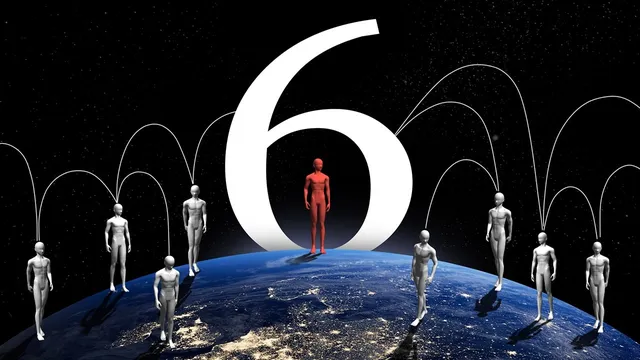
Can you really reach anyone in 6 steps?
Based on Veritasium's video on YouTube. If you like this content, support the original creators by watching, liking and subscribing to their content.
A tiny fraction of long-range connections can drastically reduce average separation without destroying local clustering.
Briefing
Six degrees of separation is often treated as a comforting fact about human closeness, but the deeper finding here is that network structure—not just “how many steps away” people are—determines how fast infections, information, and even cooperation rise or collapse. A classic 1999 experiment traced a path from a falafel salesman, Salah ben Ghaly, to Marlon Brando in just six social links, reinforcing the idea that almost anyone can be reached quickly. Yet the transcript stresses a paradox: real social life is highly clustered locally, which should make distant connections hard—so how can short paths still appear?
The answer comes from network science’s “small-world” middle ground. A simple model arranges people in a regular ring where everyone mostly knows nearby neighbors. In that setup, reaching someone far away takes enormous numbers of steps. But when a tiny fraction of connections are rewired into “shortcuts” to distant nodes, the average path length collapses toward random-graph levels. Watts and Strogatz found that rewiring just 1% of links can drop average separation dramatically (from about 50 to about 10 in their ordered starting point) while clustering stays high for much longer. Scaling the logic to billions of people implies that only a small share of friendships—on the order of a few out of every 10,000—would need to act as shortcuts for average separation to fall to around six.
The transcript then tests whether this mechanism matters beyond trivia. Simulations of disease spread show that adding shortcuts can turn a slow, clustered outbreak into a rapid one: with a regular network, infection takes roughly 73 days to engulf the whole system (with the model’s time step), but with about 10% shortcuts it can take about 26 days. The same structural effect appears in real-world analogies: hubs in airports, for instance, can propagate disruption widely—one weather event at Chicago O’Hare can cancel hundreds of flights and ripple across other airports within a day.
That leads to a second network insight: not all “small-world” behavior comes from shortcuts. Albert-Lászllo Barabási’s work on the World Wide Web found that the web’s small-world feel comes largely from hubs—highly connected pages—rather than uniformly random shortcuts. Those hubs emerge naturally through growth and preferential attachment: as networks expand, new nodes tend to connect to already well-connected nodes, producing a long-tailed link distribution.
Finally, the transcript connects network topology to human behavior and beliefs. In a prisoner's dilemma played on networks, cooperation can thrive when interactions are mostly local and clustered, but a small number of shortcuts can crush cooperation by mixing groups that would otherwise protect each other. Later human experiments complicate the story: when participants can choose whom to interact with, cooperation becomes more likely, suggesting that agency can counteract structural risks. The overall message is practical and cautionary: networks shape outcomes, but people can reshape networks—through the ties they form, the hubs they rely on, and the choices they make about who they engage with.
Cornell Notes
The transcript explains why “six degrees of separation” can be true even though real social networks are locally clustered. Watts and Strogatz’s small-world model shows that a tiny fraction of long-range “shortcuts” can sharply reduce average path length while keeping clustering high. That same structure speeds up spreading processes: disease simulations show infection can take far fewer time steps once shortcuts are added. A separate line of work (Barabási and Albert) shows that hubs—created by network growth and preferential attachment—can also produce short paths, as seen in the World Wide Web. Finally, network structure can flip social outcomes: cooperation can collapse when shortcuts connect defectors and cooperators, but allowing people to choose partners can restore cooperation.
How can average separation drop to around six steps when real friendships are clustered locally?
Why do shortcuts matter for disease spread in particular?
What’s the difference between the “shortcuts” explanation and the “hubs” explanation for small-world behavior?
How can the same network idea flip cooperation into defection?
Why did a later human experiment sometimes find that network structure didn’t matter at first?
What intervention increased cooperation in the later experiments?
Review Questions
- In Watts and Strogatz’s model, what happens to clustering and average path length when only a small percentage of links become shortcuts?
- How do hubs produced by preferential attachment differ from shortcuts in explaining why the World Wide Web has short paths?
- In the prisoner's dilemma simulations, why can shortcuts destroy cooperation even when individual strategies stay the same?
Key Points
- 1
A tiny fraction of long-range connections can drastically reduce average separation without destroying local clustering.
- 2
Shortcuts accelerate spreading dynamics by linking distant clusters early, which can make outbreaks unfold much faster.
- 3
Some networks achieve short paths through hubs created by growth and preferential attachment, not through uniformly distributed shortcuts.
- 4
Network topology can determine social outcomes: cooperation can thrive in clustered pockets but collapse when shortcuts connect those pockets.
- 5
Human choice can counteract structural effects; letting people select interaction partners increases cooperation.
- 6
Real-world disruptions can propagate through hub-like nodes, turning localized events into system-wide consequences quickly.