Can You Swim in Shade Balls?
Based on Veritasium's video on YouTube. If you like this content, support the original creators by watching, liking and subscribing to their content.
Shade balls are half-full of water, making them heavy and limiting how much buoyant support each ball provides when submerged.
Briefing
Shade balls—plastic spheres used to cover drinking-water reservoirs—can be swum in only under narrow, risky conditions, and the experience quickly turns into a lesson about buoyancy, drag, and how multi-layer packing behaves like a solid. In a controlled-but-not-safe “YouTube way” test, a single layer of shade balls allowed limited swimming (with difficulty), while multi-layer coverage—more representative of how reservoirs are actually protected—made normal movement ineffective and prone to sinking.
The test began with the central question: can someone swim in shade balls? The manufacturer discouraged swimming and refused residential orders, underscoring that the balls are not designed for human use. The physical setup also mattered. Each shade ball is half-full of water, making the balls heavy; a batch of 1,200 weighed about 300 kilograms (660 pounds). That weight shaped the logistics—10,000 balls had to be transported and arranged in a pool—before any swimming attempts could happen.
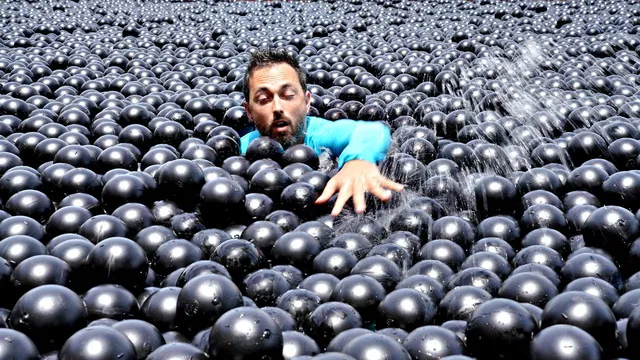
In the single-layer experiment, the swimmer could move, using strokes like breaststroke and front crawl, but the balls repeatedly struck the face and shoulders. Even with tight packing, the balls did not fully block sunlight: gaps between spheres let light through, and reflections created patterns on the pool bottom. The balls also produced intense noise because they were so close to the swimmer’s head that they drowned out other sounds. The difficulty wasn’t just discomfort; it also connected to physics. Moving through the balls increases drag, which scales roughly with velocity squared (V²). Faster motion means encountering more balls per second and pushing them out of the way with greater relative impact.
Next came the more realistic scenario: multi-layer shade balls, similar to how Los Angeles Reservoir is covered. Attempts to run or slide across the surface failed. The reasoning was buoyancy math: when fully submerged, each ball supports only about 300 grams, so keeping an entire body afloat would require more than 260 balls trapped under a person. Movement also changed the mechanics. In a single layer, balls can slip past each other; in multiple layers, they jam against one another and behave more like a solid, creating significantly higher resistance.
The only “working” approach was unconventional: staying mostly beneath the balls and barely moving. In that near-still state, the swimmer could float and feel almost like being in a ball pit. But once motion began, the balls gained enough energy to shift, and the swimmer sank deeper and deeper—mirroring quicksand-like behavior.
The final takeaway wasn’t a how-to for swimming; it was what to do with 10,000 shade balls afterward. The experiment ended with a plan to sign and mail balls to Patreon supporters, turning the risky physics demonstration into a distribution campaign rather than a recreational challenge.
Cornell Notes
Shade balls can support limited swimming only in a single, loosely packed layer. In that setup, the swimmer can move (with face and shoulder impacts) because balls can shift and slip past each other, producing drag that rises with velocity squared. Multi-layer coverage—closer to real reservoir conditions—acts like a jammed, solid-like structure, making normal swimming ineffective and causing sinking when movement starts. Buoyancy limits also matter: each ball supports only about 300 grams when submerged, so floating a full body would require far more balls than can realistically be trapped under a person. The practical result: floating is possible only with minimal motion, while active movement is what triggers the quicksand-like failure mode.
Why does a single layer of shade balls allow some swimming, while multi-layer coverage does not?
How do the balls’ internal water content affect safety and buoyancy?
What role does drag play in the swimming difficulty?
What observations showed that shade balls don’t fully block sunlight even when packed tightly?
What “strategy” allowed floating in multi-layer shade balls, and why did it fail when motion began?
Why did the manufacturer’s stance matter to the experiment’s framing?
Review Questions
- In the transcript’s explanation, what physical change between single-layer and multi-layer packing causes the multi-layer system to behave more like a solid?
- How does the estimated buoyancy per ball (about 300 grams when submerged) translate into the feasibility of floating a full body?
- Why does drag scale with velocity squared in the context of swimming through a dense field of balls?
Key Points
- 1
Shade balls are half-full of water, making them heavy and limiting how much buoyant support each ball provides when submerged.
- 2
A single layer can allow limited swimming because balls can shift and slip past each other, but impacts and drag make movement difficult.
- 3
Multi-layer shade-ball coverage behaves more like a jammed solid, so normal swimming and running across the surface fail.
- 4
Buoyancy calculations suggest that floating a full body would require hundreds of balls trapped under a person, which is not realistically achievable in the multi-layer setup.
- 5
Drag through packed balls increases sharply with speed, consistent with drag scaling roughly as velocity squared (V²).
- 6
Floating in multi-layer coverage depends on staying mostly still; movement transfers energy to the balls, triggering shifting and sinking.
- 7
The manufacturer discouraged swimming and refused residential orders, highlighting that the experiment is not a recommended activity.