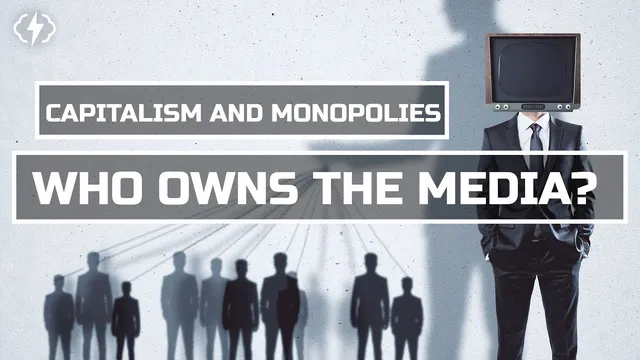
Capitalism And Monopolies: How Five Companies Control All US Media
Based on Second Thought's video on YouTube. If you like this content, support the original creators by watching, liking and subscribing to their content.
Five corporations—Comcast, Disney, National Amusements, News Corp, and AT&T—control about 90% of U.S. media and reach nearly all U.S. households.
Briefing
American media is dominated by a handful of mega-corporations—so concentrated that the country effectively operates under an oligopoly, with near-monopoly power over what most people watch, read, and hear. The core finding is that five companies—Comcast, Disney, National Amusements, News Corp, and AT&T—control roughly 90% of U.S. media and reach nearly 100% of households, meaning “choice” in news and entertainment is largely an illusion shaped by the same concentrated ownership.
The transcript argues that these firms avoid the strict legal label of a monopoly because no single company holds “complete control” with no close substitutes. But power works differently in practice: cross-ownership, overlapping stakes, and constant deal-making among the big players create an environment where smaller competitors struggle to survive. The result is a market that behaves like a monopoly in everyday terms even if it technically falls short of the legal definition.
How the U.S. got here traces back to policy changes—especially the 1996 Telecommunications Act. The legislation was framed as deregulation to open broadcast and telecommunications markets to competition, yet the outcome was rapid consolidation. The transcript cites a shrinking number of controlling media interests: about 50 in the early 1980s, down to roughly six by the year 2000, and staying near that level since. It also points to mergers as a mechanism for tighter information control, aligning with concerns raised by Howard Zinn in A People’s History of the United States.
The transcript then inventories the “big five” and the brands under their umbrellas to show how broad the reach is. News Corp ties together Fox (including Fox Sports) and major media properties such as National Geographic, The Wall Street Journal, HarperCollins, and The New York Post. National Amusements—often less visible publicly—sits behind CBS and a wide portfolio spanning Paramount, Nickelodeon, MTV, BET, Comedy Central, GameSpot, VH1, and Simon & Schuster, among others. AT&T (after acquiring Time Warner in 2018 for $109 billion) brings CNN, HBO, Warner Bros, DC, TBS, TruTV, Cinemax, TNT, Adult Swim, and Hulu-related holdings, plus Time magazine and other assets. Comcast owns NBC, MSNBC, USA Network, Sci-Fi, Universal Pictures, Rotten Tomatoes, and multiple sports networks, alongside extensive internet ventures. Disney spans ABC, ESPN, The History Channel, Lifetime, The Marvel and Lucasfilm franchises, and a large share of comic-book and entertainment infrastructure.
A key nuance is that Netflix is mentioned as a partial exception: it isn’t owned outright by the big five, though it is described as having large external investors. Still, the overall conclusion is that most content—news, streaming, film, and print—flows from the same concentrated corporate ecosystem. The transcript links this structure to a political and cultural effect: major outlets reinforce the status quo, emphasize manageable differences, and divert attention from deeper societal problems. It closes by warning that consolidation is spreading beyond media into other sectors like pharmaceuticals, energy, and manufacturing, raising the stakes for how concentrated power could shape everyday life.
Cornell Notes
Five corporations—Comcast, Disney, National Amusements, News Corp, and AT&T—control most U.S. media, reaching nearly all households and governing about 90% of the market. The transcript argues that while this doesn’t meet the strict legal definition of a monopoly, it functions like an oligopoly with monopoly-like influence through cross-ownership and deal-making. The 1996 Telecommunications Act is presented as a turning point that accelerated consolidation rather than competition, shrinking the number of controlling media interests from around 50 in the early 1980s to about six by 2000. Brand-by-brand examples show how major news networks, studios, and print publishers sit under the same ownership groups. The practical impact claimed is reduced real choice and messaging aligned with maintaining the status quo.
Why doesn’t the transcript call the big five a “pure monopoly,” and what does it call the situation instead?
What policy change is credited with accelerating media consolidation, and what was the claimed outcome?
How does the transcript support the claim that consolidation happened over time?
What are the “big five” and what kinds of media properties do they control?
What is the transcript’s argument about “choice” for audiences?
Is Netflix treated as a full exception to the big-five dominance?
Review Questions
- What legal definition of monopoly does the transcript use, and how does that definition affect its conclusion?
- Which timeline markers (years and approximate numbers) are used to show how media control shrank over time?
- How do the transcript’s examples of brand ownership support the claim that audience “choice” is limited by common incentives?
Key Points
- 1
Five corporations—Comcast, Disney, National Amusements, News Corp, and AT&T—control about 90% of U.S. media and reach nearly all U.S. households.
- 2
The transcript distinguishes legal monopoly from practical monopoly-like power, arguing that oligopoly dynamics can still produce near-total influence.
- 3
Cross-ownership and deal-making among the big firms are presented as a reason smaller competitors struggle to gain lasting traction.
- 4
The 1996 Telecommunications Act is identified as a turning point that accelerated consolidation rather than competition.
- 5
A cited historical trend shows media control shrinking from roughly 50 controlling interests in the early 1980s to about six by 2000.
- 6
The transcript links concentrated media ownership to messaging that reinforces the status quo by shaping news and entertainment priorities.
- 7
Consolidation is portrayed as a broader pattern extending beyond media into other industries such as pharmaceuticals, energy, and manufacturing.