Capitalism Is Destroying Us - The New Climate Report
Based on Second Thought's video on YouTube. If you like this content, support the original creators by watching, liking and subscribing to their content.
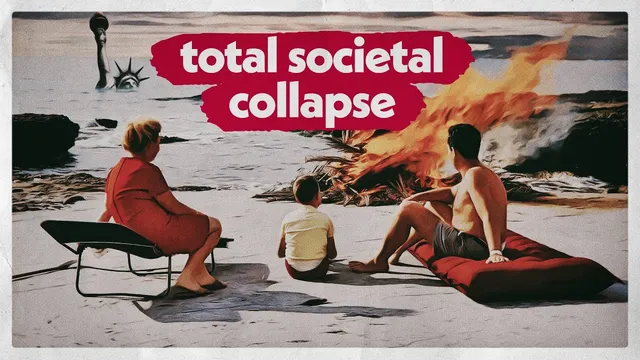
The UN’s disaster-risk assessment frames three of four scenarios as leading to escalating global catastrophes, with “total societal collapse” as a central warning unless action is taken immediately.
Briefing
A new UN disaster-risk assessment warns that humanity is on track for “total societal collapse” in most plausible futures unless climate action is taken immediately—because climate impacts and political failures reinforce each other. The report’s bottom line is stark: three of four scenarios lead to escalating global catastrophes, including droughts, famines, poverty, and disease becoming permanent and widespread features of life.
The argument then pivots from abstract climate projections to lived consequences, insisting that the crisis feels real only when it reaches ordinary people—through footage of homes destroyed, communities forced to evacuate, and families watching their homelands disappear. The comparison to a car barreling toward a pedestrian frames urgency as non-negotiable: whether harm is intentional or accidental, the response must be the same—step out of the way now.
From there, the focus turns to policy options, with “green growth” positioned as the central false promise. The approach—popular across governments, the World Bank, and the Green New Deal—rests on the idea that capitalism can keep expanding while switching electricity generation to renewables, avoiding sacrifices in production and consumption. ESG funds and other investment vehicles are treated as the financial wing of that strategy, selling the notion that making the right things profitable will deliver climate safety.
The critique is structural rather than technical. Under capitalism, growth is not optional: firms and countries are pressured to deliver higher quarterly profits and rising GDP, which in practice requires more extraction, energy use, transportation, waste, and emissions. Even if renewable energy can be scaled, the transition cannot happen fast enough to meet temperature limits if economic growth continues at current rates. Research cited in the discussion argues that empirical evidence does not support the idea that sustainability and growth can coexist in time; the models only work when GDP growth is essentially near zero.
The analysis also points to market power as a practical blocker. Fossil fuels remain the most capitalized industry, giving oil and gas companies leverage to slow or sabotage regulation and political action. The discussion cites political donations and lobbying, plus long-running efforts to discredit climate science and shift blame toward individual consumer choices. It also notes that fossil-fuel profits have surged even amid worsening climate impacts, illustrating how incentives reward delay.
Against this backdrop, the proposed alternative is a democratic economic model that reduces decision-making power for a small profit-driven elite and returns it to the public. To support the claim that ordinary people can prioritize long-term sustainability, the discussion draws on a Harvard-Yale experiment in which most participants used shared resources sustainably rather than maximizing short-term gains. A real-world parallel is offered from France’s 2019 Citizens’ Assembly, where randomly selected people drafted proposals to cut carbon emissions sharply—many requiring restrictions that would hurt industrial profits. Even though the process was ultimately undermined by political leadership, the takeaway is that citizens were willing to make difficult tradeoffs when given real authority.
The closing message is a choice: either democratic control over climate policy leads to a fairer, survivable future, or continued deference to profit-maximizing interests locks in a harsher collapse trajectory. The urgency is not just environmental—it is political, because the feedback loop between climate stress and governance failure is what makes the worst scenarios stick.
Cornell Notes
The UN’s disaster-risk assessment warns that most plausible futures involve escalating catastrophes and “total societal collapse” unless decisive action is taken quickly. The discussion argues that “green growth” fails because capitalism’s built-in requirement for ongoing economic growth drives more extraction, energy demand, and emissions—making it impossible to scale renewables fast enough to meet temperature limits. Fossil-fuel companies are portrayed as a major obstacle due to their concentrated capital and political influence, which can delay or sabotage climate policy. In contrast, democratic decision-making is presented as more compatible with long-term sustainability, supported by a Harvard-Yale experiment and France’s citizens’ assembly experience. The implication: climate safety depends less on market promises and more on shifting power from profit-driven elites to the public.
What does the UN assessment say about the likelihood of collapse, and why does it matter?
Why is “green growth” treated as a dead end in this argument?
What role do fossil-fuel interests play according to the discussion?
How does the argument support the claim that democracy can improve climate outcomes?
What happened in France’s citizens’ assembly, and what does it illustrate?
Review Questions
- What specific mechanism links economic growth requirements to increased climate harm in the critique of green growth?
- How do the Harvard-Yale experiment results challenge common assumptions about individual incentives under shared-resource conditions?
- What does the France citizens’ assembly case suggest about the gap between public willingness to cut emissions and political willingness to implement those cuts?
Key Points
- 1
The UN’s disaster-risk assessment frames three of four scenarios as leading to escalating global catastrophes, with “total societal collapse” as a central warning unless action is taken immediately.
- 2
Climate impacts and political failures are portrayed as reinforcing feedback loops that make worst-case outcomes harder to avoid over time.
- 3
Green growth is criticized as incompatible with capitalism’s growth imperative, because growth pressures require more extraction, energy use, and emissions.
- 4
Even if renewable energy is scalable, the transition is argued to be too slow to meet 1.5°C–2°C limits if GDP continues growing at current rates.
- 5
Fossil-fuel firms are described as uniquely powerful due to concentrated capital, enabling lobbying, sabotage, and influence over regulation and public messaging.
- 6
Democratic decision-making is presented as more likely to prioritize long-term sustainability than profit-maximizing incentives, supported by a Harvard-Yale collective-resource experiment.
- 7
France’s citizens’ assembly illustrates both public readiness for difficult climate tradeoffs and the ability of political elites to derail democratic climate planning.