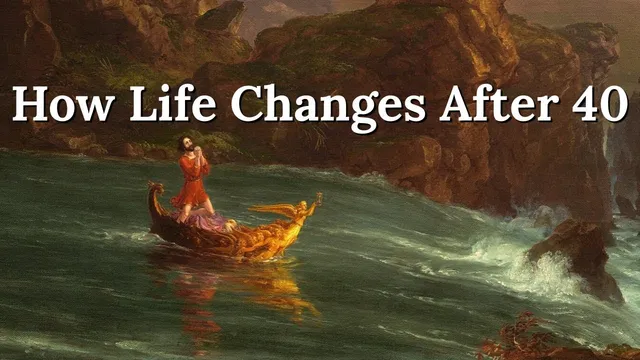
Carl Jung - How Life Changes After 40
Based on Academy of Ideas's video on YouTube. If you like this content, support the original creators by watching, liking and subscribing to their content.
Jung holds that the second half of life requires a different inner “law” than the first; applying early-life rules to later problems can damage the soul.
Briefing
Carl Jung’s central claim about aging is that the second half of life can’t be lived by simply carrying forward the rules of the first half. The “afternoon” of adulthood demands a different inner program—one aimed at meaning rather than expansion—because trying to solve later-life crises with earlier-life strategies damages the soul. Jung warns that people who keep applying “the law of the morning” to later decades often end up with psychological deterioration, including neurosis and depression, while those who adapt can harvest fulfillment from life’s later chapters.
In Jung’s framework, the first half of life is about outward growth. Psychological development begins in narrow family limits and gradually widens a person’s horizon, pushing hopes and desires toward personal power, possessions, career, marriage, children, and social standing. An extraverted orientation fits this stage: success comes from engaging the outer world, pursuing opportunities, and building a life through external achievements. Too much introversion, Jung suggests, can cause people to miss the chances that make youth and early adulthood feel expansive—an idea reinforced by psychologist Jolande Jacobi, who describes reflective people who later feel they “were the losers” because youth’s promises have passed.
But the second half reverses the direction of the quest. Jung’s “man of life’s afternoon” must find within what youth once sought outside. Midlife crises, in this view, are less about removing obstacles to profession or relationships and more about discovering a meaning that makes continued living possible. That shift requires detaching from social expectations and loosening identification with the persona—the social mask used to function among others. Jung portrays a strong persona as useful earlier, yet harmful later, because it can reduce a person to “decorum” without a real personality underneath.
Jung also links meaning to psychological wholeness: mature decades should be used to cultivate a complete personality and integrate what has been left unexperienced. Robert Johnson and Jerry Ruhl describe this as “living our unlived life,” meaning the essential parts of a person that never got integrated—often heard as “woulda-coulda-shoulda” regret. Alongside inward work, Jung recommends pursuing wisdom with the same dedication many people devote to wealth and status. Wisdom, he argues, can help people navigate later-life trials, offers value in itself, and positions older adults to serve as guides and guardians of cultural knowledge.
Finally, Jung urges a reframe of death. In a modern world short on religious myth, fear of death can become neurotic and fuel health anxiety that blocks fulfillment. Jung instead treats death as a goal toward which one can strive, and he encourages openness to some form of immortality—especially for older patients—because, psychologically, death is not merely an end but a turning point. The tragedy, Jung and later commentators warn, is that many people refuse the required change: they chase youth through surgery, fashion, compulsive health obsession, or shallow pleasures. Jung’s warning is blunt—later-life problems can’t be solved by old recipes, and denying life’s natural arc invites regret and inner contraction rather than meaning.
Cornell Notes
Carl Jung argues that life’s second half requires a different inner “program” than the first. Early adulthood is oriented outward—career, status, relationships, and social power—often helped by an extraverted attitude. Later decades shift toward meaning: detaching from the persona, turning inward to integrate what was never lived, and pursuing wisdom rather than more external achievement. Jung also recommends changing one’s relationship to death, treating it as a psychological goal rather than something to be fought, and encouraging openness to immortality. When people cling to first-half strategies—especially attempts to stay young—they risk neurosis, depression, and deep regret.
What does Jung mean by “the law of the morning” being harmful in later life?
How do Jung’s descriptions of life’s first half and second half differ in direction and priorities?
Why does Jung think the persona becomes a problem in midlife?
What is “living our unlived life,” and how does it connect to Jung’s idea of wholeness?
How does Jung’s approach to death aim to prevent neurotic fear?
What behaviors does the transcript describe as attempts to “race against time,” and why are they costly?
Review Questions
- According to Jung, what changes in the source of fulfillment from youth to later adulthood?
- How does detaching from the persona support psychological wholeness in Jung’s framework?
- Why does Jung treat death as a goal rather than merely an end, and what psychological effect does that aim to produce?
Key Points
- 1
Jung holds that the second half of life requires a different inner “law” than the first; applying early-life rules to later problems can damage the soul.
- 2
Early adulthood is oriented outward—career, status, relationships, and social power—often benefiting from an extraverted attitude.
- 3
Later adulthood shifts toward meaning, demanding detachment from others’ expectations and loosening identification with the persona (the social mask).
- 4
Midlife crises are framed less as logistical obstacles to remove and more as a search for meaning that makes continued living possible.
- 5
“Living our unlived life” means integrating essential inner parts that were never fully experienced, often signaled by regret and “woulda-coulda-shoulda.”
- 6
Jung recommends pursuing wisdom through openness, solitude, and deep reflection, not through grasping for it like a commodity.
- 7
Fear of death can become neurotic; Jung urges treating death as a psychological goal and encourages openness to immortality.