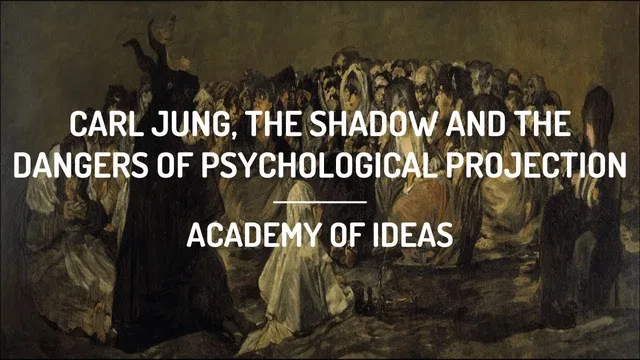
Carl Jung, the Shadow, and the Dangers of Psychological Projection
Based on Academy of Ideas's video on YouTube. If you like this content, support the original creators by watching, liking and subscribing to their content.
Jung’s “shadow” consists of traits pushed into the unconscious; denial doesn’t remove their influence on behavior.
Briefing
Carl Jung’s core warning is that people often outsource their inner darkness to others through psychological projection—and that this habit can corrode both personal relationships and society’s stability. In Jung’s framework, the “shadow” is the portion of the psyche shaped by traits and impulses a person refuses to acknowledge. Defense mechanisms push these qualities into the unconscious, where they still influence behavior. When someone acts from that hidden material—through cruelty, self-sabotage, or other harmful patterns—projection becomes a way to avoid responsibility by attributing the unwanted qualities to someone else.
Projection can target negative traits more readily than positive ones. Freud popularized the concept as a defense against anxiety triggered by confronting one’s own faults. Jung’s view overlaps with that idea but adds a developmental twist: projection is also “inevitable and necessary” because it can reveal what remains unconscious. The healthy response, Jung says, is to recognize the subjective origin of the projection, withdraw it from the external target, and integrate the disowned trait into conscious awareness. That process demands courage—because it requires facing weaknesses and “dark qualities” rather than maintaining a flattering self-image.
The danger intensifies when people try to be “good and wonderful and perfect” beyond their capacity. Jung describes a feedback loop: the more someone strives for an idealized persona, the more the shadow “develops a definite will to be black and evil and destructive.” If the person denies or minimizes the resulting contradictions, responsibility gets shifted outward. The result is a life organized around scapegoats—first often a friend or family member, and then, when problems persist, another target. Eventually, the scapegoat may become not an individual but an entire group.
Collective scapegoating is especially volatile because it offers psychological and social advantages. It protects close relationships from the damage of blaming someone near, and it reduces the likelihood of genuine contact that might puncture the distorted image of the targeted group. Even when the scapegoated group contains real flaws, Jung notes that “even the worst projection” is anchored to “a hook” offered by the other side—small enough to be true, large enough to be exploited. Collectivist movements can then magnify that hook into a total explanation for society’s problems, making persecution, violence, and even extermination seem justified.
Power structures can further weaponize projection through propaganda, false flags, and other manipulations that redirect attention away from leaders’ own actions. Jung’s broader claim is that the greatest threat to civilization is not merely external weaponry but internal ignorance—an inability to understand oneself and confront destructiveness. Quoting Aleksandr Solzhenitsyn, the transcript emphasizes that the line dividing good and evil runs through every human heart. Without integrating the shadow, projection can scale up into mass conflict; with it, people gain a better chance to identify the real sources of evil rather than manufacturing enemies. Jung even suggests that if collective projection becomes widespread, war becomes a likely outcome—because people may need catastrophe to discover what they are unwilling to face within.
Cornell Notes
Jung frames the “shadow” as the unconscious part of personality shaped by traits people refuse to acknowledge. When harmful behavior emerges from that shadow, projection lets people avoid responsibility by attributing those traits to others. Freud treated projection mainly as a defense against anxiety, while Jung adds that projection can also be a necessary signal of what is unconscious—if it is withdrawn and integrated into conscious awareness. The transcript warns that denial and perfectionism intensify the shadow, leading to scapegoating. When scapegoating shifts from individuals to groups, it can fuel persecution and large-scale violence, especially when leaders exploit it through propaganda.
What is the “shadow,” and why does it still affect behavior even when someone denies it?
How do Freud and Jung differ on the purpose of projection?
What is the “healthy” response to projection according to Jung?
Why does striving to be “good and wonderful and perfect” make things worse?
How does scapegoating move from personal relationships to entire groups, and why is that dangerous?
What role do leaders and propaganda play in collective projection?
Review Questions
- How does Jung’s concept of the shadow connect to projection and scapegoating in the transcript’s causal chain?
- What conditions make projection more likely to escalate from blaming individuals to blaming groups?
- According to the transcript, what is the key difference between using projection to avoid responsibility and using it as a developmental signal?
Key Points
- 1
Jung’s “shadow” consists of traits pushed into the unconscious; denial doesn’t remove their influence on behavior.
- 2
Projection shifts responsibility outward by attributing unconscious traits to others, often focusing on negative qualities.
- 3
A constructive response to projection requires recognizing its subjective origin, withdrawing it from the target, and integrating the trait into conscious awareness.
- 4
Perfectionism can intensify the shadow: trying to be “marvellous” beyond capacity can produce destructive outcomes that are then denied or blamed elsewhere.
- 5
Scapegoating becomes socially dangerous when it scales from individuals to groups, enabling persecution and violence.
- 6
Collectivist movements can exploit small elements of truth (“hooks”) to justify sweeping blame and justify extreme actions.
- 7
When leaders use propaganda and false flags to redirect blame, internal moral ignorance can manifest as external conflict, including war.