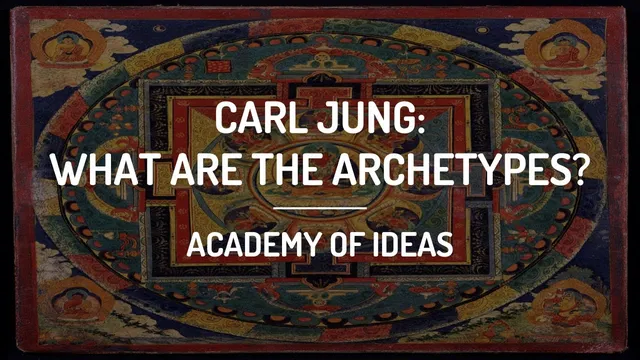
Carl Jung - What are the Archetypes?
Based on Academy of Ideas's video on YouTube. If you like this content, support the original creators by watching, liking and subscribing to their content.
Jung’s archetypes are inherited psychic structures housed in the collective unconscious, shaping how humans perceive and imagine the world.
Briefing
Jung’s core claim is that the human mind isn’t built from experience alone: it contains inherited, pre-personal psychic structures—archetypes—that shape how people perceive, dream, and make meaning. That idea matters because it offers a single explanation for why myths, religions, and even certain dream images can share striking patterns across cultures, and why similar symbols can surface in the inner lives of people who have never encountered those traditions.
Jung framed the psyche as a total personality made up of three interacting realms: consciousness, the personal unconscious, and the collective unconscious. Consciousness is the slice of experience a person is aware of. The personal unconscious holds forgotten or repressed material tied to an individual’s life. Deeper still, the collective unconscious contains shared psychic structures—“cognitive categories” common to all humans—that influence thought and behavior. Archetypes live in this collective layer, acting like underlying mental “organs” that organize experience before a person can consciously interpret it.
The archetypes’ influence becomes visible through symbolic imagery. Jung’s approach distinguishes symbols from signs. A sign points to something known and objective—language works largely through signs. A symbol, by contrast, points toward something essentially unknown: a mystery within the psyche. In this view, religious and mythic images don’t function as literal references to external objects. Instead, they express patterns of the unconscious that cannot be fully reduced to clear, discursive explanations.
Because archetypes provide structure rather than fixed content, the same underlying pattern can appear in different symbolic forms. Cultures and individuals may generate different images, but those images tend to cluster around a limited set of archetypal principles rather than drifting into chaos. Knowledge of these patterns comes through interpreting symbol groupings—images that “gather round” what is being understood—rather than through purely logical analysis.
A central example is Jung’s archetype of the Self, described as the unifying center of the psyche. The Self is linked to many religious and mythic symbols, especially mandalas—circular images often with a center and sometimes a square or cross. Themes such as wholeness, the union of opposites, a central generative point, and the “axis of the universe” are treated as symbolic expressions of the Self. Jung also emphasized that this doesn’t reduce God to psychology; the unconscious is portrayed as the medium through which religious experience seems to flow, while the ultimate source of archetypes remains beyond human knowledge.
Jung wrestled with where archetypes come from, suggesting both evolutionary development and a possible resemblance to Platonic forms—immutable structures of a metaphysical kind. Whatever their origin, archetypes are said to shape everyone’s life. The practical implication is developmental: people are tasked with becoming conscious of unconscious contents pressing upward, so that awareness expands rather than remaining trapped in unconsciousness. In Jung’s formulation, the aim is to kindle “a light in the darkness of mere being.”
Cornell Notes
Jung argued that humans are not born as blank slates. The psyche includes a collective unconscious containing inherited archetypal structures that shape perception, dreams, and behavior. Archetypes don’t appear as fixed images; they provide underlying structure while symbolic forms vary by culture and individual. Symbols differ from signs: signs point to known entities, while symbols express living, subjective meanings tied to unknown psychic realities. By interpreting symbol clusters—especially archetypal patterns like the Self—people can expand consciousness and integrate unconscious contents rather than remain governed by them.
If the mind isn’t a blank slate, where does Jung place the source of inherited structure?
Why do myths and religions across cultures show similar themes, according to Jung?
What’s the difference between a sign and a symbol in Jungian psychology?
How can someone gain knowledge of archetypes if archetypes themselves can’t be directly observed?
What does the archetype of the Self represent, and how does it show up symbolically?
Does Jung treat archetypes as a replacement for God?
Review Questions
- How does Jung’s model of the psyche (consciousness, personal unconscious, collective unconscious) explain inherited influences on experience?
- Why does Jung insist that archetypes are revealed through symbols rather than through direct observation, and how does that affect interpretation?
- What role does the Self archetype play in unifying the psyche, and what symbolic motifs are used to represent it?
Key Points
- 1
Jung’s archetypes are inherited psychic structures housed in the collective unconscious, shaping how humans perceive and imagine the world.
- 2
The psyche is organized into consciousness, the personal unconscious, and the collective unconscious, with archetypes located in the collective layer.
- 3
Archetypes don’t dictate identical images; they provide structure while symbolic forms vary across cultures and individuals.
- 4
Symbols differ from signs: signs point to known entities, while symbols express living meanings tied to unknown psychic realities.
- 5
Recurring mythic and religious patterns can be explained as symbolic manifestations of shared archetypal structures rather than as mere cultural coincidence.
- 6
Jung’s archetype of the Self is linked to unification and appears in motifs such as mandalas and themes like wholeness and the union of opposites.
- 7
Personal growth, in Jung’s view, depends on becoming conscious of unconscious contents pressing upward—expanding awareness instead of staying trapped in unconsciousness.