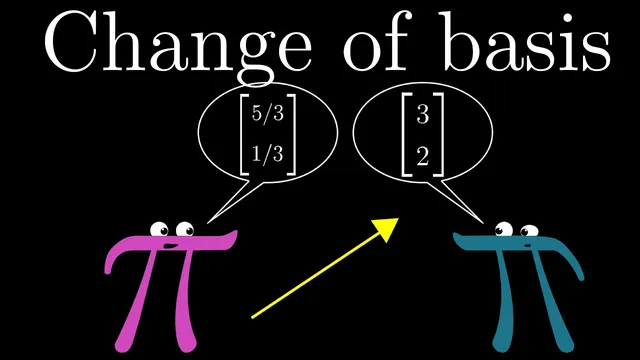
Change of basis | Chapter 13, Essence of linear algebra
Based on 3Blue1Brown's video on YouTube. If you like this content, support the original creators by watching, liking and subscribing to their content.
Coordinates are coefficients in a basis expansion, so changing the basis changes the numbers even when the geometric vector stays the same.
Briefing
Coordinate systems aren’t just bookkeeping—they encode the geometry of space. In the standard setup, a vector like (3, 2) is interpreted as “3 units along i-hat (right) plus 2 units along j-hat (up).” That interpretation depends entirely on what i-hat and j-hat mean in the first place. Switching to a different pair of basis vectors changes the “language” used to describe the same physical vector, so the same point in space can have different coordinates.
Consider Jennifer, who uses basis vectors b1 and b2 that are tilted relative to the standard axes. In standard coordinates, b1 is (2, 1) and b2 is (-1, 1). Jennifer’s coordinate system is defined so that b1 and b2 themselves play the roles of her “unit directions”: in her language, b1 corresponds to (1, 0) and b2 corresponds to (0, 1). With that setup, the vector that is (3, 2) in the standard system becomes (5/3, 1/3) in Jennifer’s system. Translating this means expressing the vector as a linear combination of her basis vectors: (5/3)·b1 + (1/3)·b2. The key takeaway is that coordinates are coefficients in a basis expansion, not universal labels.
To translate between coordinate systems, the change-of-basis matrix does the heavy lifting. If Jennifer’s basis vectors are written in the standard coordinates, those vectors become the columns of a matrix A. Multiplying A by a coordinate vector in Jennifer’s language produces the same geometric vector in standard coordinates. Going the other direction requires undoing that mapping, which is done with the inverse matrix A^{-1}. In the example, the inverse change-of-basis matrix has columns (1/3, -1/3) and (1/3, 2/3). Multiplying A^{-1} by the standard vector (3, 2) yields (5/3, 1/3), confirming the coordinate conversion.
The same idea extends beyond points and vectors to linear transformations. A rotation matrix is tied to the basis used to define i-hat and j-hat, because its columns record where those specific basis vectors land. Jennifer’s rotation matrix must instead describe where her own basis vectors land, and in her coordinate language. The practical method is a three-step matrix conjugation: convert a vector from Jennifer’s coordinates into standard coordinates (A), apply the transformation in standard coordinates (M), then convert back into Jennifer’s coordinates (A^{-1}). The resulting matrix in Jennifer’s language is A^{-1} M A (written in the transcript as A inverse times M times A).
For a 90° counterclockwise rotation, the standard basis vectors map to (0, 1) and (-1, 0), which determine the usual rotation matrix. When translated into Jennifer’s coordinate system using the conjugation procedure, the resulting matrix has columns (1/3, 5/3) and (-2/3, -1/3). This shows how the same geometric transformation can look numerically different depending on the coordinate system.
Alternate coordinate systems matter because they can make certain transformations simpler—an advance that sets up the next topic: eigenvectors and eigenvalues.
Cornell Notes
Coordinates are coefficients of a vector written in a chosen basis. Changing basis changes the “meaning” of the numbers: the same geometric vector can have different coordinates in different systems. A change-of-basis matrix A (with Jennifer’s basis vectors as columns, written in standard coordinates) converts Jennifer-coordinates to standard-coordinates; A^{-1} converts back. Linear transformations also depend on basis, so the transformation matrix in Jennifer’s coordinates is obtained by conjugation: A^{-1} M A. This produces a numerically different matrix that still represents the same geometric rotation or linear map, just expressed in a different coordinate language.
Why does the vector (3, 2) become (5/3, 1/3) in Jennifer’s system?
How does the change-of-basis matrix translate coordinates between systems?
What does “A^{-1} M A” mean for linear transformations?
Why can’t Jennifer just reuse the standard rotation matrix columns directly?
For the 90° counterclockwise rotation, what numerical change appears in Jennifer’s matrix?
Review Questions
- Given a basis change matrix A whose columns are the new basis vectors in standard coordinates, what operation converts a vector from the new basis coordinates to standard coordinates?
- If M represents a rotation in standard coordinates, how do you construct the matrix representing the same rotation in a different basis?
- Why does the numerical form of a transformation matrix depend on the chosen basis even when the geometric transformation is unchanged?
Key Points
- 1
Coordinates are coefficients in a basis expansion, so changing the basis changes the numbers even when the geometric vector stays the same.
- 2
In standard coordinates, i-hat and j-hat define the usual meaning of (1, 0) and (0, 1); a different basis defines a different meaning.
- 3
A change-of-basis matrix A (with the new basis vectors as columns in standard coordinates) converts new-basis coordinates to standard coordinates.
- 4
The inverse matrix A^{-1} converts standard coordinates back into the new basis.
- 5
A linear transformation matrix depends on the basis because its columns track how basis vectors move.
- 6
To express the same linear transformation in a new coordinate system, use conjugation: A^{-1} M A.
- 7
Alternate coordinate systems can make transformations easier to interpret, setting up eigenvectors and eigenvalues next.