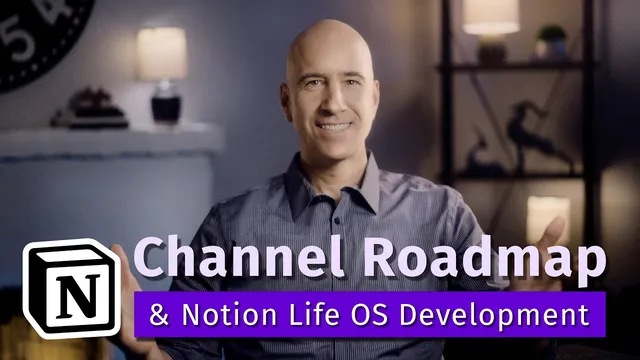
Channel Roadmap & Notion Life OS Development
Based on August Bradley's video on YouTube. If you like this content, support the original creators by watching, liking and subscribing to their content.
The roadmap positions Notion as a software development platform for building integrated life systems, not just a productivity tool.
Briefing
The channel roadmap centers on a single claim: Notion is best understood as a life-systems “software development platform,” not just a productivity app—and the real opportunity is building integrated, first-principles systems that reflect decades of lived experience. The creator frames the work as three missions—peak mind and body wellness, sharing the systems and practices that enabled recovery and thriving after dire circumstances, and building a life of freedom and meaning through rewarding work. The through-line is “systems thinking,” where knowledge, habits, projects, values, purpose, and mental models aren’t treated as separate tools but as interlocking parts of a larger, self-reinforcing ecosystem.
A major emphasis lands on what’s missing in today’s Notion ecosystem. Feature demos and surface-level tips are valuable, but the landscape lacks deep personal systems built from long-term life lessons. The roadmap criticizes template recycling and the continued use of older methodologies—especially GTD and similar approaches—arguing they were designed for a world with far more limited technology. The core point is that tools shape what people believe is possible; therefore, modern platforms like Notion should enable new system designs rather than forcing “square pegs into round holes.” Notion’s “dynamic interconnectedness” is presented as the differentiator: it supports integrated life systems that create “synergistic emergence” across components, something isolated apps or siloed workflows can’t replicate.
At the center of the channel’s Notion work sits “pillars, pipelines, and vaults” (PPV), described as a system designed to leverage Notion’s unique capabilities while embedding psychology and physical practices learned over decades. PPV is portrayed as “battle tested” through tens of thousands of users and reinforced by ongoing reader feedback delivered via emails. The creator also positions PPV as a framework that goes beyond learning Notion quickly; it’s about internalizing life lessons through real experience and then translating that nuance into a practical structure that guides ongoing action.
The roadmap also lays out sequencing. The primary channel will start with a series on building Notion life systems for life enhancement, including newer Notion functionality, then move into deeper coverage of pillars, pipelines, and vaults—how they evolved and how to make them more accessible. After that, the plan is to map PPV into the larger ecosystem of systems, emphasizing that systems exist within larger systems and influence one another through cause-and-effect loops. The creator repeatedly returns to the idea that emergence comes from designing each component for its role in the whole, not from optimizing isolated modules.
Finally, the roadmap signals ongoing development work behind the scenes via a second YouTube channel, “create and build,” described as a more raw backstage look. The overall message is that progress in life comes from alignment, focus, and action: identify what’s meaningful, translate it into aspirations, define daily and weekly actions, and ensure knowledge and resources resurface at the right time and context—using Notion as the engine for intentional design.
Cornell Notes
The roadmap argues that Notion should be treated as a software development platform for building integrated life systems, not merely a notes or task tool. It frames “pillars, pipelines, and vaults” (PPV) as a life-design framework that combines Notion’s interconnected capabilities with decades of psychology and physical practices, then refines the system through large-scale user feedback. A key critique targets template recycling and older methodologies like GTD, claiming they don’t fit modern digital environments and limit what people think is possible. The channel’s sequencing starts with Notion system-building for life enhancement (including newer features), then deepens into PPV, and later maps PPV into a broader “systems within systems” ecosystem. The end goal is alignment, focus, and action: meaningful values → aspirations → daily/weekly steps → timely knowledge retrieval.
Why does the roadmap treat Notion as more than a productivity or note-taking tool?
What’s the main critique of GTD and other older methodologies in this plan?
What are “pillars, pipelines, and vaults” (PPV) meant to accomplish?
How does the roadmap connect PPV to broader systems thinking?
What sequencing does the roadmap plan for the primary channel?
What role does the second channel (“create and build”) play?
Review Questions
- How does the roadmap justify replacing template-based Notion workflows with systems designed from first principles?
- Describe PPV’s three core tenants and explain how they connect alignment to action.
- Why does the roadmap claim that emergence requires designing components for their role in a larger system rather than optimizing them in isolation?
Key Points
- 1
The roadmap positions Notion as a software development platform for building integrated life systems, not just a productivity tool.
- 2
It argues that older frameworks like GTD don’t fit modern multi-dimensional tools and can limit what people think is possible.
- 3
Pillars, pipelines, and vaults (PPV) are framed as a life-design engine: meaning → aspirations → daily/weekly actions → timely knowledge retrieval.
- 4
The channel’s content plan sequences from newer Notion capabilities and systems design into deeper PPV coverage, then into the broader systems ecosystem around PPV.
- 5
Systems thinking is treated as the core lens: life domains are interconnected through cause-and-effect loops, producing “emergence” when designed as a whole.
- 6
The approach is presented as battle tested through tens of thousands of users and reinforced by ongoing reader feedback.
- 7
A second channel (“create and build”) is reserved for backstage documentation of methods and business-building progress.