Chat GPT and thematic analysis - Here is how I really use it
Based on Qualitative Researcher Dr Kriukow's video on YouTube. If you like this content, support the original creators by watching, liking and subscribing to their content.
Use ChatGPT after initial coding, not as a replacement for the analyst’s first-pass code creation.
Briefing
ChatGPT is most useful in qualitative thematic analysis not as an automatic coder, but as a “research assistant” that helps refine the analyst’s work—especially when moving from detailed initial codes to more structured axial codes and toward theme-ready wording. The core practice is keeping human control: coding is done by hand first, then ChatGPT is used to generate grouping options and to rewrite code labels so they read cleanly and fit the eventual theme structure.
The workflow starts after initial coding. The analyst builds a large set of descriptive, data-faithful codes—essentially summaries of what participants say. Next comes stage two: grouping these codes into categories (often called focus codes or axial codes). ChatGPT can do this by taking a list of codes and proposing groupings, but giving it full autonomy can reduce control and increase the risk of unreliable or unwanted organization. Instead, the analyst provides context (a study description) and asks for grouping ideas while aiming for clarity—ideally letting each code belong to one category, though overlap is acceptable when it truly fits.
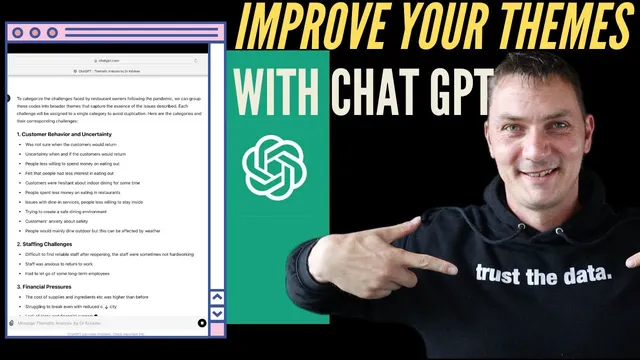
In a hypothetical study about restaurant owners’ experiences following the pandemic, the analyst pastes challenge-related codes into ChatGPT along with the study context. ChatGPT returns several plausible grouping buckets such as customer behavior and uncertainty, staffing challenges, financial pressures, and regulation and compliance. These groupings are treated as starting points: the analyst reviews them, adjusts wording, and sometimes adopts only one or two suggestions depending on how well they align with the data and with the analyst’s conceptual plan.
A second major use comes when code groups look promising but the codes themselves still don’t sound like theme-ready components. Some code labels are too long or too messy to function as subthemes. To fix this, the analyst copies codes from a group and asks ChatGPT to “clean them up,” generating multiple alternative phrasings. Rather than accepting a single suggestion, the analyst reviews several options—often combining elements across suggestions—to produce tighter labels such as reframing “people would mainly dine outdoors, but this can be affected by weather” into variants like “impact of weather on outdoor dining” or “outdoor dining dependent on weather.”
The same approach is applied to other unwieldy codes, such as those about difficulty enforcing new policies, where ChatGPT proposes clearer rewrites (e.g., “struggling to enforce mask policies” or similar). The result is more professional, compact code wording that better supports later theme development. Throughout, the analyst treats ChatGPT as a collaborator for idea generation and wording refinement, while retaining final judgment—reviewing every grouping and every rewritten code to ensure it still matches the meaning of the original data.
Cornell Notes
ChatGPT works best in qualitative thematic analysis when it supports the analyst’s decisions rather than replacing them. The workflow described keeps initial coding human-led, then uses ChatGPT to (1) propose groupings for axial/focus codes and (2) rewrite code labels so they become compact, theme-ready statements. For grouping, the analyst supplies study context and asks for multiple category options, then manually checks and revises because AI can misread codes or produce categories that don’t fit. For wording, the analyst provides one code at a time and selects from several rewrite options—sometimes combining ideas—so labels stay faithful to the data while sounding professional. This “research assistant” approach improves organization and clarity while preserving control.
Why does the analyst avoid letting ChatGPT do the initial coding?
How is ChatGPT used during the transition from initial codes to axial/focus codes?
What’s the risk of giving ChatGPT too much autonomy in grouping?
What does the analyst do when code groups look good but the codes still don’t sound like themes?
How does the analyst refine a long, awkward code label?
What is the overall role relationship between the analyst and ChatGPT?
Review Questions
- When moving from initial codes to axial/focus codes, what two things does ChatGPT help with in this workflow?
- What safeguards does the analyst use to prevent ChatGPT from misgrouping or misrepresenting codes?
- How does the analyst decide which rewritten code label to keep when multiple phrasing options are offered?
Key Points
- 1
Use ChatGPT after initial coding, not as a replacement for the analyst’s first-pass code creation.
- 2
Provide study context when asking for grouping so categories reflect the research focus rather than generic patterns.
- 3
Treat ChatGPT’s grouping suggestions as drafts: review every category and adjust wording or membership as needed.
- 4
Aim for clarity by assigning each code to one category when possible, while allowing overlap when it genuinely fits.
- 5
When code labels are too long or messy to support themes, ask ChatGPT to rewrite them and then manually select or combine options.
- 6
Refine codes one at a time for better control over meaning and phrasing quality.
- 7
Keep final judgment with the analyst; ChatGPT functions as an assistant for ideas, not an authority on interpretation.