ChatGPT 5.2 Tested on Real Academic Work (Not the Hype)
Based on Andy Stapleton's video on YouTube. If you like this content, support the original creators by watching, liking and subscribing to their content.
ChatGPT 5.2 can quickly surface recent peer-reviewed papers and provide usable references for rapid literature scanning.
Briefing
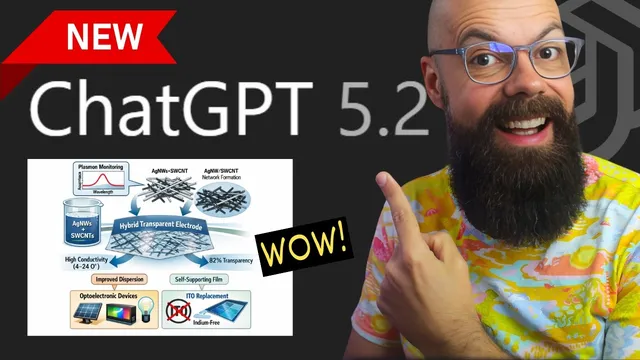
ChatGPT 5.2 delivers a clear upgrade for academic “knowledge work,” especially when tasks demand quick literature discovery and visually communicating research. In practical tests, it reliably surfaced recent peer-reviewed papers on OPV device efficiency and produced a graphical abstract that looked markedly better than earlier generations—good enough to serve as a starting point for a polished figure.
The model’s best performance showed up in two areas: fast, referenced searching and improved visual output. For a prompt requesting “10 new peer-reviewed papers” on improved efficiency in OPV devices, it returned a set of recent papers with plausible efficiency figures (e.g., around 19%, 20.5%, 20.8%) and links that the tester confirmed existed. It also generated a graphical abstract from a paper abstract, producing a clean, understandable layout that the tester described as “head and shoulders” above prior attempts. The workflow still benefits from human editing—removing unnecessary text and refining layout in tools like Canva—but the core ability to turn text into a usable research graphic is now within reach for more researchers.
Where 5.2 fell short was in longer, structured academic deliverables that require more than prose: detailed literature reviews, conference posters, and multi-slide presentations. When asked for a detailed literature review on nano composite transparent electrodes, the system produced a lengthy, well-referenced write-up after asking clarifying questions and running many internal searches (22 sources across 68 searches). Yet the output lacked the “rich data” expected from competing research tools—especially tables and other structured elements—and it was awkward to export and reformat for field-specific citation needs.
Poster and slide generation exposed a similar pattern: text generation works, design automation doesn’t consistently land. Converting a paper into a conference poster produced a PDF that included relevant text but not a usable design; converting into a PowerPoint presentation was worse at first, devolving into mostly word-only slides. Turning on “thinking” improved layout and even extracted a table with key results, but the presentation still became unreliable, with some slides turning into confusing or incorrect layouts. The tester described the results as “tantalizingly close” to something usable, but not dependable enough to submit as-is.
The most telling comparison came from agent-style academic tasks. In SciSpace agent mode, a prompt to compile dinosaur field study locations into an interactive map produced a functioning website with an interactive timeline and map. Attempting a similar interactive web app build with ChatGPT 5.2 generated code and a previewable app, but it was less polished and required more cleanup. The conclusion: ChatGPT 5.2 is a strong upgrade for certain research workflows—especially literature discovery and graphical abstracts—yet specialized academic tools still win for structured literature synthesis and agent-driven, data-heavy outputs.
Cornell Notes
ChatGPT 5.2 shows meaningful gains for academic workflows that need fast discovery and visual communication. It can quickly return recent peer-reviewed papers with usable references, and it produces graphical abstracts from paper abstracts that are substantially better than earlier versions. However, it struggles with tasks that demand structured, export-ready scholarship—especially detailed literature reviews with tables and field-appropriate formatting. Poster and slide generation improves when “thinking” is enabled, but the design output remains inconsistent and sometimes devolves into unusable layouts. For agent-style, interactive data products (like interactive maps), SciSpace still produces more reliable, academia-aware results.
How did ChatGPT 5.2 perform on a straightforward literature search for new peer-reviewed papers?
What changed with graphical abstracts, and why does it matter for researchers?
Why did the literature review test underwhelm despite good referencing?
What happened when converting a paper into a conference poster and PowerPoint?
How did ChatGPT 5.2 compare to SciSpace for agent-style interactive academic outputs?
Review Questions
- Which two academic tasks produced the most reliable results for ChatGPT 5.2, and what evidence from the tests supports that?
- What specific shortcomings appeared in the literature review output, and how did they affect usability?
- When “thinking” was enabled, what improvements occurred in PowerPoint generation—and what still went wrong?
Key Points
- 1
ChatGPT 5.2 can quickly surface recent peer-reviewed papers and provide usable references for rapid literature scanning.
- 2
Graphical abstract generation is a standout improvement, producing clearer, more usable visuals from paper abstracts (often still needing editing).
- 3
Detailed literature reviews may be long and referenced but can lack structured “rich data” elements like tables and export-ready formatting.
- 4
Poster and slide generation remains inconsistent: text is easier than design, and some slides can become confusing even after improvements.
- 5
Enabling “thinking” can improve presentation structure and extract key elements (like tables), but it doesn’t fully solve layout reliability.
- 6
For agent-style, interactive academic deliverables, specialized tools like SciSpace currently outperform ChatGPT 5.2 in polish and reliability.