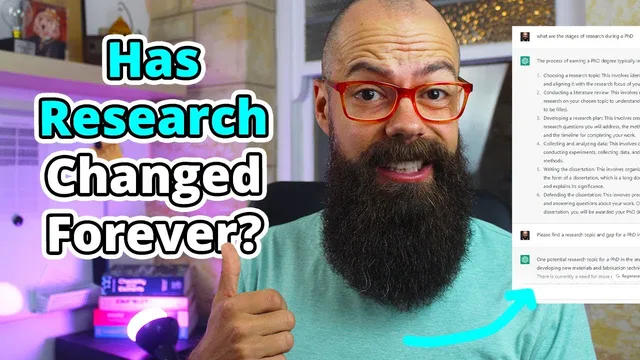
ChatGPT: A game changer for researchers? See it in action
Based on Andy Stapleton's video on YouTube. If you like this content, support the original creators by watching, liking and subscribing to their content.
ChatGPT can quickly outline the standard stages of a PhD, turning a vague request into an actionable workflow checklist.
Briefing
ChatGPT is positioned as a fast, practical assistant for researchers—especially for generating research directions, refining questions, and drafting structured plans—while still leaving the heavy lifting (literature judgment, experimental specifics, and supervisor-level guidance) to the researcher. In a live walkthrough focused on PhD work in organic photovoltaic devices, it quickly mapped the standard stages of a PhD, then went further by proposing a plausible research topic, surfacing likely “gaps,” and generating candidate research questions tied to real constraints in the field.
The most useful early payoff came when the assistant was asked to find a PhD topic in organic photovoltaic devices. It suggested developing new materials and fabrication techniques for higher-efficiency solar cells, then justified the need by noting that organic photovoltaic devices often lag in efficiency and that the field still seeks more efficient and cost-effective solar cells. It also highlighted major bottlenecks such as stability and lifetime—particularly degradation under sunlight exposure and oxygen—along with cost reduction and performance improvements. While it didn’t always produce a single sharply defined question on command, it did generate a set of research directions that helped narrow what to pursue.
The walkthrough then shifted from broad questions to more targeted interests. When asked about “aesthetic properties” of organic solar cells, the assistant produced concrete application-oriented directions such as transparent or semi-transparent designs, flexible and lightweight solar cells, colored solar cells, textured solar cells, and customizable solar cells. That mattered because it functioned less like a literature review and more like a structured brainstorming engine—turning a vague interest into multiple workable sub-angles that a researcher could then test against the actual literature.
For literature review support, the assistant was prompted to find review papers on textured solar cells and returned a list of potential references with links. The results were described as specific and aligned with search intent, though the assistant’s recency varied (some items appeared older, such as 2012 and 2016). The takeaway: it can accelerate the “first pass” discovery of review sources, but researchers still need to verify relevance and update coverage.
When asked to develop a research plan for improving the look of textured solar cells, it generated a multi-step framework: identify important aesthetic features for building owners, translate those preferences into design criteria, and then run experiments. It also offered example fabrication and testing steps—such as microelectrical mechanical systems, nano imprint lithography, and stability checks including light soaking, thermal cycling, and humidity testing. The plan remained somewhat high-level in places, and the walkthrough emphasized that details and scientific judgment still require domain expertise.
Even at the dissertation stage, the assistant provided general scheduling templates (e.g., a week-by-week outline over three months) and writing tips like starting early and using templates. The overall conclusion was pragmatic: ChatGPT can help researchers get unstuck, generate structured options, and speed up early planning, but it doesn’t replace supervisor guidance, experimental design rigor, or the critical evaluation of sources. Spending more time testing its limits—especially for producing truly specific, field-accurate guidance—was framed as the next step for anyone considering it as a research tool.
Cornell Notes
ChatGPT can serve as a rapid research assistant by turning broad prompts into structured PhD stages, topic ideas, research questions, and draft plans. In organic photovoltaic devices, it suggested a topic tied to efficiency and cost, flagged stability/lifetime issues under sunlight and oxygen, and generated application-oriented directions such as transparent, flexible, colored, and textured solar cells. It also produced a literature-review starter list of review papers (with links), though coverage may skew older depending on the query. For planning experiments, it offered example fabrication techniques and realistic stability tests, but the walkthrough emphasized that researchers must supply domain-specific details and supervisor-level judgment. Used this way, it helps researchers move past the “blank page” hurdle and explore promising angles faster.
How did ChatGPT translate the broad idea of “research” into a PhD workflow?
What did ChatGPT identify as a likely “gap” when asked for a PhD topic in organic photovoltaic devices?
How did the assistant help narrow research questions when the interest shifted to “aesthetic properties”?
What role did ChatGPT play in literature review, and what limitation appeared?
What did ChatGPT include when generating a research plan for textured organic solar cells?
Why did the walkthrough conclude ChatGPT shouldn’t replace supervisor guidance?
Review Questions
- When asked for a PhD topic in organic photovoltaic devices, which problem areas did ChatGPT highlight beyond efficiency (and why do they matter for real devices)?
- What kinds of outputs were most useful for the “aesthetic properties” angle—research questions, literature leads, or experimental steps—and what did each require from the researcher?
- Where did the assistant’s limitations show up most clearly (e.g., specificity, recency, or experimental detail), and how should a researcher respond to those gaps?
Key Points
- 1
ChatGPT can quickly outline the standard stages of a PhD, turning a vague request into an actionable workflow checklist.
- 2
For organic photovoltaic devices, it generated a topic direction tied to efficiency and cost, while also flagging stability/lifetime degradation under sunlight and oxygen.
- 3
Shifting prompts to application goals (like aesthetic properties) can produce multiple concrete design directions such as transparent, flexible, colored, and textured solar cells.
- 4
It can jump-start literature review by returning candidate review papers with links, but recency may vary, so researchers must verify and update sources.
- 5
Research plans generated by ChatGPT can include realistic experiment components—fabrication technique examples and stability tests—yet remain high-level in places.
- 6
Dissertation help tends to be general (tips and scheduling templates), so researchers still need supervisor and team expertise for specificity and rigor.