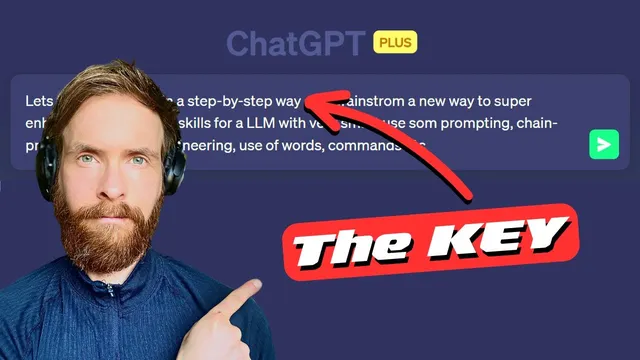
ChatGPT Prompt Engineering DIY Research: Master Prompt Crafting Today!
Based on All About AI's video on YouTube. If you like this content, support the original creators by watching, liking and subscribing to their content.
Use ArcSave.org to locate prompting-related research papers, then skim for frameworks that look short and actionable.
Briefing
A practical workflow for inventing new prompt sequences for ChatGPT and other LLMs is built around mining research papers, turning them into reusable “frameworks,” and then stress-testing the results on a benchmark problem. The core idea is low-friction: find relevant academic work, summarize it with LLM plugins, synthesize a prompt strategy framework from multiple papers, and iterate by running the resulting prompt chain against real tasks.
The process starts with paper discovery, using ArcSave.org to search for topics like “prompting large language model.” The workflow then narrows to papers that look promising after skimming—examples mentioned include “strategic reasoning with language model,” “prompt based tuning,” “short answer grading using one shot prompting,” “code prompting,” “a neural symbolic method,” and “encrypted prompts.” Once a target paper is selected, its PDF link is pasted into ChatGPT using plugins such as “Ask Your PDF” and “Link Reader.” A first prompt requests an in-depth PDF summary, and a follow-up prompt asks for step-by-step instructions on how the framework works. Those summaries are saved into a text file so multiple papers can be processed and stored together.
Next comes synthesis: the saved summaries are fed back into ChatGPT to generate a new prompt-sequence framework. The resulting structure is described as designed to enhance strategic reasoning—guiding decision-making through elements like value assignment prompts, belief tracking prompts, chain-of-thought-style reasoning prompts, “racing” prompts, cascade prompts, and demonstration prompts. The creator typically integrates at most two papers, then adds a second research source—“Oola GPT empowering llms with human-like problem solving abilities”—to enrich the approach with additional prompting templates aimed at generating better questions, thinking templates, step thinking, and critical thinking.
After assembling the combined research insights, the workflow shifts from research to creation. A new ChatGPT run (using default GPT-4, without plugins) is prompted to generate fresh ideas that the user can research further, then the paper-derived material is pasted in. A final instruction asks for a step-by-step prompt chain that “super enhance[s]” logical problem solving, explicitly using chain-of-thought reasoning and other prompt-engineering techniques while avoiding direct replication of the papers.
The test phase uses a classic benchmark: measuring exactly 6 liters with a 12-liter jug and a 6-liter jug. The generated five-step prompt sequence is executed, and results are mixed. Early steps produce wrong or confused reasoning—at one point the model behaves as if it must manipulate both jugs despite the task not requiring that. Later steps still fail to produce the correct solution consistently. A regeneration attempt yields a more coherent response, with the model acknowledging earlier confusion and the premise that it should manipulate both jugs. The takeaway is not that the first synthesized prompt chain always works, but that the research-to-framework-to-benchmark loop can reveal what prompt structures help, what they miss, and where iteration is needed.
The transcript also detours into Nvidia’s gaming-focused AI stack—Nvidia Ace for games—describing how Nemo (character language models), Riva (speech-to-text and text-to-speech), and Omniverse Audio2Face (facial animation from audio) integrate with Unreal Engine 5 and Metahuman. That segment reinforces the broader theme: prompt and model orchestration techniques can be applied beyond ChatGPT to other AI systems and domains.
Cornell Notes
The workflow turns research papers into working prompt chains by summarizing PDFs with ChatGPT plugins, saving those summaries, and then synthesizing a reusable “prompt sequence framework.” After combining insights from one or two papers, it generates a new step-by-step prompt chain aimed at improving logical problem solving (using techniques like decomposition, hypothesis generation, evaluation, and contingency planning). The chain is then tested on a benchmark task—measuring 6 liters using a 12-liter and a 6-liter jug—to check whether the model reliably reaches the correct outcome. Results can be inconsistent at first, but regeneration and iteration help diagnose where the prompt structure leads the model astray. The method matters because it provides a repeatable way to engineer prompts from evidence rather than guessing.
How does the workflow convert academic papers into prompt engineering assets?
What does “synthesis” mean in this context—how are multiple papers combined?
What prompt-chain elements are used to target logical problem solving?
Why does the benchmark (12-liter and 6-liter jugs) matter for evaluating prompt quality?
What role does regeneration play when the prompt chain fails?
Review Questions
- If you were limited to integrating only two papers, which parts of each paper’s prompting framework would you prioritize for logical reasoning (decomposition, evaluation, belief tracking, demonstrations, etc.) and why?
- What specific failure pattern in the jug benchmark suggests the prompt chain is imposing the wrong constraints on the model’s reasoning?
- How would you modify the five-step prompt chain to reduce the chance of the model assuming unnecessary operations (like manipulating both jugs)?
Key Points
- 1
Use ArcSave.org to locate prompting-related research papers, then skim for frameworks that look short and actionable.
- 2
Summarize each selected PDF inside ChatGPT using plugins such as “Ask Your PDF” and “Link Reader,” and store those summaries in a text file for later synthesis.
- 3
Synthesize a new prompt-sequence framework by feeding saved summaries back into ChatGPT and generating a structured set of prompting components (e.g., decomposition, belief tracking, evaluation).
- 4
Integrate insights from at most two papers to keep the framework coherent, then generate a fresh step-by-step prompt chain aimed at a specific skill like logical problem solving.
- 5
Test the generated prompt chain on a benchmark with a clear right/wrong answer to quickly reveal reasoning failures.
- 6
Expect inconsistency: if the chain fails, regenerate and iterate to identify which prompt steps introduce incorrect assumptions.
- 7
Apply the same research-to-framework-to-benchmark loop beyond ChatGPT, since prompt orchestration concepts carry over to other LLM-driven systems.