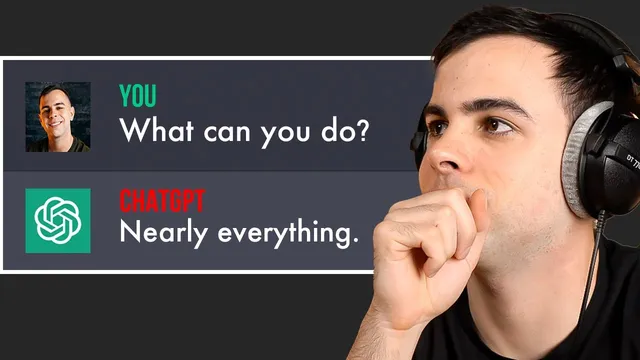
ChatGPT - Why You NEED To Be Using This!
Based on FromSergio's video on YouTube. If you like this content, support the original creators by watching, liking and subscribing to their content.
ChatGPT’s conversational text generation is positioned as immediately useful, with reported early adoption outpacing other major platforms’ initial growth timelines.
Briefing
ChatGPT’s rapid adoption signals a shift in how people search, learn, and produce text—especially for tasks that normally require multiple searches, drafts, or coding help. In the first week after launch, it reportedly surpassed a million users in under a week, outpacing other major platforms’ early growth timelines. The core appeal is straightforward: ChatGPT is a language model that generates human-like responses to text prompts, and it performs strongly across everyday questions, technical problem-solving, and content drafting.
One of the most immediate uses is treating ChatGPT like a “Google alternative” for planning and recommendations. For example, when planning a London trip, the tool can produce itinerary ideas and suggestions that the user can directly fold into a plan. It also works for gift ideas—especially when the user provides details about the recipient—while allowing quick iteration if the first recommendations miss the mark.
Programming is where the tool’s usefulness becomes more dramatic. ChatGPT can generate code and scripts based on natural-language instructions, walking through steps and producing full drafts that only require minor adjustments. The transcript claims some people have even built games and applications without prior coding knowledge. For learners, it can also function as a structured tutor: users can request projects to learn Python, then ask for progressively harder assignments as they improve.
Beyond creation, ChatGPT can reduce the time cost of consuming information. The transcript describes using it to summarize long articles from sources like Refinery and Hacker News by copying the full text into the chat and asking for a “TLDR” (too long then read). This turns lengthy reading into a faster scan of key points and insights, with the option to read the full piece only when something stands out.
Content creation is presented as the most controversial application because the outputs can be so polished that they resemble human writing. The transcript gives examples for stoicism: prompts can generate outlines, quirky introductions, and conclusions—effectively providing a strong first draft. Still, it draws a line between written text and video creation: even a good script outline doesn’t replace a creator’s personality and delivery, which the tool can’t replicate well.
Communication tasks are another practical win. ChatGPT can draft emails in different tones (e.g., polite or extremely formal) and can rewrite existing messages to match a desired style—useful for inspiration, though the transcript warns against blindly copying responses.
Several caveats temper the enthusiasm. ChatGPT can produce incorrect answers that aren’t always obvious, so students and academics should be cautious about plagiarism and factual reliability when using it for essays or research. While ChatGPT is free “for now,” the transcript argues that pricing is likely to change as compute costs rise, and it notes that other models such as DaVinci 3 are paid. Finally, it flags ongoing ethical and copyright concerns, especially as AI-generated art (e.g., DALL·E) and AI-written content scale.
A key clarification distinguishes ChatGPT from GPT-3: ChatGPT is portrayed as a smaller, conversation-focused model, while GPT-3 is described as more general-purpose and more customizable, with different integration options. The overall message is that ChatGPT is already reshaping workflows for planning, learning, summarizing, drafting, and communication—while demanding careful verification and responsible use.
Cornell Notes
ChatGPT is presented as a fast-growing language model that can generate human-like text for planning, learning, coding assistance, summarization, and drafting. It can replace parts of search for certain queries (itinerary ideas, gift recommendations) and help with programming by producing scripts and step-by-step guidance. It also speeds up reading by summarizing long articles when users paste the text and ask for a TLDR. For content creation, it can generate outlines and even quirky intros and conclusions, but the transcript argues it can’t replace a creator’s personality in video delivery. Despite the usefulness, it warns that outputs can be wrong, that students must avoid plagiarism and overreliance, and that pricing and ethics/copyright issues remain unresolved.
Why does ChatGPT’s early user growth matter for how people will use it?
In what ways does ChatGPT function as a “search alternative,” and where does it fit best?
How does ChatGPT help with programming and learning, according to the transcript?
What’s the transcript’s method for using ChatGPT to summarize long articles?
What’s the main concern about using ChatGPT for content creation?
What caveats and risks does the transcript emphasize before relying on ChatGPT?
Review Questions
- Which categories of tasks does the transcript claim ChatGPT improves most—search-like discovery, summarization, coding, or writing—and what example supports each?
- What specific risks does the transcript warn about for students and academics, and why do those risks matter?
- How does the transcript distinguish ChatGPT from GPT-3, and what implications does that distinction have for how people might use each model?
Key Points
- 1
ChatGPT’s conversational text generation is positioned as immediately useful, with reported early adoption outpacing other major platforms’ initial growth timelines.
- 2
For planning and recommendations, ChatGPT can produce itinerary ideas and gift suggestions, especially when users provide detailed context and iterate on prompts.
- 3
Programming help is a major strength: ChatGPT can generate scripts and code from instructions and provide step-by-step guidance that users can adjust.
- 4
ChatGPT can reduce reading time by summarizing long articles when users paste the text and request a TLDR of main points and insights.
- 5
Content drafting can be highly effective for written work (outlines, intros, conclusions), but the transcript argues human personality still matters for video delivery.
- 6
Outputs require verification: ChatGPT can be wrong in ways that aren’t always obvious, and students should avoid plagiarism and overreliance.
- 7
Free access may not last as compute costs rise, and ethical/copyright concerns remain active—especially for AI art and large-scale AI-written content.