Chatting with Glue - Close reading / Analysis / Note Taking
Based on Robert Haisfield's video on YouTube. If you like this content, support the original creators by watching, liking and subscribing to their content.
Conversation meaning comes from multiple channels—text plus tone, pacing, formatting, and interface structure—not just the literal words typed.
Briefing
A close reading of “Chatting with Glue” turns on a simple but consequential claim: conversation carries far more meaning than the words typed into it, and the design of chat interfaces can reshape how people think, remember, and build ideas together. Beyond tone, pauses, and gestures, the structure of messaging—threading, channels, formatting, and even visual cues—changes what participants notice and what gets lost. That matters because modern communication tools don’t just transmit thoughts; they actively steer attention, collaboration, and the trajectory of shared reasoning.
Chapter 1’s core themes focus on “channels of communication,” where information flows through multiple layers: text plus nonverbal signals like emphasis, pacing, and tone. It also argues that chat structure can “linearize” thinking, making conversations feel like a single stream even when real discussion meanders—splitting, returning, and revisiting earlier points. The permanence of a transcript versus the ephemerality of a live exchange becomes part of the argument: once messages are typed into a system, they can be “engraved” into a durable record, changing how people can revisit and reuse what was said.
The discussion then pivots to a set of guiding questions for reading and designing conversational systems: what in conversation enables effective thought; what computer-mediated conversation enables that face-to-face interaction does not; and how conversational design choices—Socratic seminars, dyads, small groups, broadcasting—alter outcomes. A key thread is that better thinking often emerges when participants respond in ways that extend each other’s ideas, not just when they exchange information. Explaining an idea functions as a forcing mechanism for clearer articulation, while the partner’s verbal or nonverbal feedback determines whether elaboration deepens shared understanding.
Chapter 2 sharpens the problem by treating conversations as “wandering” rather than linear. Ideas behave like building materials: bricks that can stack into small houses or scale into skyscrapers, but rarely along a straight predetermined path. The central challenge becomes legibility—how to capture topic shifts and returns without burying important remarks. Linear chat streams make it hard to revisit earlier points, while threaded systems can still fail to represent the full shape of discussion. Outlines and outliner-like structures offer a different affordance: they encode relations between ideas through hierarchy, and can add a time dimension via ordering and nesting. Yet outlines also have weaknesses: as discussions deepen, the topic can drift, and later nodes may no longer match the assumptions implied by the top-level framing.
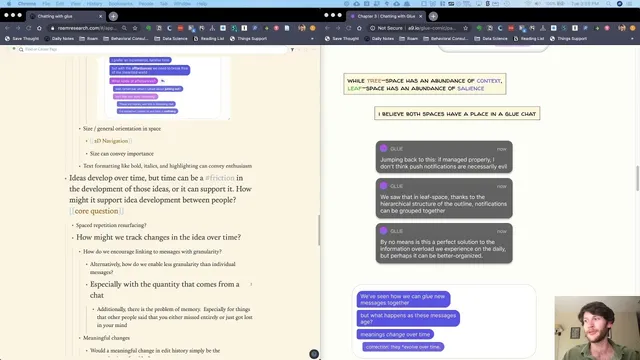
The notes culminate in a proposed interface metaphor for “glue” across time: separate “tree space” (a dense, navigable view of the whole conversation) from “leaf space” (a shallower, timeline-like view emphasizing what’s salient and new). The goal is to reduce information overload while preserving the context needed to catch up. The overall takeaway is not a final design, but a framework: conversational media should be judged by how well it supports attention, navigation, and the evolution of ideas—especially when quantity, group size, and time away create gaps that participants must bridge.
Cornell Notes
The discussion of “Chatting with Glue” argues that conversation meaning comes from more than typed words: tone, pacing, formatting, and interface structure all shape what people notice and how they think. Chat systems also affect the “shape” of thought—real conversations wander, but many interfaces present them as linear streams. Outlines and hierarchical structures can encode relationships between ideas and add a time dimension, yet they can also bury shifts in topic and assume later remarks still match earlier framing. To manage scale and catch-up, the notes propose splitting navigation into “tree space” (dense, whole-conversation structure) and “leaf space” (shallower, salience-focused timeline). The practical importance is designing chat tools that preserve context while making topic shifts legible.
Why does conversation carry more information than the literal text?
How can chat interfaces distort thinking?
What makes “wandering conversations” hard to represent?
What do hierarchical outlines add, and what do they risk losing?
Why split navigation into “tree space” and “leaf space”?
How do group size and organizational context change the design problem?
Review Questions
- What specific “channels of communication” besides text are highlighted as carrying meaning, and how do interface features amplify them?
- In what ways can outlines improve legibility of idea relationships, and in what ways can they mislead when conversations wander?
- How do “tree space” and “leaf space” each support catching up, and what trade-off does the split aim to solve?
Key Points
- 1
Conversation meaning comes from multiple channels—text plus tone, pacing, formatting, and interface structure—not just the literal words typed.
- 2
Chat interfaces can linearize thinking, masking how real discussions split, wander, and return to earlier topics.
- 3
Threading and channels help navigation, but they can still bury important remarks when topic shifts aren’t made legible.
- 4
Hierarchical outlines encode relations between ideas and can add a time dimension, yet deep nesting can assume continuity that conversations often don’t have.
- 5
A major design challenge is capturing topic shifts and returns in a way that remains scannable at scale.
- 6
Separating navigation into “tree space” (dense structure) and “leaf space” (salient, shallow timeline) targets the catch-up problem created by time away and information overload.
- 7
Group size changes the affordances required: what works for dyads or small groups may fail under organizational scale and higher message volume.