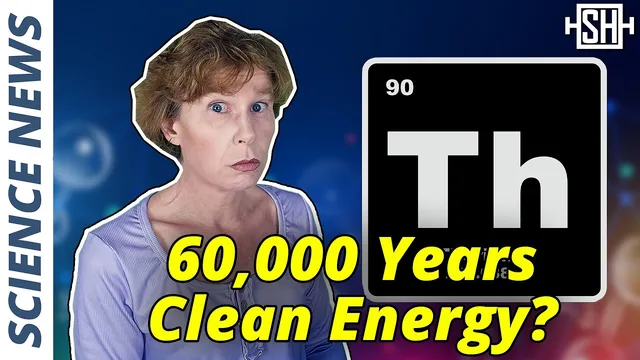
China Discovers 60,000-Year Supply of Thorium
Based on Sabine Hossenfelder's video on YouTube. If you like this content, support the original creators by watching, liking and subscribing to their content.
A declassified 2020 survey cited by the South China Morning Post links Bayan Obu mining waste in Inner Mongolia to an estimated 1 million tons of thorium.
Briefing
China’s reported discovery of a thorium supply large enough to power the country for roughly 60,000 years has reignited interest in a nuclear fuel that promises low-carbon electricity without the same weaponization pathways as conventional uranium. The claim traces back to a declassified 2020 survey cited by the South China Morning Post, pointing to the Bayan Obu mining complex in Inner Mongolia. The report says mining waste there could yield about 1 million tons of thorium, and it further claims China has identified more than 230 thorium sites—suggesting the country’s total reserves may be far larger than earlier estimates.
Thorium’s appeal rests on nuclear engineering fundamentals. Thorium is more abundant than uranium in Earth’s crust—about three to four times more—so the raw material base is potentially larger. It also cannot be used directly to trigger a chain reaction; reactors must start the process using another element, typically uranium. That requirement matters for proliferation: thorium is “not as readily used for nuclear weapons,” though it is not impossible with effort. The most touted advantage is fuel efficiency. In thorium-based reactor designs, the system can use essentially the entire fuel rather than only a small fraction, meaning more energy can be extracted from the same mass of thorium than from uranium in conventional setups.
The central question is whether the new reserve numbers translate into real-world power. The answer is “maybe,” but the bottleneck is technology, not geology. The thorium route discussed here relies on molten salt reactors, a design that can shut itself down automatically if cooling fails. Yet molten salts have historically been difficult: they are highly corrosive and can degrade materials quickly. Over the past several decades, researchers have tried to solve this with more corrosion-resistant alloys and by adjusting molten salt compositions, but the technology is still described as being in an exploration phase rather than a fully proven industrial standard.
Even if thorium is abundant, reactor design choices determine how much enriched uranium is needed. In pressurized water reactors—the dominant commercial technology—thorium would still require more enriched uranium to sustain the reaction, making it less attractive economically. In contrast, molten salt thorium systems operate in temperature and pressure ranges that improve efficiency and reduce reliance on scarce, expensive enriched uranium. That economic angle is sharpened by the fact that enriched uranium supply has been heavily tied to Russia.
China is already testing the approach. It has run a small thorium reactor for a few years at about 2 megawatts, and plans call for a larger 10-megawatt demonstration reactor with an operational target around 2030. After that, the pathway envisioned is scaling toward small modular reactors on the order of 100 megawatts.
Still, the 60,000-year framing depends on the accuracy and completeness of the underlying survey. The transcript notes that India’s estimated thorium supply is also around 1 million tons, and that China’s higher number may reflect more extensive surveying rather than a fundamentally different geology. Meanwhile, other countries—including the United States and the UK—have pursued thorium and molten salt experiments, but none have yet delivered a broad commercial breakthrough. Until corrosion-resistant materials, reactor durability, and fuel-cycle performance are fully demonstrated, thorium remains promising—but not revolutionary in practice.
Cornell Notes
China’s reported thorium find—about 1 million tons from mining waste at Bayan Obu in Inner Mongolia, plus more than 230 thorium sites—has fueled claims of a 60,000-year power supply. Thorium is attractive because it’s more abundant than uranium, is harder to use directly for weapons, and can be used far more completely in thorium reactor designs. The catch is that thorium typically requires a reactor setup that starts the reaction with another element (often uranium) and, in the designs discussed, relies on molten salt reactors. Molten salt systems have historically struggled with corrosive salts that damage reactor materials, though alloys and salt mixtures have improved. China’s small 2-megawatt test and planned 10-megawatt demonstration by around 2030 are key milestones, but the technology still isn’t fully proven at scale.
What exactly is the thorium claim tied to, and how is it being reported?
Why do thorium reactors get described as “more efficient” than uranium reactors?
How does thorium relate to nuclear weapons risk?
What is the main technical obstacle for molten salt thorium reactors?
Why does enriched uranium supply matter in the thorium conversation?
What milestones has China set for thorium reactor development?
Review Questions
- How do thorium’s abundance and fuel utilization advantages compare with the engineering challenges of molten salt reactors?
- What role does enriched uranium play in thorium reactor designs, and why does that affect economics and supply risk?
- What evidence would you look for to judge whether China’s thorium reserve numbers are comparable to other countries’ estimates?
Key Points
- 1
A declassified 2020 survey cited by the South China Morning Post links Bayan Obu mining waste in Inner Mongolia to an estimated 1 million tons of thorium.
- 2
China’s reported total includes more than 230 thorium sites, but differences in surveying effort could partly explain why other countries’ numbers look smaller.
- 3
Thorium is more abundant than uranium in Earth’s crust and can be used more completely in thorium reactor designs, potentially boosting energy yield per unit fuel.
- 4
Thorium cannot sustain a chain reaction by itself; reactors need a starter element, typically uranium, which affects both design and proliferation considerations.
- 5
Molten salt reactors are central to the thorium pathway discussed, but corrosive salts have historically damaged materials, leaving the technology not fully proven at scale.
- 6
China’s thorium program includes a 2-megawatt test reactor and plans for a 10-megawatt demonstration reactor targeted around 2030, with further scaling envisioned afterward.