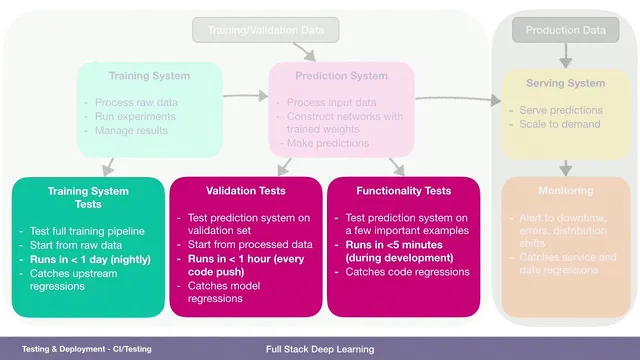
CI/Testing (3) - Testing & Deployment - Full Stack Deep Learning
Based on The Full Stack's video on YouTube. If you like this content, support the original creators by watching, liking and subscribing to their content.
CI runs unit and integration tests automatically on every repository push, typically before deployment.
Briefing
Continuous integration is the backbone of reliable machine-learning development: every time code is pushed, an automated pipeline runs tests (and often linting) before anything gets deployed. The core idea is straightforward—run unit tests for individual modules, run integration tests for the full system or key interfaces, and do it continuously so regressions get caught early rather than after deployment. In practice, “continuous” means triggering jobs on every commit to a repository, while “integration” means executing the full test suite that validates how components work together.
For teams building full-stack deep learning workflows, the transcript also ties CI to containerization, emphasizing that tests should run in a self-contained environment with pinned dependencies. Containerization packages the operating system, libraries, binaries, and the Python environment needed to run training and evaluation, reducing the “works on my machine” problem. That matters because ML pipelines are especially sensitive to environment drift—small differences in library versions or system packages can change training behavior, validation metrics, or even runtime stability.
On the tooling side, CI services typically integrate with GitHub, GitLab, or Bitbucket so that each push kicks off a job defined as code. Those jobs often run inside containers and may publish results to an artifact repository or dashboard for later inspection. The transcript contrasts common CI options by how they’re hosted and what they’re best suited for.
CircleCI and Travis CI are positioned as software-as-a-service approaches: they’re integrated directly with repositories and can start jobs automatically without requiring teams to manage infrastructure. CircleCI is noted as having a free plan that works well for solo practitioners. Jenkins and Buildkite, by contrast, are described as more flexible and infrastructure-friendly. Jenkins is characterized as “old-school” but still widely used, largely because it runs on servers teams install and manage themselves, making it highly configurable. Buildkite is presented as a newer option that can run agents either on the team’s own hardware, in the cloud, or in a hybrid setup.
That hybrid angle becomes important for long-running training system tests—especially those that require GPUs. The transcript suggests using self-managed GPU capacity for scheduled training tests so teams don’t pay cloud GPU rates every night just to run heavy validation. Buildkite’s pipeline-and-agent model is highlighted: a pipeline defines what should happen, agents can run wherever capacity exists, and results are reported back to a dashboard. For simpler setups, CircleCI is recommended as the easier on-ramp; for more advanced DevOps needs, Buildkite is framed as a strong fit.
Overall, the message is that dependable ML testing depends on two pillars: automated CI that runs unit and integration checks on every change, and containerized environments that make those checks reproducible across machines and time—especially when training and validation workloads are expensive and GPU-bound.
Cornell Notes
Continuous integration (CI) automates testing on every code push: unit tests validate individual modules, while integration tests validate the full system or critical interfaces. CI typically triggers jobs on repository commits and runs tests (often alongside linting) before deployment. Containerization supports reproducibility by packaging the operating system, libraries, binaries, and Python environment with pinned dependencies so training/validation behave consistently. CI tools differ mainly in hosting and infrastructure control: CircleCI and Travis CI are software-as-a-service, while Jenkins and Buildkite offer more configurability and can run GPU-heavy scheduled tests on self-managed hardware. This combination helps catch ML regressions early without environment-related surprises.
What’s the practical difference between unit tests and integration tests in a CI pipeline?
Why does containerization matter specifically for deep learning testing and deployment?
How do CI services like CircleCI and Travis CI typically connect to a code repository?
When does Jenkins become a better fit than a software-as-a-service CI tool?
What’s the advantage of Buildkite’s pipeline/agent model for GPU-heavy ML tests?
How should a team choose between CircleCI and Buildkite based on operational maturity?
Review Questions
- How would you design a CI test suite that includes both unit and integration tests for an ML system, and what would you expect each test type to catch?
- Explain how containerization reduces testing variability in deep learning pipelines. What components must be pinned to make results reproducible?
- Compare CircleCI/Travis CI with Jenkins/Buildkite in terms of hosting model and how that affects running GPU-heavy scheduled tests.
Key Points
- 1
CI runs unit and integration tests automatically on every repository push, typically before deployment.
- 2
Unit tests validate individual modules; integration tests validate the full system and key interfaces, including boundaries with external components.
- 3
Containerization packages pinned dependencies—operating system, libraries, binaries, and Python environment—to make ML tests reproducible.
- 4
CircleCI and Travis CI are software-as-a-service options that integrate with GitHub/GitLab/Bitbucket and trigger jobs on commits.
- 5
Jenkins runs on self-managed servers and is highly configurable, making it a long-standing choice for CI.
- 6
Buildkite’s pipeline and agent model supports hybrid execution, enabling GPU-heavy scheduled training tests on on-prem hardware to avoid recurring cloud GPU costs.
- 7
For solo or simpler setups, CircleCI is presented as a practical starting point; for more advanced DevOps and resource control, Buildkite is recommended.