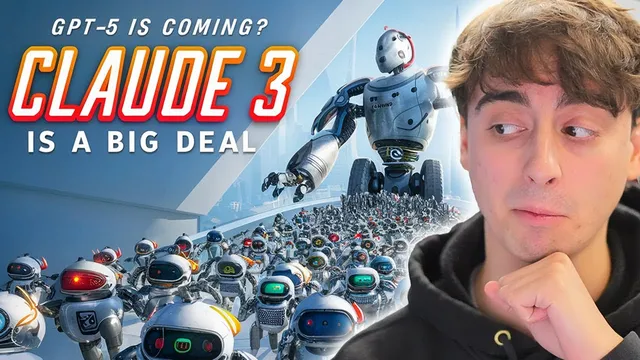
Claude 3 Opus is the best AI LLM - Open AI is Sweating?
Based on MattVidPro's video on YouTube. If you like this content, support the original creators by watching, liking and subscribing to their content.
Claude 3 is presented as outperforming GPT-4 on graduate reasoning, math, multilingual math, and coding, with Opus highlighted as the strongest tier.
Briefing
Anthropic’s Claude 3—especially the Opus model—lands with benchmark results that put it ahead of GPT-4 across key areas like graduate-level reasoning, math, multilingual math, and coding, while also matching or nearly matching GPT-4 on vision and long-context performance. The practical takeaway is that Claude 3 isn’t just “competitive”; it’s positioned as a stronger all-around option, with Haiku standing out for cost and Opus for capability.
Claude 3 arrives in three sizes: Opus (largest), Sonnet (middle), and Haiku (smallest). In reported evaluations, Opus beats GPT-4 on undergraduate knowledge, handily outperforms GPT-4 on graduate reasoning, and also scores higher on grade-school math and math problem solving. Multilingual math and coding are highlighted as major wins, including a large jump in a zero-shot coding metric (67% for GPT-4 versus 85% for Claude 3 Opus). Sonnet is described as close to GPT-4 in many areas, with Haiku just under GPT-4 levels in some tests—except coding, where the smaller models are still presented as strong.
Pricing and scale are where the smaller model story gets sharper. Haiku is framed as dramatically cheaper than GPT-3.5 and even GPT-4 Turbo, with claims that it’s roughly 40 times cheaper than GPT-4 Turbo while delivering nearly comparable performance. That leads to a community reaction that Anthropics’ smallest model could “kill” many alternatives by combining strong results with low cost.
Long-context handling also gets attention. Claude 3 is tied to claims of extremely high recall accuracy over 200,000-token contexts using a “needle in a haystack” evaluation, where a hidden text fragment is inserted into a massive document and the model must retrieve it. The discussion then pivots to the bigger question: if performance stays near-perfect at 200,000 tokens, what happens at inputs exceeding 1 million tokens—especially since all three Claude 3 models are said to accept inputs beyond that threshold.
Several live-style demonstrations reinforce the theme of tool use and agentic workflows. In an “economic analyst” scenario, Claude 3 Opus uses a web browsing tool to read GDP trend charts, then a Python interpreter to plot and validate estimates against real data, landing within about 5% accuracy. For broader world-economy analysis, it dispatches sub-agents in parallel—assigning different models to specific countries (US, China, Germany, Japan, etc.)—and then aggregates results into projections and visualizations for 2020 versus 2030.
Vision and document processing are showcased with Haiku’s ability to work directly from scanned images. Using the Library of Congress Federal Writers Project (Great Depression-era interview transcripts), the model is described as transcribing messy scans and producing structured JSON outputs with metadata such as titles, dates, and keywords, plus judgments about story and character appeal.
Finally, hands-on tests include image description comparisons (with Opus improving over Sonnet on a stylized logo) and a “pound of photons” math trick question that Claude 3 tackles using energy–mass equivalence. Overall, the message is clear: Claude 3—particularly Opus—pairs strong benchmark performance with practical tool-driven reasoning, and its agent dispatch plus long-context potential is framed as the kind of capability that could pressure OpenAI’s next moves.
Cornell Notes
Claude 3 arrives in three tiers—Opus, Sonnet, and Haiku—with reported benchmark results that place Opus ahead of GPT-4 in graduate-level reasoning, math, multilingual math, and coding. Haiku is emphasized for pricing, with claims it delivers near-GPT-4 performance while costing far less than GPT-4 Turbo. Long-context performance is highlighted via “needle in a haystack” recall tests at 200,000 tokens, alongside the claim that all three models can accept inputs exceeding 1 million tokens. Demonstrations focus on tool use: Claude 3 can browse web pages, run Python for plots and simulations, and dispatch multiple sub-agents in parallel for multi-country economic analysis. Vision is also a key pillar, with Haiku transcribing and extracting structured metadata from scanned archival documents.
What benchmark areas most strongly separate Claude 3 Opus from GPT-4 in the transcript’s reporting?
Why does Haiku’s pricing matter as much as its benchmark scores?
How does “needle in a haystack” relate to long-context reliability?
What’s distinctive about the economic-analysis demo beyond basic question answering?
How is vision capability demonstrated, and what output format is emphasized?
What do the hands-on image and math tests suggest about Claude 3’s strengths and limits?
Review Questions
- Which Claude 3 tier is positioned as best for coding and why (benchmarks vs pricing)?
- What does a “needle in a haystack” test measure, and what uncertainty remains when scaling from 200,000 to 1 million tokens?
- In the economic-analysis example, what tools and agent steps are used to move from web reading to projections?
Key Points
- 1
Claude 3 is presented as outperforming GPT-4 on graduate reasoning, math, multilingual math, and coding, with Opus highlighted as the strongest tier.
- 2
Claude 3 comes in Opus, Sonnet, and Haiku; Sonnet is described as close to GPT-4 in many areas, while Haiku is positioned as highly cost-effective.
- 3
Reported long-context performance includes very high recall accuracy at 200,000 tokens using a “needle in a haystack” evaluation, with claims of inputs exceeding 1 million tokens.
- 4
Claude 3’s tool-driven workflow is showcased through web browsing plus Python-based plotting and Monte Carlo-style simulation for GDP projections.
- 5
A standout capability in the demo is dispatching multiple sub-agents in parallel to handle multi-country analysis and then aggregating results.
- 6
Vision is emphasized via Haiku’s ability to transcribe and extract structured JSON metadata from scanned archival documents at scale.
- 7
Hands-on tests suggest Opus improves image understanding over smaller models, while highly nuanced factual domains can still produce errors.