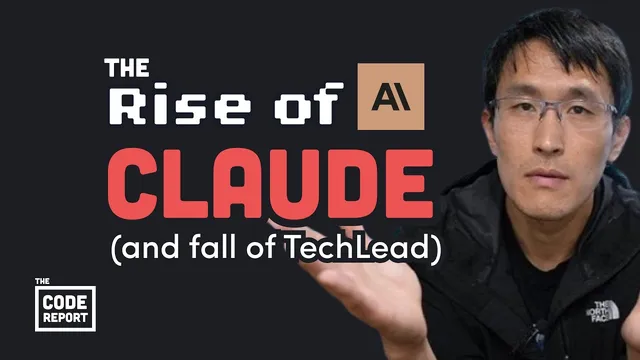
Claude crushed GPT-4o… and 13 other tech stories you missed in June
Based on Fireship's video on YouTube. If you like this content, support the original creators by watching, liking and subscribing to their content.
Figma added prompt-based UI generation and visual asset search, shifting design workflows from text-based retrieval to appearance-based discovery.
Briefing
June’s tech news cycle is dominated by a fast-moving AI arms race—new models, new tooling, and new hardware—while regulators, lawsuits, and platform wars keep turning the screws on big companies and creators.
Design and development workflows are getting an AI makeover. Figma rolled out AI tools that let users generate UI layouts from prompts and search for visual assets by appearance rather than just text in an artboard. That shift matters because it changes how designers retrieve components—moving from keyword-based searching to “find it by how it looks,” which can speed up iteration for everything from product mockups to thumbnails.
On the model side, Claude Sonnet 3.5 is positioned as a top choice for coding, with a standout feature called “artifacts” that saves code snippets individually so they can be assembled into a larger application. OpenAI then followed with “critic GPT,” a GPT-4-based model aimed at finding errors in GPT-4 code—an approach that treats code generation and code review as separate but connected steps. The demand for these tools is also reshaping the market: Nvidia briefly became the most valuable company in the world.
Hardware and compilers are joining the race. A startup called etched is described as burning the Transformer architecture onto silicon to boost inference speed, betting that Transformers will remain the dominant workload long enough to pay off. Intel is pushing a different angle with its “lunar L” chip—an x86 design aimed at much better power efficiency so it can run in laptops without overheating. Meta’s “LLM compiler” model adds another layer, built on Llama but trained on 546 billion tokens of LLVM IR and assembly code, raising the prospect of models that eventually help generate or even evolve programming languages.
Not all momentum is technical. Kaspersky antivirus was banned in the United States over alleged ties to Putin. Cloudflare faced a high-stakes extortion-style demand: a $120,000 upfront payment for an enterprise plan after a $250/month arrangement, with threats to take down domains within 24 hours—made more sensitive by the target site being an online casino.
Corporate and legal pressure also escalated. Adobe’s terms were criticized for claiming ownership of content created with Adobe products, and the company was also sued by the U.S. government for making subscriptions too hard to cancel. Apple took an EU hit tied to the Digital Markets Act, with a potential $30 billion fine. Meanwhile, YouTube creator Tech lead faced accusations of abusing the copyright system; the channel’s defenders frame the controversy as satire.
Even open-source and platform economics weren’t spared. A GitHub pull request to support an extremely old Node.js version drew heavy downvotes and suspicion about motives, including whether it was a backdoor or tied to paid maintenance via Tidelift. The “State of JS 2023” results reaffirmed React’s dominance, while spelling and Vue.js were noted as established holdovers. And YouTube’s ad strategy reportedly escalates: server-injected ads embedded directly into video files could make ad blockers less effective—an arms race that ends, at least in this telling, with viewers “eating” an ad even when blockers fail.
Cornell Notes
June’s biggest throughline is an AI acceleration across design tools, coding models, and underlying infrastructure—paired with rising legal and platform conflict. Figma added prompt-based UI generation and visual asset search, while Claude Sonnet 3.5 emphasized coding with “artifacts” that store snippets for later assembly. OpenAI’s “critic GPT” targets code quality by detecting errors in GPT-4 output. Hardware and systems work also advanced: etched aims to speed Transformer inference by burning the architecture onto silicon, Intel’s “lunar L” targets power-efficient x86 for laptops, and Meta’s LLM compiler model trains on LLVM IR and assembly to push compilation automation. These technical shifts are happening alongside bans, lawsuits, and ad-block countermeasures that affect users and creators directly.
What new capabilities did Figma add that change how designers search and build UI work?
Why does “artifacts” matter for Claude Sonnet 3.5’s coding workflow?
How does “critic GPT” fit into the coding pipeline described here?
What bets are being made on the future of AI compute—etched, Intel’s lunar L, and Meta’s LLM compiler?
Which non-AI developments show how regulation and platform power are shaping tech outcomes?
What controversy emerged around an open-source GitHub pull request for Node.js 0.4?
Review Questions
- Which specific features differentiate Claude Sonnet 3.5’s coding approach from a standard single-output LLM workflow?
- How do etched, Intel’s lunar L, and Meta’s LLM compiler each target different bottlenecks in running and building software with AI?
- What patterns connect the Cloudflare extortion story, Adobe’s subscription dispute, and YouTube’s ad-block countermeasures?
Key Points
- 1
Figma added prompt-based UI generation and visual asset search, shifting design workflows from text-based retrieval to appearance-based discovery.
- 2
Claude Sonnet 3.5’s “artifacts” supports modular coding by saving snippets individually for later assembly into a full application.
- 3
OpenAI’s “critic GPT” is positioned as a code-quality layer that searches for errors in GPT-4 output rather than generating code alone.
- 4
Etched’s silicon approach aims to speed Transformer inference by hard-wiring the architecture, while Intel’s “lunar L” targets power-efficient x86 laptop use.
- 5
Meta’s LLM compiler model trains on massive LLVM IR and assembly data, pushing toward more automated compilation and potentially language-level generation.
- 6
Regulatory and legal pressure escalated across the stack: Kaspersky’s U.S. ban, Cloudflare’s enterprise-payment dispute, Adobe’s content/subscription issues, and Apple’s EU Digital Markets Act exposure.
- 7
YouTube’s planned server-injected ads embedded into video files could make ad blockers less effective, intensifying the platform-versus-blockers arms race.