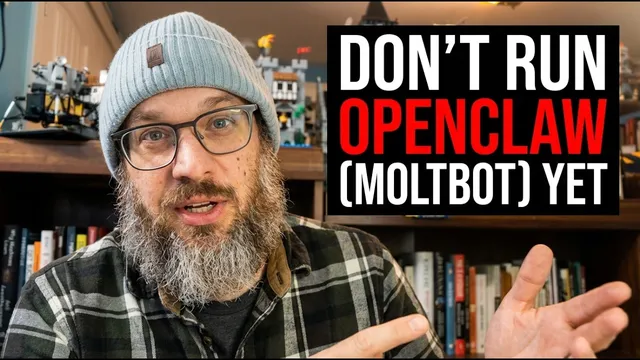
Clawdbot to Moltbot to OpenClaw: The 72 Hours That Broke Everything (The Full Breakdown)
Based on AI News & Strategy Daily | Nate B Jones's video on YouTube. If you like this content, support the original creators by watching, liking and subscribing to their content.
Moltbot’s appeal comes from agentic automation: it connects to messaging/email and can execute actions like browsing, form-filling, and code changes rather than only generating text.
Briefing
Local AI agents are surging from “chat” to “do,” and Moltbot—formerly Claudebot—has become the flashpoint. Tens of thousands of developers rushed to run it on Mac minis to grant an AI assistant root-level reach across messaging, email, browsers, and even code repositories. The demand is so intense that it’s rippling into mainstream tech markets: Cloudflare’s stock jumped more than 20% because Moltbot-style agents often rely on Cloudflare Tunnels to safely bridge a home network to the public internet.
Moltbot’s core pitch is straightforward: an AI assistant that runs on a user’s hardware, keeps conversation history and credentials local, and then orchestrates actions through apps people already use. It maintains websocket connections to messaging platforms such as WhatsApp, Telegram, Signal, and iMessage, then routes tasks to an LLM backend—commonly Claude, sometimes GPT-4—and can also use local models via Ollama. A growing library of “skills” gives it hands and feet: browser automation, file access, shell commands, and calendar integration. The architecture is “local first,” but not always “local only,” since intelligence may still be rented from Anthropic or OpenAI APIs.
The growth story is matched by a rapid security and operational collapse. Within 72 hours, trademark pressure forced a rebrand from Claudebot to Moltbot after Anthropics lawyers objected to the name’s similarity. During the rename, the old GitHub and X handles were released before the new ones were secured, leaving a roughly 10-second window in which crypto scammers grabbed both accounts. That led to fake Claude tokens on Solana—briefly reaching a $16 million market cap—along with a wave of scam accounts and speculators pressuring the founder to endorse tokens he never owned.
Security researchers then found deeper problems in the code and deployment patterns. Jameson O’Reilly of DVULN reported that Moltbot’s gateway authentication logic trusted local host connections by default. In common setups using a reverse proxy, outside traffic could be treated as local, potentially granting access to credentials, conversation history, and command execution. Scans reportedly found hundreds of exposed instances, including ones with open API keys and Telegram bot tokens, and at least one with Signal configured on a public server. Another researcher, Matt Vukoule, demonstrated a proof of concept using prompt injection via email integration that could extract a private key and seize control in under five minutes. Separate reporting from Slowmist described authentication bypasses that exposed hundreds of API keys and private conversation histories.
Even if individual bugs get patched, the underlying tension remains: agentic AI needs broad permissions to be useful, and broad permissions expand attack surface. Prompt injection is especially hard to defend against because LLMs can’t reliably distinguish instructions from content, meaning a crafted message could trigger credential forwarding or shell execution. The extensibility model—skills and marketplace downloads treated as trusted—also creates supply-chain risk.
The result is a split market reality. Moltbot’s power is real—users report autonomous problem-solving like securing a restaurant reservation by calling directly when OpenTable lacked availability, and building apps or automations that run overnight. But the same capabilities that enable creative recovery also make exploitation easier. The practical takeaway is blunt: only highly technical users should run it, with strong isolation and credential hygiene; most people should wait for better-funded products with enterprise-grade guardrails. Meanwhile, the Mac mini buying frenzy may be less about novelty and more about locking in personal compute before memory and hardware economics make local agent deployment harder to afford.
Cornell Notes
Moltbot (formerly Claudebot) is an open-source “local-first” AI agent that can connect to messaging and email, draft and triage content, automate browsers, and even run code—keeping conversation history and credentials on the user’s machine while orchestrating actions through LLM backends like Claude or GPT-4. Its popularity has surged, but security research and deployment reports show serious risks: authentication logic that can treat outside traffic as “local,” exposed API keys and tokens, prompt-injection paths to private-key theft, and a marketplace/supply-chain model that treats downloaded skills as trusted. The core lesson is that agentic AI’s usefulness depends on broad permissions, which inherently increases attack surface. That trade-off is why enterprises are likely to be safer than DIY open-source setups for most users.
What makes Moltbot different from a typical chatbot?
How does “local-first” work, and where does the dependency still remain?
Why did Moltbot’s name change from Claudebot happen so quickly?
What went wrong during the rebrand that enabled scams?
What were the most serious technical security findings reported by researchers?
Why is prompt injection such a structural problem for agentic systems?
Review Questions
- What does “local-first” guarantee for Moltbot, and what does it still leave dependent on external services?
- How can reverse proxies turn a “local host trusted” authentication assumption into a remote takeover risk?
- Why does agentic AI’s need for broad permissions make security boundaries harder to maintain than in traditional software?
Key Points
- 1
Moltbot’s appeal comes from agentic automation: it connects to messaging/email and can execute actions like browsing, form-filling, and code changes rather than only generating text.
- 2
“Local-first” keeps conversation history and credentials on the user’s machine, but many deployments still send queries to external LLM APIs unless users run local models like Ollama.
- 3
The Claudebot-to-Moltbot rebrand triggered a fast scam wave because old GitHub/X handles were released before new ones were secured, creating a brief window for account hijacking.
- 4
Security researchers reported serious flaws tied to authentication assumptions (trusting local host by default) and common deployment patterns (reverse proxies), leading to exposed credentials and command execution risk.
- 5
Prompt injection is a fundamental challenge for LLM-driven agents because attackers can embed hidden instructions inside content the agent receives.
- 6
The marketplace/skills model increases supply-chain risk when downloaded code is treated as trusted without meaningful moderation or isolation.
- 7
Most users should avoid connecting such agents to sensitive systems until stronger sandboxing, least-privilege controls, and enterprise-grade guardrails are standard.