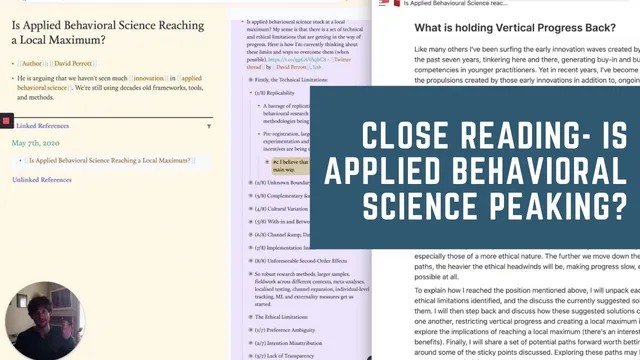
Close reading / commentary in Roam on "Is Applied Behavioural Science reaching a Local Maximum?"
Based on Robert Haisfield's video on YouTube. If you like this content, support the original creators by watching, liking and subscribing to their content.
Applied behavioral science can reach wide adoption without achieving deeper effectiveness if it keeps optimizing from evidence and methods that don’t translate well to real-world contexts.
Briefing
Applied behavioral science is stuck at a “local maximum” because the field keeps relying on decades-old tools and evidence, and the few promising paths forward run into a deeper bottleneck: technical fixes and ethical constraints collide, slowing progress even when each limitation has known solutions. Horizontal adoption is broad—marketing, UX, and management all use behavioral methods—but vertical progress stalls because the evidence base imported from academia often doesn’t translate cleanly into real-world settings, where context, incentives, and measurement realities differ.
A central thread is the mismatch between academic research goals and applied needs. Academic behavioral science tends to chase generalizable principles using representative samples and tightly controlled conditions. Applied work, by contrast, operates with specific populations and messy environments where context effects matter. That translation gap helps explain why practitioners may be “optimizing” from starting points that were never truly validated for the environments they’re trying to change.
The discussion then reframes the replication crisis as more than a publishing embarrassment—it directly threatens the credibility and trust that evidence-based practice depends on. Replicability problems are linked to small samples, outdated protocols, and questionable research practices such as p-hacking and cherry-picking. Even when replication efforts improve rigor, the underlying problem persists: studies often remove context to isolate variables, then fail to capture how interventions behave when deployed in the field. For practitioners, shaky evidence can waste time and money and can lead to harmful decisions built on faulty assumptions.
Beyond replicability, the field struggles with unknown boundary conditions—situations where an intervention works only under certain conditions. A concrete example is the energy-conservation approach popularized by Opower, which used social benchmarks comparing a household’s electricity use to neighbors. The intervention reduced energy use for people below the benchmark, but produced a “boomerang effect” for those above it, who then slackened. The key takeaway is that boundary conditions aren’t edge cases; they determine who benefits, who is harmed, and why.
The transcript also highlights a practical research gap: combinatory effects. In real deployments, interventions are rarely used in isolation; they’re stacked. Yet evidence on how interventions interact—whether they amplify each other, interfere, or produce crowding-out effects—is limited. The concern is that assuming “X works, Y works, so X+Y works” can be dangerous, especially when psychological mechanisms and incentives shift once multiple levers are pulled.
Finally, the “local maximum” framing ties these issues together as a system. Many technical limitations have proposed solutions, but the solutions don’t operate independently. Ethical constraints can intensify as technical ambition increases, and proposed resolutions can constrain one another—making effective innovation slow, costly, and difficult to scale. The path forward implied here is not abandoning behavioral science, but investing in better translation, stronger evidence practices, deeper boundary-condition research, and more rigorous study of intervention combinations—so the field can move beyond optimization of old assumptions and toward new, workable frameworks for real-world change.
Cornell Notes
Applied behavioral science has broad adoption but limited vertical progress because it keeps optimizing with evidence and methods that don’t reliably translate from controlled academic settings into complex real deployments. Replication problems, unknown boundary conditions, and weak understanding of how interventions interact all undermine confidence in “evidence-based” decisions. The transcript argues that technical fixes alone won’t break the bottleneck: ethical constraints and the way proposed solutions interact can create headwinds that slow innovation and produce a “local maximum.” Moving forward requires stronger translation from academia to practice, better incentives and open-science practices to improve replicability, and more rigorous research on boundary conditions and combinatory effects.
Why does broad adoption of applied behavioral science not automatically lead to better outcomes over time?
How does the replication crisis matter for practitioners, not just researchers?
What are “boundary conditions,” and why does the energy-benchmark example matter?
Why is studying combinatory effects of interventions harder—and why is it important?
What does it mean that limitations create a “system” that produces a local maximum?
How do academic goals differ from applied needs in behavioral science?
Review Questions
- What mechanisms link replication failures to reduced trust and worse decision-making in applied behavioral science?
- Using the energy-benchmark example, how would you identify likely boundary conditions before deploying a social benchmark intervention?
- Why might ethical constraints intensify as technical solutions become more ambitious, and how could that slow innovation even when each technical fix is known?
Key Points
- 1
Applied behavioral science can reach wide adoption without achieving deeper effectiveness if it keeps optimizing from evidence and methods that don’t translate well to real-world contexts.
- 2
Replication problems (small samples, outdated protocols, p-hacking, cherry-picking) directly threaten the credibility practitioners rely on for evidence-based decisions.
- 3
Academic research’s focus on generalizable principles and controlled conditions can create a translation gap when applied interventions face specific populations and messy environmental context.
- 4
Unknown boundary conditions can turn average successes into mixed or harmful outcomes, as illustrated by social benchmarking’s boomerang effect for above-benchmark households.
- 5
Interventions are usually combined in practice, but combinatory effects are under-studied; assuming additivity can be dangerous, including risks like crowding-out.
- 6
Progress can stall at a “local maximum” when technical and ethical constraints interact, making solutions that work in isolation harder to implement together.
- 7
Moving forward likely requires stronger translation, better evidence practices (including open-science style reforms), and more rigorous research on boundary conditions and intervention interactions.