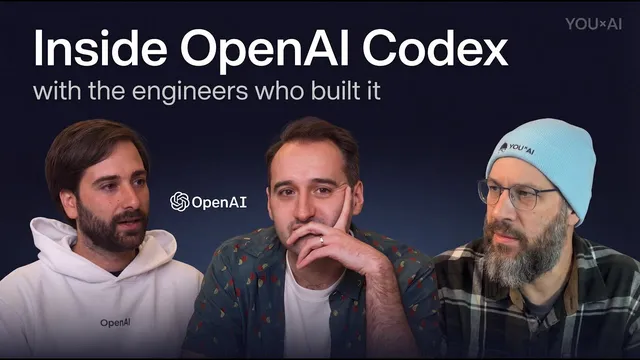
Codex 5.2 Launch Revealed: How OpenAI Got Non-Engineers Shipping Real Code
Based on AI News & Strategy Daily | Nate B Jones's video on YouTube. If you like this content, support the original creators by watching, liking and subscribing to their content.
Codex is used at OpenAI as an always-on PR review layer, a casual assistant for non-technical staff, and a power-user system for long-running multi-agent workflows.
Briefing
Codex is becoming an always-on layer of code review and “ambient intelligence” at OpenAI—so non-engineers can ship fixes and engineers get a safety net that catches subtle issues without adding review overhead. The practical shift isn’t just that more people can use AI; it’s that workflows blur across roles, with designers, copywriters, and other non-technical staff pulling up PRs, submitting changes, and iterating directly in the codebase.
Inside OpenAI, Codex usage falls into three patterns: mandatory review of PRs (even when developers don’t request it), casual use by staff outside engineering, and heavy “power user” workflows that run for hours and increasingly involve multi-agent loops. Designers describe a step-change in recent model capability that made Codex feel like a teammate rather than a tool you actively trigger. One engineer reportedly uses it for everything from note-taking to acting as a primary interface, while others post demos in Slack and move from “I didn’t need code” to “I couldn’t until a few months ago.” The result is a force multiplier: more people can contribute closer to implementation details, and small paper cuts get fixed faster.
A key operational detail is how OpenAI manages signal-to-noise. Codex is tuned to keep hit rates high so users don’t feel spammed or forced to engage with low-quality suggestions; the system is designed to be turn-off-worthy only in theory, not in practice. Designers also highlight that code review notifications became a loved feature because they arrive as helpful, legible guardrails—work that would otherwise be skipped due to time constraints.
OpenAI’s strategy for widening access goes beyond the terminal. Codex ships across multiple surfaces: an ID extension, a CLI product, and a web interface where enterprise-connected users can prompt for targeted changes (like updating UX copy) without needing to inspect code. Integrations such as Slack and Linear further support end-to-end workflows—turning small tickets into tracked tasks, PRs, and reviewable artifacts.
The conversation also frames a broader organizational change: job titles matter less than skill sets, and teams co-evolve their processes alongside the models. With code generation increasingly “solved” in sandboxed settings, the bottlenecks shift toward deployment, monitoring, and safe agent action in the real world. Safety and alignment remain unsolved for agents that can take consequential actions—deleting services or accessing user logs—so review and supervision become the near-term interface.
Finally, the discussion ties Codex to career and productivity economics. The equalizer effect is that access to powerful tooling reduces the cost of experimentation and learning-through-doing, while impact-based progression replaces credential-heavy gatekeeping. As models improve, OpenAI argues that evaluation should move from saturated, narrow benchmarks toward measures tied to economic value (citing GDPval) and real-world usefulness—because “useful work” keeps expanding from code generation into understanding, review, deployment support, and administrative automation.
Cornell Notes
Codex is positioned as an always-on teammate that changes day-to-day software workflows at OpenAI, including for non-engineers. Staff use it in three main ways: mandatory PR review, casual assistance across roles, and long-running “power user” agent workflows. OpenAI emphasizes high signal-to-noise so review suggestions feel helpful rather than noisy, and it expands access through multiple surfaces (IDE extension, CLI, and web prompts) plus integrations like Slack and Linear. As code generation becomes safer and more reliable in sandboxed contexts, the next bottlenecks shift toward deployment, monitoring, and safely supervising agents that can affect real systems. The broader organizational impact is a move toward impact-based progression and “learning through doing” rather than credential-first career paths.
What are the three distinct ways Codex is used at OpenAI, and why does that matter for workflow change?
How does OpenAI try to prevent Codex from becoming “noise” for developers?
Why does Codex’s availability across interfaces (IDE, CLI, web, integrations) matter for non-engineers?
What shifts from “code generation” to “code review” as the main interface for agents?
How does the transcript describe long-running agent memory and state management?
What does the discussion suggest about evaluating model progress beyond saturated benchmarks?
Review Questions
- Which Codex usage pattern (mandatory PR review, casual non-technical use, or long-running power-user workflows) best explains the “AI teammate” effect, and what concrete example supports it?
- What safety and alignment limitations remain when agents move from sandboxed code generation to deployment and on-call operations?
- How do compaction and file-based state help agents handle tasks that exceed a model’s context window?
Key Points
- 1
Codex is used at OpenAI as an always-on PR review layer, a casual assistant for non-technical staff, and a power-user system for long-running multi-agent workflows.
- 2
OpenAI emphasizes high signal-to-noise so Codex suggestions are trusted enough that users don’t feel spammed or forced to engage with low-quality output.
- 3
Access is widened through multiple surfaces—IDE extension, CLI, and web prompts—plus integrations like Slack and Linear to support end-to-end workflows.
- 4
As code generation becomes safer and more reliable in sandboxed environments, the bottlenecks shift toward deployment, monitoring, and safely supervising agents that can affect real systems.
- 5
Safety and alignment remain unsolved for agents that can take consequential actions (e.g., deleting services or accessing user logs), making review and steering central.
- 6
The transcript frames career progression as impact-based and “learning through doing,” with titles mattering less than demonstrated problem-solving.
- 7
Model evaluation should move toward economic or real-world usefulness metrics (e.g., GDPval) rather than relying only on benchmarks that can become saturated.