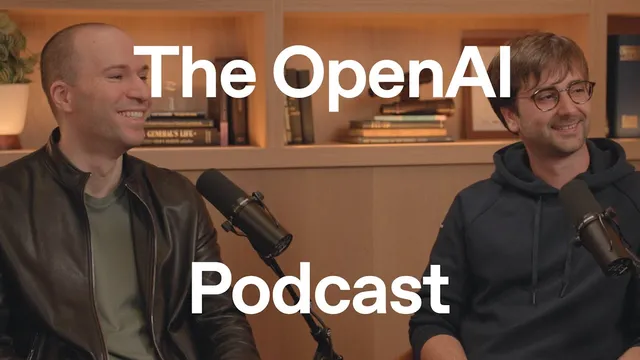
Codex and the future of coding with AI — the OpenAI Podcast Ep. 6
Based on OpenAI's video on YouTube. If you like this content, support the original creators by watching, liking and subscribing to their content.
AI coding is moving toward agentic systems that can execute work (run tools and tests), not just generate code snippets.
Briefing
AI coding is shifting from “smart autocomplete” to an agentic workflow where models are tightly coupled to tools, run code, and collaborate over hours—turning refactoring, debugging, and code review into delegated work rather than manual back-and-forth.
Greg Brockman and Thibault Sottiaux trace that change to a core lesson from early language-model coding: raw capability matters, but usefulness depends on the “harness”—the integration layer that lets a model act in an environment. In simple chat, a model can generate text. In coding, it must execute, iterate, and use tools. That harness includes the agent loop, tool access, and the way the system loops through tasks until tests pass or a change is complete. Sottiaux frames it as “body vs. brain”: the model supplies reasoning, while the harness supplies action.
Brockman connects the harness idea to product constraints that shaped how coding assistants evolved. For GitHub Copilot, latency became a non-negotiable feature: autocomplete-style interactions need to land within roughly 1,500 milliseconds. When smarter models can’t meet that timing, the solution isn’t abandoning them—it’s changing the interface and harness so slower intelligence can still deliver value. The result is a co-evolution of model and product design: faster models for quick turns, slower but deeper models for complex work.
That same logic drives the push toward multiple “form factors” for Codex. Early experiments included an async agentic mode that could keep running remotely after a user steps away, plus local and IDE-based experiences. The current direction aims to make one collaborator feel continuous across tools—terminal, IDE, and GitHub—rather than forcing developers to learn separate systems. Sottiaux describes Codex in GitHub as able to perform tasks like fixing bugs or moving tests by running work on OpenAI infrastructure, while IDE and terminal workflows offer different kinds of control and presentation.
A concrete example of agentic coding is Codex’s code review mode. Sottiaux says the bottleneck wasn’t just model accuracy; it was review bandwidth. The team built a high-signal review approach that checks whether the code matches the intended “contract,” digging through dependencies and raising findings that even strong human reviewers might miss. Brockman adds that once such tools cross a utility threshold, users stop treating them as noise and start relying on them—contrasting earlier auto-review attempts that felt net-negative.
The episode also spotlights GPT-5 Codex. Sottiaux describes it as optimized for the harness, designed to be more reliable and to “go on for much longer” on complex refactoring tasks—citing internal runs up to seven hours. The model is positioned as fast for simple questions but persistent for multi-step changes: plan, execute, run tests, and finish the refactor.
Looking toward 2030, both emphasize that the future won’t be “robots writing everything.” Instead, AI will handle the tedious parts while humans steer what matters. The bigger challenge becomes oversight at scale: how to keep trust when agents operate across systems, and how to ensure correctness. They also argue that progress will extend beyond coding into domains like medicine and materials, where AI can propose novel experiments or ideas that humans validate. Underneath it all sits a practical constraint: compute scarcity. The path forward depends on making intelligence cheaper and more efficient, and on placing compute closer to users to reduce latency—so agentic work can happen continuously without demanding unrealistic infrastructure.
Cornell Notes
The discussion frames modern AI coding as a shift from text generation to tool-using agents. A “harness” is central: it connects a model to tools, an agent loop, and execution so the system can run code, iterate, and complete tasks like refactors and debugging. Product design constraints such as latency shaped how assistants were deployed—fast autocomplete for quick turns, and different interfaces for slower but deeper models. GPT-5 Codex is presented as tightly coupled to this harness, optimized for reliability and long-running refactoring (reported up to seven hours internally). The long-term goal is steerable, safe multi-agent systems that humans supervise, with trust maintained through oversight and correctness techniques.
What does “harness” mean in AI coding, and why is it as important as model intelligence?
How did latency constraints shape the evolution from early coding assistants to today’s agentic workflows?
Why did the team experiment with different “form factors” (terminal, IDE, async remote agents) instead of picking one?
What makes Codex code review different from earlier “auto-review” attempts?
What is GPT-5 Codex optimized for, and what does “long-running refactoring” mean in practice?
How do the speakers connect agentic coding to safety and oversight?
Review Questions
- How does the harness change the user experience compared with a pure text-completion model?
- Why does latency drive different interface choices for coding assistants, and what’s the workaround when models are slower?
- What does “contract and intention” mean in the context of AI-assisted code review, and how does that reduce noise?
Key Points
- 1
AI coding is moving toward agentic systems that can execute work (run tools and tests), not just generate code snippets.
- 2
The harness—tools, agent loop, and execution infrastructure—is a decisive factor in whether model output becomes a usable collaborator.
- 3
Latency constraints (e.g., ~1,500 ms for autocomplete) force product designs that co-evolve with model capability.
- 4
Codex’s deployment strategy spans terminal, IDE, GitHub, and async remote execution to match different developer workflows.
- 5
High-signal code review succeeds when it validates intent/contract and crosses a utility threshold that avoids “noise” behavior.
- 6
GPT-5 Codex is positioned as tightly optimized for the harness, with reported ability to complete complex refactors over multi-hour runs.
- 7
The long-term challenge is steerable, safe oversight at scale, alongside compute-efficiency improvements under compute scarcity.