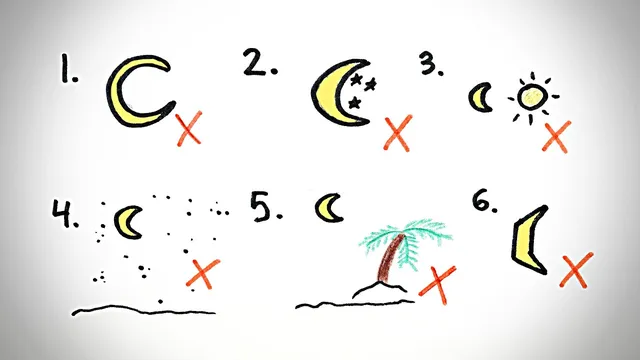
Common Moon Mistakes
Based on minutephysics's video on YouTube. If you like this content, support the original creators by watching, liking and subscribing to their content.
A realistic crescent or gibbous Moon’s outer unobstructed illuminated edge forms half a circle because the Moon is a sphere lit on half its surface.
Briefing
Moon illustrations keep getting the same physics wrong: the illuminated crescent’s shape, what can appear inside it, and how the Moon’s orientation and timing relate to the Sun and Earth. The biggest recurring error is treating the dark side of a crescent as if it were transparent—placing stars inside the crescent—when the Moon is a solid sphere and the unlit portion blocks distant objects.
A realistic crescent (and gibbous) Moon always has an outer, unobstructed illuminated edge that forms half a circle. That happens because the Moon is spherical and the Sun illuminates half the sphere; when viewed from different angles, the opposite points of the illuminated crescent still land on opposite points of the sphere. Only eclipses produce crescent shapes that don’t match the half-circle rule: during a lunar eclipse, Earth’s shadow can shorten the Moon’s illuminated portion, and during a solar eclipse, the Moon’s shadow can elongate the Sun’s apparent crescent.
The “stars inside the crescent” mistake fails for a simple reason: stars are much farther away than the Moon, so they would be blocked by the Moon’s body. If an artist wants something framed by the thin crescent, it should be something that wouldn’t be hidden by the Moon—like a cloud, a firefly, or even the International Space Station—or something that’s not actually “behind” the Moon, such as city lights on a colonized lunar surface in a sci-fi scenario. Otherwise, the crescent should not contain visible background stars.
Next comes orientation. The bright portion of the Moon must point toward the Sun, because the Sun is what lights the lunar surface. That also ties directly to phase and position in the sky: a fuller Moon appears when the Moon is on the far side of Earth from the Sun, while a thinner crescent appears when the Moon sits between Earth and the Sun. In practical terms, the thinnest crescent rises and sets almost together with the Sun.
Timing errors follow. A full Moon is opposite the Sun, so it rises at sunset, stays up all night, and sets at sunrise. But a crescent Moon is in the same part of the sky as the Sun, so it rises near dawn, stays up during the day, and sets near sunset—meaning “moon only at night” is usually wrong for crescents. A half Moon splits the difference, spending part of its time above the horizon during the day and part at night.
Finally, location matters. Because the Moon’s orbit is roughly aligned with Earth’s equator, the crescent’s apparent tilt depends on latitude: near the poles, crescents can look horizontally “cup-like,” while near the equator they tend to look more like a cup oriented differently. The Lion King is cited as an example where multiple mistakes stack up—an overly elongated crescent, a crescent shown in the middle of the night rather than moving with the Sun, and an orientation that fits North America more than equatorial Africa.
For a quick fix, the transcript recommends a simple real-world method: hold a ball outside on a sunny day in the same direction as the Moon relative to your position; its lighting from your perspective reveals the correct phase and appearance. Augmented reality astronomy apps can also supply the correct phase and placement. The same latitude-dependent orientation idea is noted for Jupiter’s stripes, which look horizontal near the poles and vertical near the equator.
Cornell Notes
Realistic Moon phases follow strict geometry: the illuminated edge of an unobstructed crescent or gibbous Moon forms half a circle because the Moon is a sphere lit on half its surface. The dark part is not transparent, so stars cannot appear “inside” a crescent; distant background light would be blocked by the Moon’s body. The bright side must always face the Sun, which determines both phase and sky timing: full Moons rise at sunset and set at sunrise, while crescents rise near dawn and set near sunset. Apparent crescent tilt also depends on latitude, since the Moon’s orbit is roughly aligned with Earth’s equator. These rules explain why some popular illustrations (including a cited Lion King scene) look physically inconsistent.
Why must the outer edge of a realistic crescent Moon be half a circle?
What’s wrong with drawing stars inside the dark portion of a crescent Moon?
How does the Moon’s phase determine when it rises and sets?
Why should the bright side of the Moon point toward the Sun in an illustration?
How can latitude change the apparent orientation of a crescent Moon?
What practical method helps artists get the correct Moon phase and look?
Review Questions
- If a crescent Moon is shown with visible stars inside its dark face, which physical rule is being violated and why?
- Describe how the Sun’s position relative to Earth determines whether a Moon phase should rise at sunset or near dawn.
- How would the apparent tilt of a crescent Moon differ between near the poles and near the equator, and what causes that change?
Key Points
- 1
A realistic crescent or gibbous Moon’s outer unobstructed illuminated edge forms half a circle because the Moon is a sphere lit on half its surface.
- 2
Stars cannot appear inside a crescent’s dark region in realistic art because the Moon blocks distant light.
- 3
The illuminated portion of the Moon must point toward the Sun in any accurate illustration.
- 4
Full Moons rise at sunset and set at sunrise, while crescent Moons rise near dawn and set near sunset because both phases track the Sun’s part of the sky.
- 5
The Moon’s apparent orientation (tilt) changes with latitude since the Moon’s orbit is roughly aligned with Earth’s equator.
- 6
Eclipses are the main exception to the half-circle crescent/gibbous edge rule, producing shortened or elongated crescent shapes via Earth’s or the Moon’s shadow.
- 7
A quick phase-check method is to use a ball outdoors in sunlight or an augmented reality astronomy app to match the current Moon phase.