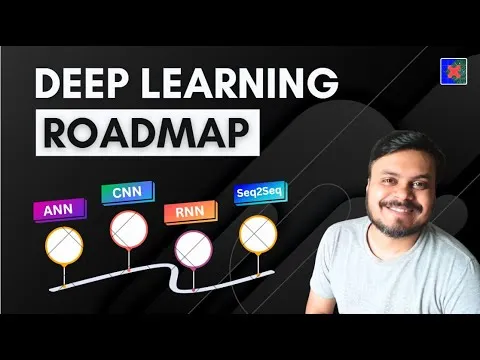
Complete Deep Learning Roadmap | CampusX
Based on CampusX's video on YouTube. If you like this content, support the original creators by watching, liking and subscribing to their content.
Start with linear algebra, optimization-focused calculus, probability/statistics, and Python fundamentals before attempting deep learning architectures.
Briefing
Deep learning is the foundational skill set behind today’s GenAI and LLM work—and the fastest path to becoming job-ready is a structured, six-month roadmap that starts with math and programming basics, then moves through neural networks, computer vision, sequence models, transformers, and finally unsupervised learning. The plan matters because it prevents the common trap of jumping straight into “LLM engineering” without understanding how training, optimization, and architectures actually work.
The roadmap begins by setting prerequisites that make deep learning learnable rather than mysterious. Learners are asked to build a working base in linear algebra (vectors, matrices, tensors, and how to manipulate them), calculus focused on optimization (differentiability and the math behind gradient-based learning), and probability/statistics basics (conditional probability, independent events, and the statistical ideas that show up when interpreting model outputs). Alongside these, basic Python skills are treated as non-negotiable: numerical arrays, data manipulation with pandas, and plotting with matplotlib. The creator also recommends a machine-learning playlist for math-for-ML and a separate linear-algebra playlist, plus Khan Academy-style explanations to fill gaps.
After prerequisites, the curriculum is divided into six parts. Part 1 covers Artificial Neural Networks: biological inspiration and history, perceptrons and multilayer perceptrons, activation functions (sigmoid/tanh/ReLU), forward propagation, loss functions, backpropagation, and gradient descent variants such as Adam, AdaGrad, and RMSProp. Part 2 focuses on improving neural networks when raw training underperforms—addressing vanishing/exploding gradients, then techniques like early stopping, regularization, dropout, weight initialization strategies, batch normalization, and hyperparameter tuning (learning rate, batch size, epochs, and architecture choices). Learners are encouraged to validate understanding through basic projects such as digit classification, customer churn prediction, sentiment analysis, and recommendation-style tasks.
Part 3 shifts to Convolutional Neural Networks for image and video data, explaining why CNNs outperform plain MLPs on vision tasks. It includes core operations (convolution, padding, stride), pooling, fully connected layers, common losses, training and preprocessing, data augmentation, and transfer learning using established architectures like LeNet, AlexNet, VGG, Inception, ResNet, and MobileNet. Part 4 optionally expands into computer-vision-adjacent topics like object detection, localization, segmentation, and generative models (autoencoders, variational autoencoders, GANs such as DCGAN), with a recommendation to do this only if targeting computer vision roles.
Part 4 then returns to sequence modeling with Recurrent Neural Networks: RNN architectures, training and backpropagation through time, and variants like LSTM and GRU, plus bidirectional RNNs. Part 5 is the centerpiece for GenAI: transformers. It starts with encoder-decoder and attention mechanisms (including additive and multiplicative attention), then builds to self-attention, positional encoding, multi-head attention, layer normalization, residual connections, and the full transformer training pipeline. The roadmap connects this to real LLM families—BERT, GPT, RoBERTa, ALBERT, and T5—then covers pretraining objectives (like masked language modeling and causal language modeling), fine-tuning, evaluation, and optimization.
Finally, Part 6 addresses unsupervised deep learning: autoencoders and GANs. The roadmap closes by listing practical tooling for the journey—TensorFlow/Keras or PyTorch, Hugging Face Transformers, experiment tracking (TensorBoard/MLflow), hyperparameter tuning (Keras Tuner/Optuna), deployment (FastAPI, Docker, Kubernetes, TF Serving, TorchServe), distributed training (DeepSpeed, PyTorch Lightning), and model/data resources (Hugging Face model hubs, TensorFlow Hub, PyTorch Hub, plus data versioning tools like DVC and DVC-like workflows). With this foundation, the creator argues learners can pivot into one of three career tracks: GenAI/LLM engineering, NLP engineering, or computer vision engineering.
Cornell Notes
The roadmap treats deep learning as the core foundation for GenAI and LLM work, so it starts with prerequisites (linear algebra, optimization-focused calculus, probability/statistics, and Python basics) before touching modern architectures. It then moves through six curriculum blocks: (1) Artificial Neural Networks with forward/backprop and gradient descent variants, (2) techniques to improve training (regularization, dropout, batch norm, initialization, hyperparameter tuning), (3) CNNs for vision with transfer learning, (4) RNNs for sequential data with LSTM/GRU, (5) transformers—the origin of today’s LLM ecosystem—covering attention, self-attention, pretraining and fine-tuning, and (6) unsupervised learning via autoencoders and GANs. The practical thread is building small projects and using the right tooling for training, tuning, deployment, and distributed compute.
What prerequisites does the roadmap require before starting deep learning, and why are they targeted?
How does the curriculum structure learning to avoid “theory without improvement” in neural networks?
Why are CNNs treated as a separate major block, and what concrete skills are included?
What’s the learning path from RNNs to transformers in the roadmap?
What does the transformer block include beyond architecture—covering training and deployment readiness?
Which tooling categories does the roadmap emphasize for real-world deep learning work?
Review Questions
- Which prerequisite topics (math and programming) does the roadmap treat as mandatory, and what deep learning concepts do they support?
- In what order does the roadmap teach neural network fundamentals, improvement techniques, and then architecture specialization (CNN/RNN/transformers)?
- What are the key transformer components and training ideas the roadmap lists, and how do they connect to LLM families like BERT and GPT?
Key Points
- 1
Start with linear algebra, optimization-focused calculus, probability/statistics, and Python fundamentals before attempting deep learning architectures.
- 2
Learn neural networks end-to-end first: forward propagation, loss functions, backpropagation, and gradient descent variants.
- 3
Treat training problems as part of the curriculum: vanishing/exploding gradients, regularization, dropout, batch normalization, and hyperparameter tuning.
- 4
Specialize by data modality: use CNNs for vision tasks and RNN/LSTM/GRU for sequential/text data.
- 5
Make transformers the centerpiece for GenAI by mastering attention, self-attention, positional encoding, and the pretraining/fine-tuning workflow.
- 6
Validate learning with small projects after each major block rather than only reading theory.
- 7
Use a practical toolchain for training, tuning, deployment, and scaling (frameworks, Hugging Face, TensorBoard/MLflow, Optuna/Keras Tuner, FastAPI/Docker/Kubernetes, DeepSpeed/PyTorch Lightning, and DVC).