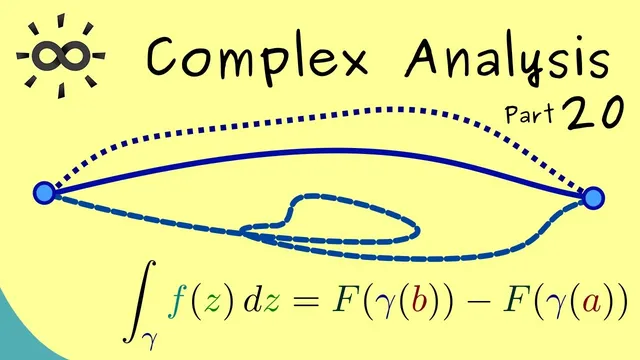
Complex Analysis 20 | Antiderivatives
Based on The Bright Side of Mathematics's video on YouTube. If you like this content, support the original creators by watching, liking and subscribing to their content.
A primitive F of f on U means F is holomorphic on U and satisfies F′(z)=f(z).
Briefing
Complex antiderivatives (also called primitives) let integrals in the complex plane be computed purely from endpoint values: if a holomorphic function f has a primitive F on a domain U, then the contour integral of f along any curve from a to b depends only on where the curve starts and ends, not on the path taken. Concretely, for a curve γ in U with γ(a)=z_start and γ(b)=z_end, the integral ∫_γ f(z) dz equals F(z_end)−F(z_start). This path-independence is the complex analogue of the real fundamental theorem of calculus, but it comes with the added strength that complex derivatives are more restrictive, making the existence of primitives a powerful structural condition.
The result is proved by combining the chain rule with the real fundamental theorem of calculus. Writing the complex line integral over a parametrized curve γ(t), the integrand becomes F′(γ(t))·γ′(t). Since F′ equals f, the integral reduces to an expression of the form ∫ d/dt[F(γ(t))] dt, which evaluates to F(γ(b))−F(γ(a)). A key corollary follows immediately: if the curve is closed (start and end points coincide) and f has a primitive on U, then the contour integral must be zero. In other words, primitives force “no net accumulation” around closed loops.
Examples sharpen the distinction between functions that look similar but behave differently around singularities. On U=ℂ\{0}, the function f(z)=1/z^2 has an antiderivative F(z)=−1/z. Because a primitive exists on the punctured plane, every closed contour integral of 1/z^2 is zero—even for loops that wind around the origin. By contrast, the function 1/z does not admit an antiderivative on ℂ\{0}. The earlier computation of the integral around a circle enclosing the origin gives ∮ 1/z dz = 2πi, which cannot be reconciled with the corollary that closed integrals would have to vanish if a primitive existed.
The logarithm clarifies the “almost” relationship. Although log(z) has derivative 1/z, it only works as a primitive on a smaller domain where the logarithm can be defined consistently—specifically, the complex plane with a branch cut along the negative real axis (excluding that axis, including 0). On such a slit domain, curves cannot enclose the origin in the same way, so the obstruction that produced the 2πi winding effect disappears. The takeaway is that isolated singularities matter: for 1/z, enclosing the singularity changes the integral by 2πi, while for 1/z^2 the integral remains zero. This special role of 1/z is highlighted as a central theme for later work on complex integration.
Cornell Notes
A complex primitive F for a holomorphic function f on a domain U satisfies F′(z)=f(z). Once such an antiderivative exists, contour integrals become endpoint computations: for any curve γ from z_start to z_end inside U, ∫_γ f(z) dz = F(z_end)−F(z_start). The path taken by γ is irrelevant. A corollary tightens this: if γ is closed and f has a primitive on U, then the integral must be 0. Examples show why domain matters near singularities: 1/z^2 has a primitive on ℂ\{0} so all closed integrals vanish, but 1/z does not because loops around 0 yield 2πi; log(z) becomes a primitive of 1/z only on a slit domain where the origin cannot be enclosed.
What is the complex analogue of the fundamental theorem of calculus for contour integrals?
Why must a closed contour integral vanish when a primitive exists?
How do 1/z^2 and 1/z differ on the punctured plane ℂ\{0}?
How can log(z) be an antiderivative of 1/z if 1/z has no primitive on ℂ\{0}?
What role does the domain’s geometry play near isolated singularities?
Review Questions
- State the formula relating a contour integral ∫_γ f(z) dz to a primitive F when F′=f on a domain U.
- Why does the existence of a primitive imply that every closed contour integral of f is zero?
- Explain, using the values 0 and 2πi, why 1/z and 1/z^2 behave differently on ℂ\{0}.
Key Points
- 1
A primitive F of f on U means F is holomorphic on U and satisfies F′(z)=f(z).
- 2
If f has a primitive on U, then ∫_γ f(z) dz depends only on the endpoints: it equals F(z_end)−F(z_start).
- 3
Any closed contour integral of f is 0 whenever f has a primitive on a domain containing the loop.
- 4
On ℂ\{0}, the function 1/z^2 has a primitive −1/z, so all closed integrals of 1/z^2 vanish.
- 5
On ℂ\{0}, the function 1/z has no primitive because a loop around 0 yields ∮ 1/z dz = 2πi.
- 6
The logarithm provides a primitive for 1/z only on a slit domain (complex plane minus the negative real axis), where loops enclosing 0 are not allowed.