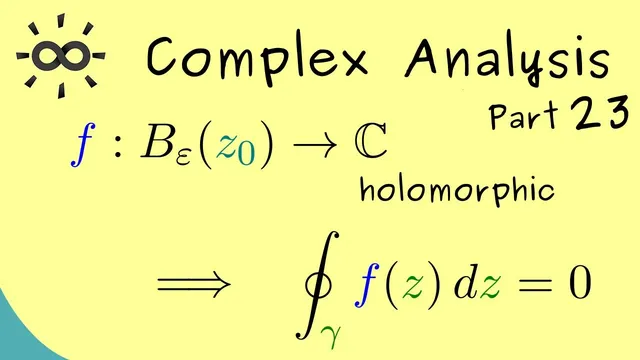
Complex Analysis 23 | Cauchy's theorem
Based on The Bright Side of Mathematics's video on YouTube. If you like this content, support the original creators by watching, liking and subscribing to their content.
Goursat’s theorem gives zero contour integrals for holomorphic functions around triangle boundaries when the triangle’s entire interior lies in the holomorphicity domain.
Briefing
Cauchy’s theorem is presented as a major strengthening of earlier results: once a holomorphic function lives on a region without “holes,” every closed contour integral inside that region collapses to zero. The discussion starts from a prior version of Cauchy’s theorem for simple shapes—triangles—where Goursat’s theorem guarantees that if a function is holomorphic on an open set and the entire triangle (including its interior) lies in that set, then the integral of the function around the triangle’s boundary is zero.
That triangle result is then extended systematically. Any quadrilateral can be split into two triangles, and because the boundary integral over the shared internal edge cancels, applying Goursat’s theorem twice yields a zero integral around the quadrilateral. The same logic scales to any polygon: finitely many triangles can triangulate a polygon, so repeated applications of the triangle case force the contour integral around the polygon boundary to vanish. This chain of generalizations highlights a key geometric requirement: the interior of the contour must stay entirely within the holomorphicity domain.
A limitation is also made explicit. Knowing the integral is zero for polygons does not automatically settle the case of a disk bounded by a circle; a circle’s interior is not automatically covered by the polygon argument unless one proves a stronger statement. That stronger statement is exactly Cauchy’s theorem in its “disk version.” Here the domain is an open disk, ensuring there are no holes and that any straight-line segment between points remains inside the region.
In the disk setting, the theorem claims that if f is holomorphic on an open disk D and γ is any closed curve lying entirely in D, then the contour integral ∮γ f(z) dz equals 0—even when γ is not polygonal (a circle is singled out as an example). The proof strategy is built around the existence of an antiderivative. If an antiderivative F exists with F′ = f, then closed contour integrals must be zero; so the task becomes constructing such an F.
The construction uses a path integral candidate: define F(z) by integrating f along a straight line from a fixed base point (chosen as 0) to z. The straight-line choice matters because it guarantees the segment stays inside the disk. To show F′ = f, the argument compares F(\tilde z) − F(z) to f(z)(\tilde z − z) using a difference quotient. The comparison reduces to integrals around a closed polygon formed by the two straight-line paths from 0 to z and 0 to \tilde z, plus the connecting segment between z and \tilde z. Since this polygon lies entirely in the disk, the earlier “closed polygon integral is zero” result applies, letting the difference quotient converge to f(z) as \tilde z → z.
Finally, the scope is clarified: the disk version works directly on disks, and it extends to entire functions (holomorphic on all of C) because any disk can be used as the local domain. The result is a clean route from holomorphicity plus geometric containment to the universal vanishing of closed contour integrals inside disk-shaped regions.
Cornell Notes
Cauchy’s theorem is established first by generalizing Goursat’s theorem from triangles to polygons: if a holomorphic function’s domain contains the entire interior of the shape, then the contour integral around the boundary is zero. The disk version then upgrades this to any closed curve inside an open disk, not just polygonal ones. The proof hinges on constructing an antiderivative F(z) by integrating f along straight line segments from a fixed base point to z; the disk geometry guarantees those segments stay inside the domain. By comparing F(\tilde z) − F(z) using a closed polygon made from two such segments plus a connector segment, the argument invokes the already-proved zero integral for polygons to show the difference quotient tends to f(z). Hence every closed contour integral in the disk vanishes.
Why does the triangle result (Goursat’s theorem) matter for later shapes like polygons?
What geometric condition is repeatedly required for contour integrals to vanish?
Why doesn’t the polygon result automatically settle the case of a circular contour bounding a disk?
How does the proof construct an antiderivative candidate, and why are straight lines essential?
How does the proof use a closed polygon to show F′(z)=f(z)?
Review Questions
- What containment condition on the contour’s interior is required for the zero-integral results to hold?
- How does triangulating a polygon reduce the problem to the triangle case?
- In the disk version proof, what role does convexity (straight-line segments staying inside the disk) play?
Key Points
- 1
Goursat’s theorem gives zero contour integrals for holomorphic functions around triangle boundaries when the triangle’s entire interior lies in the holomorphicity domain.
- 2
Polygon contour integrals become zero by triangulating the polygon into finitely many triangles and canceling integrals along shared internal edges.
- 3
The disk version of Cauchy’s theorem extends the zero-integral conclusion from polygons to every closed curve inside an open disk.
- 4
The proof constructs an antiderivative candidate F(z) by integrating f along straight line segments from a fixed base point to z.
- 5
Convexity of the disk ensures those straight-line paths and the connecting segment between points remain inside the domain, enabling the polygon argument.
- 6
Showing F′(z)=f(z) reduces to a difference quotient whose key term becomes an integral around a closed polygon, which is already known to be zero.
- 7
For entire functions (holomorphic on all of C), the disk argument applies on any disk, yielding the broader applicability of Cauchy’s theorem.