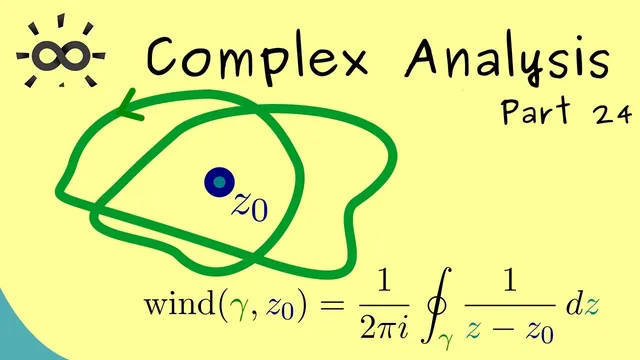
Complex Analysis 24 | Winding Number
Based on The Bright Side of Mathematics's video on YouTube. If you like this content, support the original creators by watching, liking and subscribing to their content.
Winding number counts net counterclockwise turns of a curve γ around a point z0, and it is defined only when z0 is not on the curve.
Briefing
Winding number turns “how many times a curve loops around a point” into a precise, computable integer using a complex contour integral. For a closed curve γ and a point z0 not lying on the curve, the winding number counts the net number of counterclockwise turns of γ around z0—positive for counterclockwise motion, negative for clockwise—capturing behavior that can be hard to see from geometry alone.
The idea starts with simple examples. A circle traced once counterclockwise around the origin completes one full rotation, giving winding number 1. Tracing the same circle twice corresponds to two counterclockwise turns and yields winding number 2. But the count depends on the chosen point: a curve that winds twice around one point may wind only once around another, because the angle made by the curve relative to that point increases and decreases along the path. The key takeaway is that “turning” is always defined relative to a specific complex number z0, and the point must not lie on the curve.
To measure turns systematically, the discussion connects geometry to the classic integral of 1/z. For a circle around the origin, the contour integral ∮γ (1/z) dz equals 2πi. If the same circle is traversed twice, the integral becomes 4πi. More generally, when a curve can be continuously deformed away from the origin without crossing it, Cauchy’s theorem implies the integral of 1/z over that curve is 0—matching the intuition that there are zero net turns around the origin.
This motivates the definition: the winding number of a curve γ around a point z0 is
wind(γ, z0) = (1/(2πi)) ∮γ 1/(z − z0) dz.
A change of variables shows this definition behaves exactly like the origin case, just shifted to the point z0. Although the definition is stated for general (piecewise continuously differentiable) curves, the crucial property is proved for closed curves.
The integrality of the winding number is then established. For a closed curve, one can rewrite each point on γ in polar form relative to the point z0 (after shifting so z0 becomes 0): γ(t) = ρ(t) e^{iφ(t)}, with real-valued, piecewise continuously differentiable functions ρ(t) and φ(t). Substituting this into the contour integral and applying the product rule causes terms to simplify, leaving two manageable integrals: one involving ρ′(t)/ρ(t) and another involving φ′(t). Because the curve is closed, ρ(b) = ρ(a), making the first integral vanish. The angle φ(t), however, need not return to the same value; it can differ by an integer multiple of 2π, say 2πk, since the curve ends at the same point in the plane. That forces the contour integral to equal 2πi·k, and dividing by 2πi yields wind(γ, z0) = k.
In short: winding number is an integer that encodes net turning, and it is computed directly from ∮γ 1/(z − z0) dz. That bridge between topology-like behavior (turning) and analytic machinery (contour integrals) sets up later results where winding number becomes a key tool.
Cornell Notes
Winding number converts the geometric question “how many net turns does a curve make around a point z0?” into an analytic quantity. For a piecewise continuously differentiable curve γ and a point z0 not on γ, the winding number is defined as (1/(2πi))∮γ 1/(z−z0) dz. For closed curves, this value is always an integer. The proof rewrites γ(t) in polar form relative to z0 as ρ(t)e^{iφ(t)}, substitutes into the integral, and simplifies using the product rule. Closure forces ρ(b)=ρ(a), while the angle φ can change by 2πk, producing wind(γ,z0)=k. This matters because it turns “net rotation” into a computable invariant for later contour-integral theorems.
Why does the winding number depend on the chosen point z0, and what restriction is required for z0?
How do simple circle examples motivate the integral definition of winding number?
What is the precise definition of wind(γ, z0) for a curve γ around a point z0?
Why is wind(γ, z0) guaranteed to be an integer when γ is closed?
What role do the functions ρ(t) and φ(t) play in the proof?
Review Questions
- For a closed curve γ and a point z0 not on γ, what is the formula for wind(γ, z0) in terms of a contour integral?
- In the polar-form proof, which endpoint condition makes the ρ′(t)/ρ(t) contribution vanish, and why must φ(b)−φ(a) be a multiple of 2π?
- How do Cauchy’s theorem and the integral of 1/(z−z0) relate to the intuition of “zero net turns” around z0?
Key Points
- 1
Winding number counts net counterclockwise turns of a curve γ around a point z0, and it is defined only when z0 is not on the curve.
- 2
For piecewise continuously differentiable curves, wind(γ, z0) is defined as (1/(2πi))∮γ 1/(z−z0) dz.
- 3
A single counterclockwise loop around the origin gives ∮γ (1/z) dz = 2πi, matching winding number 1.
- 4
Traversing a loop multiple times scales the integral accordingly, producing integer winding numbers.
- 5
For closed curves, wind(γ, z0) is always an integer because the polar angle can change only by 2πk when the curve returns to the same point.
- 6
The proof uses γ(t)=ρ(t)e^{iφ(t)} and simplifies the contour integral via the product rule, with closure forcing ρ(b)=ρ(a).