Complex Analysis 26 | Keyhole contour
Based on The Bright Side of Mathematics's video on YouTube. If you like this content, support the original creators by watching, liking and subscribing to their content.
A keyhole contour integral is zero for a function holomorphic on a punctured disk, provided the contour avoids the singularity at 0.
Briefing
A keyhole contour integral around an isolated singularity collapses to a simple statement: for a function holomorphic on a punctured disk, the contour integral around a large circle equals the contour integral around any smaller circle centered at the singularity (with the correct orientation sign). That invariance is the technical lever needed to prove Cauchy’s integral formula in the next step.
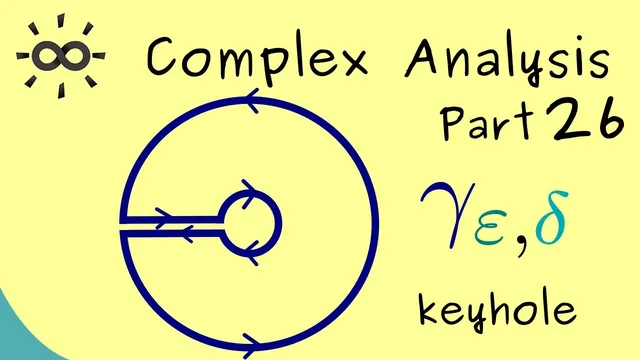
The setup starts with a holomorphic function G on the disk of radius R centered at 0, except for one problematic point at 0. A “keyhole contour” is then drawn inside this punctured disk: an outer circle, two radial line segments (forming the sides of the keyhole), and an inner circle around the singularity. The contour is parameterized by ε, the radius of the inner circle, and by Δ, the angular width of the keyhole. For any fixed ε and Δ, Cauchy’s theorem (from the previous part) implies that the integral of G around the entire closed keyhole contour is zero, regardless of how the keyhole is oriented or shaped.
The argument then focuses on what happens as the keyhole narrows: send Δ → 0. The key move is to split the keyhole contour integral into four pieces corresponding to the outer arc (γ1), the first radial segment (γ2), the inner arc (γ3), and the second radial segment (γ4). Since the total sum is always zero, each piece’s limiting behavior can be tracked.
As Δ → 0, the two radial segments squeeze together and the outer arc piece γ1 approaches the full outer circle integral. More precisely, the difference between the outer arc and the full circle becomes an integral over a vanishingly small arc; a standard estimate bounds it by (max|G| on the relevant curve) times the arc length, and the length goes to 0 with Δ.
A parallel limit applies to the inner arc γ3: as Δ → 0, it also converges to the full inner circle integral of radius ε. The only change is orientation—because the inner arc is traversed in the opposite direction relative to the outer circle when the keyhole is closed.
What about the two radial segments γ2 and γ4? As Δ → 0, they form a shrinking “closing” boundary (conceptually like a thin rectangle). Cauchy’s theorem makes the integral over the resulting closed boundary vanish, and the remaining contributions from the added small sides go to 0 by the same max|G| × length estimate. Consequently, the radial segments become irrelevant in the limit.
Putting these limits together yields the central identity: the integral of G over the outer circle equals the integral of G over the inner circle, but with a minus sign coming from the opposite orientation. The conclusion is powerful because it requires only holomorphicity on the punctured disk (one isolated exception at 0), and it allows choosing the radius freely—exactly what’s needed to derive Cauchy’s integral formula next.
Cornell Notes
For a function G holomorphic on a disk except for a single singularity at 0, integrals over circles centered at 0 become radius-invariant. Using a keyhole contour (outer arc + two radial segments + inner arc), the total contour integral is zero by Cauchy’s theorem. Narrowing the keyhole by letting the angular width Δ → 0 shows that the radial segments contribute nothing in the limit, while the outer and inner arcs each converge to full circle integrals. Because the inner circle is traversed with opposite orientation, the limiting relation includes a minus sign. This invariance lets one replace a large circle by any smaller one, a crucial step toward Cauchy’s integral formula.
Why does the keyhole contour integral equal zero before taking any limits?
What happens to the outer arc contribution as the keyhole narrows (Δ → 0)?
How do the inner arc and orientation affect the limiting relation?
Why do the two radial segments become irrelevant when Δ → 0?
What is the final takeaway identity and what does it mean?
Review Questions
- In the Δ → 0 limit, which parts of the keyhole contour survive, and which parts vanish? Why?
- Where does the minus sign in the relation between the outer and inner circle integrals come from?
- What estimate is used to show that integrals over shrinking arcs go to 0, and what quantity tends to 0?
Key Points
- 1
A keyhole contour integral is zero for a function holomorphic on a punctured disk, provided the contour avoids the singularity at 0.
- 2
Splitting the keyhole contour into outer arc, two radial segments, and inner arc makes the limiting analysis manageable.
- 3
As the angular width Δ → 0, the outer arc integral converges to the full outer circle integral because the missing piece is a shrinking arc.
- 4
As Δ → 0, the radial segments contribute nothing in the limit; they can be absorbed into a shrinking closed boundary whose integral vanishes.
- 5
The inner arc integral also converges to a full inner circle integral, but opposite traversal direction introduces a minus sign.
- 6
The resulting radius-invariance (up to orientation) of circle integrals is the key step toward Cauchy’s integral formula.