Complex Analysis 27 | Cauchy's Integral Formula
Based on The Bright Side of Mathematics's video on YouTube. If you like this content, support the original creators by watching, liking and subscribing to their content.
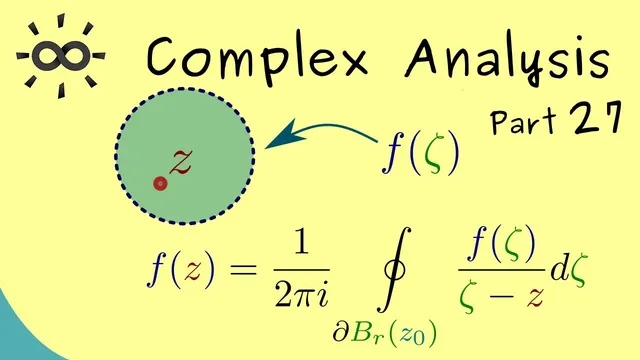
Cauchy’s integral formula reconstructs f(z) for any interior point z from an integral of f(ζ)/(ζ−z) over the boundary circle ∂B_r.
Briefing
Cauchy’s integral formula turns the “zero integral” behavior of holomorphic functions into a precise reconstruction rule: for a holomorphic function on a domain containing a closed disk, the value at any interior point is determined entirely by the function’s values on the boundary circle. That matters because it sharply limits how much freedom holomorphic functions can have—knowing them on a curve fixes them everywhere inside.
The setup starts with a holomorphic function f on an open domain D. Choose a disk B_r(0) whose closure sits inside D, so the boundary circle stays away from the domain’s boundary. Let γ be the positively oriented boundary of that disk (the circle), which winds once around any point z inside the disk. Cauchy’s formula then states that for every point z in B_r(0), the function value f(z) can be computed by an integral over the circle:
f(z) = (1/(2πi)) ∮_γ f(ζ)/(ζ − z) dζ.
Equivalently, using the common shorthand ∮_{∂B_r} for the boundary circle, the same rule applies: the integral of f(ζ)/(ζ−z) around the circle produces exactly 2πi times f(z).
The proof strategy leans on a key tool from earlier work: constructing an auxiliary function with a removable singularity and then applying the “integral around closed curves is zero” principle. A slightly larger radius R̃ is chosen so that the closed disk of radius R̃ still lies inside D. Then an auxiliary function G is defined by
G(ζ) = f(ζ)/(ζ − z),
where the only problematic point is ζ = z. With the domain enlarged, the contour integrals can be handled cleanly.
Next comes the contour manipulation. Instead of integrating around the large circle centered at 0, the argument uses the earlier “keyhole contour” idea: the integral around the big circle can be related to integrals around a smaller circle that encloses the singularity at ζ = z, with a small radius ε (chosen less than r). This reduces the problem to analyzing what happens near the singularity.
To make the integral computable, the numerator is split by adding and subtracting f(z):
f(ζ) = (f(ζ) − f(z)) + f(z).
This yields two integrals. The second one is straightforward because f(z) is constant: its integral gives 2πi·f(z). The first integral involves the difference quotient (f(ζ) − f(z))/(ζ − z). Since f is complex differentiable at z, that quotient stays controlled, and the standard estimate for contour integrals shows the contribution from this term shrinks to 0 as ε → 0 (the circle’s length scales like 2π·ε). With the “error” term vanishing, only the constant term remains.
The result is Cauchy’s integral formula itself, derived with minimal extra machinery because the earlier theorem about holomorphic functions and closed-curve integrals already did most of the heavy lifting. The payoff is substantial: once f(z) is fixed by boundary data, holomorphic functions become rigid—setting the stage for powerful consequences in the next topic.
Cornell Notes
Cauchy’s integral formula says that if f is holomorphic on a domain D containing a closed disk B_r(0), then every interior value f(z) is determined by an integral over the boundary circle. For z inside the disk, f(z) equals (1/(2πi)) times the contour integral of f(ζ)/(ζ−z) around the positively oriented circle ∂B_r. The proof introduces an auxiliary function G(ζ)=f(ζ)/(ζ−z), which is holomorphic everywhere except at ζ=z. By shrinking the contour around the singularity (using a keyhole-contour idea) and splitting f(ζ) into (f(ζ)−f(z))+f(z), one term becomes 2πi·f(z) while the remaining term goes to 0 as the small radius ε→0. This rigidity is why holomorphic functions have so little freedom.
What does Cauchy’s integral formula actually compute, and what input data does it require?
Why is the winding number around z relevant?
How does the proof use an auxiliary function, and where is the singularity?
What contour change makes the calculation easier?
Why does splitting f(ζ) into (f(ζ)−f(z))+f(z) help?
What role does the limit ε→0 play in the proof?
Review Questions
- State Cauchy’s integral formula precisely, including the factor (1/(2πi)) and the integrand.
- In the proof, what happens to the integral involving (f(ζ)−f(z))/(ζ−z) as ε→0, and why?
- Why is it necessary that the closure of the disk lies inside the domain D?
Key Points
- 1
Cauchy’s integral formula reconstructs f(z) for any interior point z from an integral of f(ζ)/(ζ−z) over the boundary circle ∂B_r.
- 2
The domain condition requires the closed disk to lie inside D so the contour never touches the boundary of the holomorphic region.
- 3
The proof uses an auxiliary function G(ζ)=f(ζ)/(ζ−z), which is holomorphic except at the singularity ζ=z.
- 4
A keyhole-contour step replaces integration over a large circle with integration over a smaller circle around ζ=z.
- 5
Splitting f(ζ) into (f(ζ)−f(z))+f(z) isolates a constant term that directly yields 2πi·f(z).
- 6
Complex differentiability at z ensures the remaining difference-quotient term becomes negligible as the small radius ε tends to 0.
- 7
The final result shows holomorphic functions are rigid: boundary data on a circle determines interior values exactly.