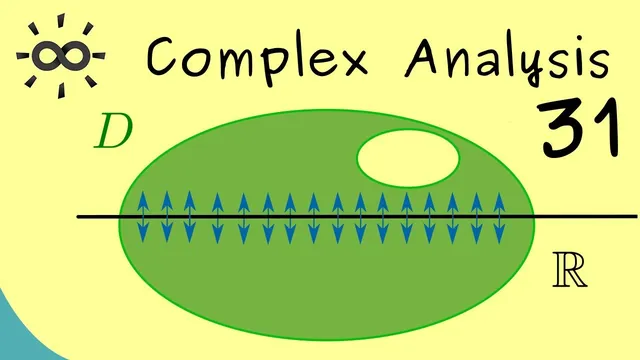
Complex Analysis 31 | Application of the Identity Theorem
Based on The Bright Side of Mathematics's video on YouTube. If you like this content, support the original creators by watching, liking and subscribing to their content.
The identity theorem states that two holomorphic functions on a connected open set D that agree on a set with an accumulation point in D must be identical on all of D.
Briefing
The identity theorem doesn’t just prove two holomorphic functions must match—it also forces uniqueness when extending real functions into the complex plane. If two holomorphic functions agree on a set with an accumulation point inside a connected open domain, they must be identical everywhere on that domain. That principle becomes a practical tool: once a real function is known on the real line and a holomorphic extension exists on a complex domain that touches the real axis, there is no freedom left in how the extension can look.
A concrete example uses the cosine function. Cosine is first treated as a real function defined on ℝ via its standard power series, with coefficients (−1)^k/(2k)! and only even powers of x. This series defines a C∞ function on ℝ. Now consider any holomorphic function G defined on an open connected set D ⊂ ℂ that intersects the real line (so D ∩ ℝ is non-empty). If G agrees with cosine on D ∩ ℝ, then the identity theorem applies because D ∩ ℝ contains accumulation points in D. The result is decisive: G must coincide with the same power series representation throughout D. In particular, extending cosine to the entire complex plane forces the unique holomorphic extension given by the usual cosine power series—there is no alternative holomorphic continuation consistent with the real-axis values.
The same logic generalizes beyond cosine. Start with any C∞ function f on ℝ, and choose a connected open set D in ℂ that intersects ℝ. If there exists a holomorphic function G on D whose restriction to D ∩ ℝ equals f’s restriction there, then G is unique. In other words, any holomorphic extension of f from the real line into such a complex domain is determined completely by the values on the real-axis slice.
This uniqueness matters because many important real functions are defined by power series. When f is given by a power series on ℝ, the corresponding power series automatically defines a holomorphic function on ℂ, and the identity theorem guarantees that any holomorphic extension matching f on the real line must be exactly that one. The takeaway is less about computing new functions and more about eliminating ambiguity: once a holomorphic extension exists under the identity theorem’s conditions, its form is fixed.
With this chapter closed, the focus shifts toward the residue theorem, a tool designed to compute difficult complex integrals—an application area where having rigid analytic structure from results like the identity theorem becomes especially valuable.
Cornell Notes
The identity theorem implies a strong uniqueness principle for holomorphic extensions. On a connected open set D ⊂ ℂ, if two holomorphic functions agree on a subset with an accumulation point in D, then they agree everywhere on D. Applying this to cosine, the real cosine function defined by its even-power series has a unique holomorphic extension: any holomorphic G on D that matches cosine on D ∩ ℝ must equal the same power series on all of D. More generally, if f is C∞ on ℝ and D is connected open with D ∩ ℝ ≠ ∅, then any holomorphic extension G of f to D is unique. For power-series-defined functions on ℝ, the complex power series provides that unique holomorphic continuation.
What exact condition forces two holomorphic functions to be identical on a connected open set?
Why does cosine have no “alternative” holomorphic extension once it matches on the real axis?
What role does the intersection D ∩ ℝ ≠ ∅ play in the extension argument?
How does the identity theorem generalize the cosine example to an arbitrary C∞ function on ℝ?
Why do power series on ℝ automatically determine the holomorphic extension on ℂ?
Review Questions
- In the identity theorem, why is an accumulation point inside D essential rather than just infinitely many agreement points?
- For a connected open set D that intersects ℝ, what does the identity theorem say about the number of holomorphic extensions of a given C∞ function f on ℝ?
- How does the cosine power series (even powers with coefficients (−1)^k/(2k)!) lead to uniqueness of its holomorphic extension?
Key Points
- 1
The identity theorem states that two holomorphic functions on a connected open set D that agree on a set with an accumulation point in D must be identical on all of D.
- 2
To extend a real function into ℂ, the complex domain D must intersect the real line so there is a real-axis agreement set.
- 3
For cosine, any holomorphic function G on D that matches cosine on D ∩ ℝ must equal the cosine power series on all of D.
- 4
A C∞ function f on ℝ has at most one holomorphic extension to any connected open set D ⊂ ℂ with D ∩ ℝ ≠ ∅.
- 5
When a real function is defined by a power series, the corresponding complex power series gives the unique holomorphic continuation consistent with the real-axis values.