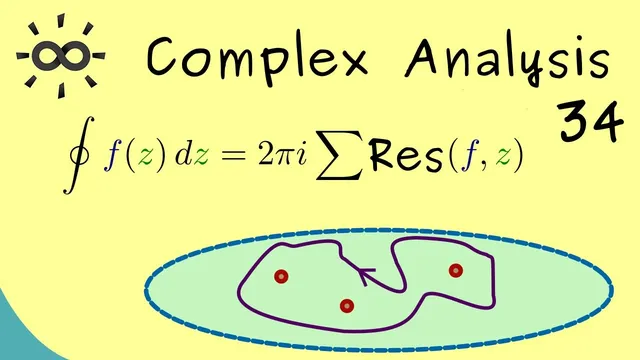
Complex Analysis 34 | Residue theorem
Based on The Bright Side of Mathematics's video on YouTube. If you like this content, support the original creators by watching, liking and subscribing to their content.
For a holomorphic function with an isolated singularity z0, the contour integral around any sufficiently small circle enclosing only z0 equals 2πi times Res(f,z0).
Briefing
Residue theorem turns contour integrals of holomorphic functions with isolated singularities into a bookkeeping problem: the integral around a closed curve is determined entirely by the residues at those singularities, weighted by how many times the curve winds around each one. In its simplest form, if a holomorphic function f is defined on a domain D except for an isolated singularity z0, then the integral of f around any small positively oriented circle enclosing z0 equals 2πi times the residue of f at z0. Because the keyhole-contour argument shows the exact circle radius doesn’t matter (as long as z0 is the only singularity inside), the same value holds for any such loop.
The general residue theorem extends this from one singularity to many. Suppose f is holomorphic on an open domain D (connected) except for finitely many isolated singularities z1, …, zn. Take a closed curve γ whose image lies in D and whose interior stays inside D except for those isolated singularities—meaning γ does not surround any non-isolated singularities. Under these conditions, the contour integral over γ is
∮γ f(z) dz = 2πi · Σ(j=1 to n) windingNumber(γ, zj) · Res(f, zj).
The winding number captures the geometric fact that γ may loop around a singularity multiple times; if it winds once, the residue contributes once, and if it winds k times, that residue contributes k times. This is the core practical payoff: once the residues are known, the contour integral follows without directly integrating along γ.
The proof strategy uses Cauchy’s integral theorem in a controlled way. To keep things simple, the discussion assumes D is an open disk with the singularities removed (a punctured disk). The curve γ is chosen so its interior lies within that punctured disk. The key idea is to enlarge γ slightly and, around each isolated singularity, insert a small keyhole contour. On each keyhole contour, Cauchy’s theorem applies to the holomorphic part, forcing the relevant integrals to cancel in a way that leaves only contributions from small circles around the singularities. Those remaining pieces are exactly the 2πi times residue terms, and the winding numbers account for how γ relates to each punctured circle.
By the end, the residue theorem is presented as a powerful generalization of Cauchy’s theorem: it converts complex contour integration into residue computation. The formula is positioned as a tool for later applications, including using contour integrals to evaluate real integrals.
Cornell Notes
Residue theorem provides a direct formula for contour integrals of holomorphic functions with isolated singularities. If f is holomorphic on an open connected domain D except for finitely many isolated singularities z1,…,zn, then for any closed curve γ lying in D whose interior contains only those isolated singularities, the integral satisfies ∮γ f(z) dz = 2πi Σj windingNumber(γ,zj)·Res(f,zj). The key geometric input is the winding number, which counts how many times γ wraps around each singularity. The proof uses Cauchy’s integral theorem by decomposing the region with keyhole contours around each singularity, reducing the integral to a sum of small-circle contributions determined by residues. This makes contour integration largely a matter of computing residues.
Why does the integral around a small circle depend only on the residue and not on the circle’s radius?
What role does the winding number play in the residue theorem?
What conditions must the curve γ satisfy for the residue theorem to apply?
How does the proof use Cauchy’s integral theorem and keyhole contours?
How does the residue theorem generalize the single-singularity case?
Review Questions
- In the residue theorem formula, what geometric quantity determines how strongly each residue contributes to the contour integral?
- What does it mean for the interior of γ to avoid non-isolated singularities, and why is that restriction necessary?
- Outline the proof idea: how do keyhole contours and Cauchy’s integral theorem combine to reduce the integral to residue terms?
Key Points
- 1
For a holomorphic function with an isolated singularity z0, the contour integral around any sufficiently small circle enclosing only z0 equals 2πi times Res(f,z0).
- 2
The keyhole-contour deformation argument shows the circle’s radius doesn’t matter as long as no other singularities enter the contour.
- 3
For finitely many isolated singularities z1,…,zn, the residue theorem gives ∮γ f(z)dz = 2πi Σj windingNumber(γ,zj)·Res(f,zj).
- 4
The winding number counts how many times γ wraps around each singularity and weights that singularity’s residue contribution accordingly.
- 5
The curve γ must lie in the domain D, and interior(γ) must stay inside D except for the isolated singularities.
- 6
A simplified proof uses Cauchy’s integral theorem on regions where f is holomorphic, inserting keyhole contours around each isolated singularity so only residue contributions survive.