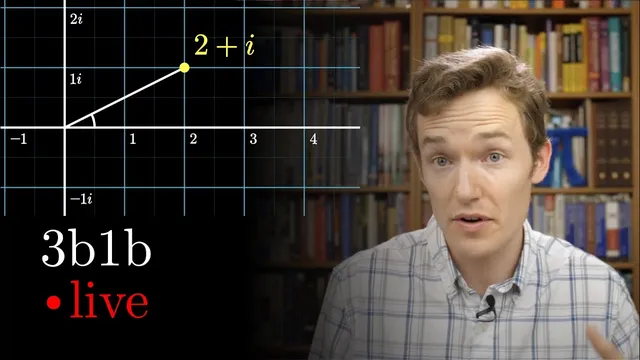
Complex number fundamentals | Ep. 3 Lockdown live math
Based on 3Blue1Brown's video on YouTube. If you like this content, support the original creators by watching, liking and subscribing to their content.
Treat i as a coordinate direction in a two-dimensional number system, not as a purely mysterious symbol.
Briefing
Complex numbers become intuitive once they’re treated as a two-dimensional number system where multiplying by i performs a 90-degree rotation. That geometric move—turning “square root of negative one” into a coordinate direction rather than a mysterious algebraic trick—explains why complex arithmetic isn’t just a formal workaround, but a practical language for rotating and scaling in the plane, with direct ties to engineering and quantum mechanics.
The session starts with a live poll about what counts as “real” among 2, √2, √−1, and infinity, setting up the central tension: √−1 feels unlike ordinary numbers, while infinity is often viewed as ill-defined. From there, the lesson pivots to a more constructive question—how to make imaginary numbers useful without requiring blind belief. The core starting point is the definition of i as a number satisfying i² = −1. Instead of treating that as a memorization hazard, the lesson reframes it as a geometric requirement that can be built into a new coordinate system.
Rather than keeping numbers on a single real line, the lesson places i “perpendicularly above” the real axis, effectively creating a plane of numbers of the form a + bi. In this picture, i and −i sit at opposite points along the imaginary direction, and adding complex numbers behaves like adding vectors: combine the horizontal (real) and vertical (imaginary) components. The arithmetic is presented as straightforward—enough that many audience members correctly compute examples like (2 + 3i) via component-wise addition.
Multiplication is where the meaning sharpens. The lesson connects complex multiplication to rotation: multiplying by i turns a point (a, b) into (−b, a), which is exactly a 90-degree counterclockwise rotation. This is demonstrated both algebraically—distributing i across (3 + 2i) and using i² = −1—and geometrically by interpreting the result as a rotated coordinate pair. A follow-up idea reinforces consistency: applying the 90-degree rotation twice produces a 180-degree rotation, matching the coordinate transformation you’d expect.
To generalize beyond 90-degree turns, the lesson introduces three “facts about multiplication.” First, multiplication by 1 leaves points fixed. Second, multiplication by i rotates by 90 degrees. Third, distributivity lets the effect of multiplying by any complex number z be determined from how z acts on 1 and on i. With those constraints, multiplying by z becomes a rigid transformation of the entire plane—preserving the structure of parallel lines and spacing—so the same rule that moves one point moves every point.
The session ends by applying this framework to compute products like (2 + i)(2 − i), encouraging pencil-and-paper distribution while also tying the algebra back to the geometric intuition of how complex multiplication acts across the plane. The takeaway is that “imaginary” numbers earn their name only historically; mathematically, they’re a built-in mechanism for rotation and scaling.
Cornell Notes
Complex numbers are presented as a two-dimensional number system a + bi, where i is defined by i² = −1. The key payoff is geometric: multiplying by i rotates any point (a, b) by 90 degrees counterclockwise, mapping (a, b) to (−b, a). Addition works like vector addition by combining real and imaginary components. Multiplication becomes understandable through three facts: z·1 = z, z·i determines the i-direction behavior, and distributivity extends the rule to all numbers of the form c + di. This turns complex arithmetic into a consistent transformation of the entire plane, not a mysterious algebraic trick.
Why define i by i² = −1 instead of treating √−1 as just a strange symbol?
How does addition of complex numbers work in the a + bi picture?
What exactly does multiplying by i do geometrically?
How can multiplication by an arbitrary complex number z be understood without doing full algebra every time?
What role does distributivity play in connecting algebra to geometry?
How does the product (2 + i)(2 − i) fit the rotation/scaling story?
Review Questions
- In the coordinate interpretation of a + bi, what point corresponds to −2 + 3i, and how would multiplying by i change it?
- Why does knowing the effect of z on 1 and on i determine the effect of z on every complex number c + di?
- What does applying multiplication by i twice correspond to geometrically, and how does that relate to i² = −1?
Key Points
- 1
Treat i as a coordinate direction in a two-dimensional number system, not as a purely mysterious symbol.
- 2
Define i by i² = −1, then interpret that definition through geometric rotation behavior.
- 3
Represent a + bi as the point (a, b), so addition becomes component-wise (vector-like) addition.
- 4
Multiplying by i rotates every point 90 degrees counterclockwise: (a, b) → (−b, a).
- 5
Use distributivity to extend the rotation rule from special cases (1 and i) to multiplication by any complex number z.
- 6
Once the images of 1 and i under multiplication by z are known, the entire-plane transformation is determined.
- 7
Compute products like (2 + i)(2 − i) both algebraically (using i² = −1) and conceptually (as a plane transformation).