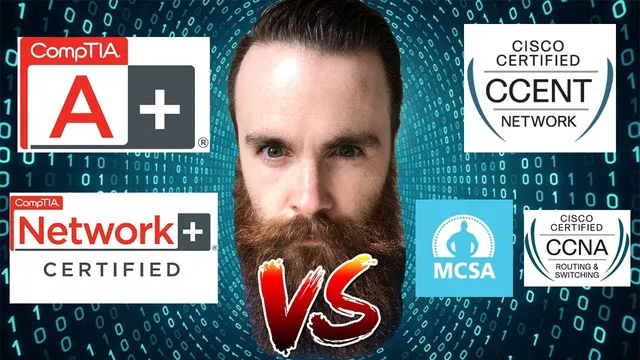
CompTIA or Cisco? - Should I get the CompTIA A+/Network+ OR the Cisco CCNA/CCENT - Microsoft MCSA?
Based on NetworkChuck's video on YouTube. If you like this content, support the original creators by watching, liking and subscribing to their content.
Use CompTIA A+ primarily as a bridge into a first help desk/desktop support job, not as the main credential for moving into network engineering or system administration.
Briefing
Vendor-specific certifications tend to beat broad, vendor-neutral credentials for people aiming to move beyond help desk work—especially when the goal is network engineering or Microsoft systems administration. The core rule offered is simple: if someone is already in (or targeting) a higher-tier path, Cisco CCNA/CCENT or Microsoft MCSA-style tracks provide a faster resume boost and more directly transferable skills than CompTIA A+.
The guidance is grounded in a personal career arc. After starting CompTIA A+ studies in 2011 with no IT experience, he landed help desk jobs even before earning the credential. While studying, he also built a habit of arriving early to study, which leadership noticed—yet a network engineer mentor questioned why he was pursuing A+ when he already had a help desk role. That mentor’s advice was to skip A+ and jump into Cisco training, beginning with CCNA’s ICND1 (the first half). The narrator didn’t follow it, finished A+, and then saw little career movement because the certification was designed to get people into help desk work—and he was already there.
From that experience, the decision framework becomes two questions: where someone is right now, and where they want to be. If the current situation is help desk or desktop support—repairing computers, supporting users, troubleshooting basic issues—CompTIA A+ can be useful. It teaches foundational material (computer repair, operating systems) and is often used as a keyword in job postings for entry-level support roles. The A+ also makes sense when someone needs a first IT job, since many employers look for it to validate baseline competence.
But the advice shifts sharply for anyone who either already has desktop-support confidence or wants to climb out of help desk quickly. If someone is already comfortable troubleshooting basic computer problems and has some familiarity with areas like Active Directory, then CCNA/CCENT or Microsoft certs should take priority. Even when A+ is still helpful, the argument is that a CCNA or Microsoft credential “trumps” A+ in hiring filters: recruiters may assume the candidate already has the broader fundamentals. The same logic is used to justify skipping other broad CompTIA tracks like Network+ and Server+ when the end goal is vendor-specific roles.
The recommended progression is to find a company with room for growth and the right technology stack—specifically a Cisco shop or Microsoft shop—then start on the help desk if necessary. From there, a motivated candidate can move upward, and the narrator cites a promotion to junior network admin tied to actively working toward a CCNA.
Overall, the pitch is that entry-level Cisco and Microsoft certifications are built for newcomers without requiring prior vendor experience, and they deliver both foundational networking/server knowledge and hands-on relevance to what employers actually use. Finishing an A+ already in progress isn’t discouraged, but starting fresh with A+ is framed as a slower path for people whose target is network engineering, Microsoft system administration, or Linux-adjacent careers.
Cornell Notes
The guidance centers on matching certifications to career stage. CompTIA A+ is most valuable for landing the first IT job—especially help desk or desktop support—because it signals baseline skills and often appears in job descriptions. Once someone already has desktop-support competence or wants to move beyond help desk, vendor-specific credentials like Cisco CCNA/CCENT or Microsoft MCSA-style tracks should take priority. The reasoning is that CCNA/MCSA credentials are designed for entry-level candidates but also provide vendor-relevant networking or server skills, which can place candidates higher on resume screens and speed promotions. A+ can still be worth finishing if already underway, but starting over with it is framed as a slower route for those aiming at network engineering or system admin roles.
When does CompTIA A+ make the most sense, according to this guidance?
Why does the guidance argue for skipping A+ when the goal is CCNA/CCENT or Microsoft MCSA?
What is the decision framework for choosing between CompTIA and vendor-specific certs?
How should someone with little or no IT experience build a path toward network engineering or system admin?
What role do CCNA/MCSA credentials play in hiring and promotions, beyond learning content?
Why are Network+ and Server+ treated as less important in this specific career plan?
Review Questions
- If someone is already working help desk and feels confident troubleshooting desktop issues, which certification path does this guidance prioritize and why?
- What two questions does the guidance use to decide between A+ and vendor-specific certifications?
- How does the recommended job strategy (Cisco shop/Microsoft shop + help desk entry) connect to the choice of CCNA/CCENT or MCSA?
Key Points
- 1
Use CompTIA A+ primarily as a bridge into a first help desk/desktop support job, not as the main credential for moving into network engineering or system administration.
- 2
If already in help desk work or already confident with desktop troubleshooting, prioritize vendor-specific tracks like Cisco CCNA/CCENT or Microsoft MCSA-style certifications.
- 3
Choose certifications based on two factors: current role/skills and the target role beyond help desk.
- 4
Aim for employers that match your target stack (Cisco or Microsoft) so your experience and certification align with real systems at work.
- 5
A+ can be worth finishing if already underway, but starting fresh with A+ is framed as slower for candidates whose goal is higher-tier IT work.
- 6
Vendor-specific entry-level certifications are described as beginner-friendly while still providing vendor-relevant hands-on knowledge.
- 7
Active progress toward a CCNA can influence internal opportunities, including promotions, when employers see commitment to the target path.