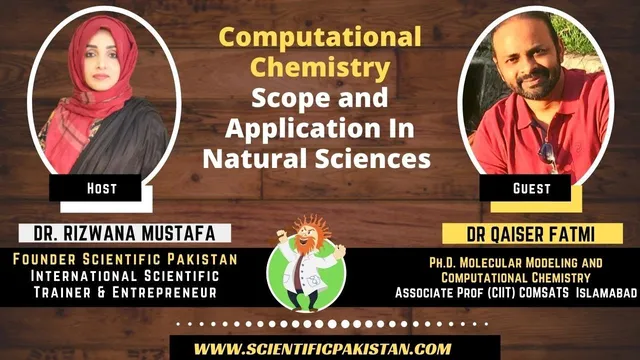
Computational Chemistry: Scope And Applications | Dr Qaiser Fatmi | Dr Rizwana
Based on Dr Rizwana Mustafa's video on YouTube. If you like this content, support the original creators by watching, liking and subscribing to their content.
Computational chemistry can predict molecular properties and reaction feasibility before experiments, reducing cost and trial-and-error.
Briefing
Computational chemistry is positioned as a practical, high-impact route for researchers—especially in settings with limited lab infrastructure—because it can screen and predict molecular behavior before expensive experiments ever begin. The core message is that computational tools let scientists study properties that are hard, costly, or time-consuming to measure experimentally, while also accelerating workflows such as drug discovery, enzyme inhibition studies, and feasibility checks for chemical reactions.
Dr Qaiser Fatmi traces her own path into computational chemistry through early work on quantitative structure–activity relationships (QSAR), then a shift toward molecular dynamics simulation as her main research thread from the mid-2000s onward. She contrasts computational chemistry with classical branches of chemistry—organic, industrial, analytical—by emphasizing that it uses software and computing resources rather than requiring large quantities of chemicals. A major advantage, she says, is accessibility: many useful tools are free for academic use (often with restrictions on commercial sale), and even commercial options can be avoided for substantial training and research output.
The discussion then narrows to scope and why demand is rising. Computational chemistry is framed as especially valuable for “screening” at scale—running through millions of compounds virtually—something that would be unrealistic experimentally due to infrastructure, time, and cost. It also supports experimental design: researchers can test reaction feasibility, compare likely products using energy and transition-state reasoning, and reduce trial-and-error. In drug discovery, the workflow becomes concrete: once protein structures are determined (for example via X-ray crystallography), virtual screening and docking can identify candidate ligands, which can later be validated experimentally.
At the same time, computational chemistry is not presented as a replacement for wet-lab work. The recommended approach is parallelism: use computation to strengthen hypotheses and narrow choices, then rely on experiments for ultimate confirmation. This balance matters in Pakistan’s research ecosystem, where limited resources can leave graduates with degrees but not the hands-on computational skills needed for competitive work. Computational chemistry is offered as a “resource-light” skill set that can still produce internationally publishable results.
The transcript also lays out how computational chemistry can be integrated into research proposals and training. For molecular docking and virtual screening, tools such as AutoDock and AutoDock Vina are highlighted as freely available academic options. For molecular dynamics, common tools include VMD for visualization and NAMD for simulation; the discussion notes that MD can be computationally heavy, sometimes beyond typical laptops. The talk further points to additional software categories—pharmacophore modeling (e.g., LigandScout), quantum mechanical calculation tools (e.g., Gaussian, with alternatives mentioned), and other workflow tools—while stressing that students need training in correct data input, parameter consequences, and goal-driven tool selection.
Finally, the talk connects computational chemistry to broader trends: artificial intelligence is described as increasingly central, with protein structure prediction cited through DeepMind’s AlphaFold as an example of fast, accurate AI-driven modeling. The closing guidance for young researchers centers on mindset: curiosity and commitment, not chasing publication alone. The overall takeaway is that computational chemistry offers a scalable, internationally relevant path to research productivity—if paired with experimental validation and guided by a clear work plan.
Cornell Notes
Computational chemistry is presented as a resource-efficient way to predict and screen molecular behavior—often enabling studies that are difficult, expensive, or slow to do experimentally. The talk emphasizes that it should run in parallel with wet-lab work: computation narrows hypotheses and candidate molecules, while experiments provide final validation. Scope is framed around feasibility checks for reactions, virtual screening of large compound libraries, and mechanistic insight via docking and molecular dynamics (including effects of mutations, pH, temperature, and post-translational modifications). Accessibility is a recurring theme: many academic tools are free (with restrictions on commercial use), and students can build publishable skills even where lab infrastructure is limited. Rising demand is linked to AI-driven advances such as protein structure prediction (AlphaFold) and growing interest in AI-assisted research workflows.
Why is computational chemistry considered especially valuable in environments with limited experimental infrastructure?
What does “scope” look like in practice—how does computation support real research workflows?
How should computational chemistry relate to experiments—replacement or partnership?
What skills and habits determine whether computational results are reliable?
Which tools were named for different computational tasks, and what are their roles?
How is AI changing computational chemistry, according to the transcript?
Review Questions
- What specific computational advantages are claimed for reaction feasibility, virtual screening, and property prediction—and how do they reduce experimental burden?
- Why does the transcript insist computational chemistry must be paired with experiments, and what does “parallel” mean for study design?
- Which factors determine the accuracy of computational results beyond simply choosing a software tool (e.g., inputs, parameters, and research goals)?
Key Points
- 1
Computational chemistry can predict molecular properties and reaction feasibility before experiments, reducing cost and trial-and-error.
- 2
Virtual screening and docking enable large-scale candidate selection (including millions of compounds) that would be impractical experimentally.
- 3
Molecular dynamics adds time-dependent insight, including how mutations, temperature, and pH can change binding and stability.
- 4
Computational chemistry should run in parallel with wet-lab experiments; computation narrows hypotheses while experiments provide final validation.
- 5
Many academic computational tools are free for non-commercial use, making the field more accessible where lab infrastructure is limited.
- 6
Reliable results depend on correct input data, appropriate parameter choices, and tool selection aligned with a clear research goal.
- 7
AI—especially protein structure prediction (AlphaFold)—is accelerating computational chemistry workflows and expanding opportunities for new research directions.