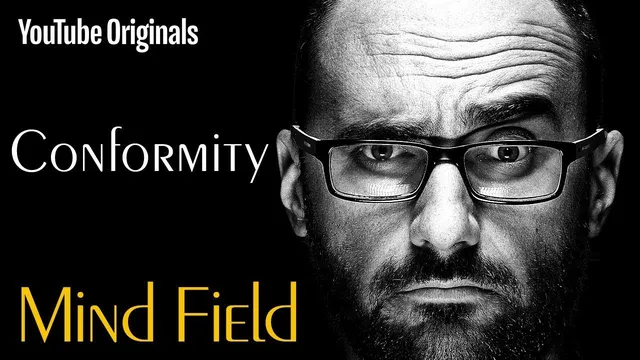
Conformity - Mind Field (Ep 2)
Based on Vsauce's video on YouTube. If you like this content, support the original creators by watching, liking and subscribing to their content.
In an Asch-style line task, social pressure can push a participant from initial resistance to matching an incorrect group answer despite clear visual evidence.
Briefing
Conformity can overpower what people see, hear, and even believe—often within minutes—and the pressure doesn’t just come from fear of embarrassment. In a classic line-matching setup modeled on Solomon Asch’s 1951 experiment, a participant initially watches others give the wrong answer after everyone else has been coached to do so. At first, confusion shows up: the participant closes one eye, tries to reconcile the mismatch, and hesitates. But once the group keeps insisting on an incorrect choice, the participant eventually shifts—first sticking to the truth while looking uncomfortable, then “falling in line” and conforming even when the correct answer is still visible. The takeaway is blunt: being right competes with fitting in, and social pressure can win.
The pressure to match the crowd extends beyond obvious “wrong answers.” In another staged scenario, a participant is told to listen to jokes while everyone else laughs at lines that are explicitly nonsense. The laughter spreads anyway, driven by politeness, a fear of looking stupid, and the desire to stay socially aligned. When later asked why they laughed, many participants describe a mental scramble—trying to make sense of the joke after the fact—rather than admitting they genuinely found it funny. That self-justifying process is framed as cognitive dissonance: when behavior conflicts with belief, people adjust their explanations to reduce discomfort.
The discussion then widens from lab tasks to real-world consequences. The bystander effect—where people are less likely to help when others are present—is illustrated with the widely taught story of Kitty Genovese, a 1964 New York City murder. But the narrative is challenged: much of the “38 witnesses did nothing” version is presented as false or exaggerated. Fewer people may have actually witnessed the attack, and calls to police did occur. The number that stuck—38—spread through an information cascade, where later reports rely on earlier claims instead of checking facts. In other words, conformity can operate through media repetition, not just through direct peer pressure.
Finally, the pressure to conform is pushed into the body. In a high-stakes-looking study involving the hallucinogenic drug NC-47, participants are told they may experience visual and auditory distortions. In reality, they receive only flavored water. Even so, many begin reporting effects consistent with the group—seeing fuzzy shapes, hearing echoes, feeling relaxed, and describing brightness or sensations near the face. After debriefing reveals the “drug” was fake, some participants still report feeling changed and continue to interpret their experiences as real. The core message lands: social influence can reshape perception and memory, and it can persist even after the truth is revealed—because the need to belong is powerful enough to rewrite what feels like evidence.
Cornell Notes
Conformity pressure can make people abandon what they see and even reshape what they think they experienced. In an Asch-style line task, a participant initially resists the group’s wrong answers but eventually matches them to avoid social discomfort. A second setup shows that people may laugh at nonsense when everyone else does, then justify the reaction afterward through cognitive dissonance. The same dynamic can spread through information cascades in real reporting, where repeated claims replace verification. In a drug-deception study, participants who drank only water still report hallucination-like symptoms after hearing others describe them, and some continue believing those effects even after the reveal.
How does the Asch-style line experiment demonstrate conformity in a way that’s hard to dismiss as “just a mistake”?
Why do people laugh at jokes they don’t find funny in the “nonsense jokes” scenario?
What’s the difference between conformity as peer pressure and conformity as “information cascade” in the Kitty Genovese discussion?
How can a fake drug study produce real-feeling reports of hallucination-like symptoms?
What happens after participants learn the “drug” was only water, and why is that important?
Review Questions
- In the Asch-style task, what specific design choices make it difficult for the participant’s eventual conformity to be explained as random error?
- How does cognitive dissonance help explain laughter at nonsense jokes, and what kinds of justifications do participants give?
- What does the Kitty Genovese correction suggest about how “conformity” can operate through media repetition rather than direct social pressure?
Key Points
- 1
In an Asch-style line task, social pressure can push a participant from initial resistance to matching an incorrect group answer despite clear visual evidence.
- 2
Building “trust” with correct answers early on makes later conformity more likely when the group switches to wrong responses.
- 3
People can laugh at nonsense when everyone else laughs, then rationalize the reaction afterward through cognitive dissonance.
- 4
The Kitty Genovese “38 witnesses” story is presented as largely inaccurate, with the number spreading via an information cascade rather than reflecting true eyewitness inaction.
- 5
Conformity can shape perception: in a fake-drug study, participants report hallucination-like visual and auditory effects after hearing others describe them, even when they drank only water.
- 6
Some participants continue to believe their reported symptoms after learning the drug was fake, showing how social influence can persist beyond debriefing.