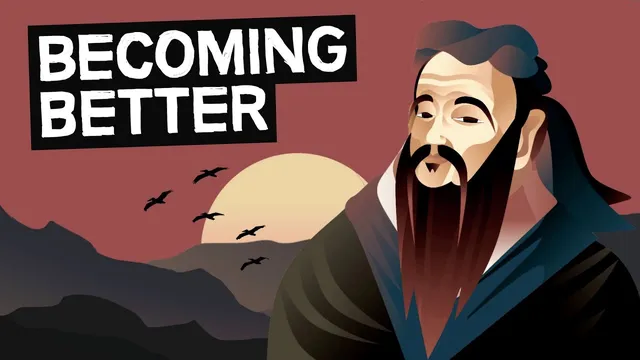
Confucius | The Art of Becoming Better (Self-Cultivation)
Based on Einzelgänger's video on YouTube. If you like this content, support the original creators by watching, liking and subscribing to their content.
The self is portrayed as changeable and fragmented rather than a fixed inner essence that can be discovered once and for all.
Briefing
The core claim is that Confucian self-cultivation doesn’t start with discovering a fixed “true self,” but with treating identity as something malleable—shaped by what people do. Michael Puett, a Harvard professor of Chinese history, is used to challenge a modern Western habit of thinking of personality as a stable set of traits. In this view, the self isn’t a discoverable inner essence; it’s fragmented and changeable, more like a “mess” of emotions and thoughts than a permanent core. That matters because believing certain behaviors can’t be changed can lock people into repeating harmful patterns—abusive relationships, substance abuse, or criminal cycles—while also making “authenticity” become a rigid excuse rather than a starting point for growth.
Confucianism reframes improvement as cultivation of conduct and character through disciplined practice. Confucius is presented as a philosopher and politician who emphasized morality, order, and respect as routes to social harmony. Ritual is central to that program. Rituals are described not as outdated religious formalities, but as “social cement” that transforms both communities and individuals. The mechanism is psychological: rituals interrupt everyday routines and temporarily replace familiar patterns with new roles and behaviors. Over time, repeated interruptions produce durable change.
A concrete example anchors the argument: Remembrance of the Dead in the Netherlands, held annually on May 4. Across public spaces and even private homes, the day becomes a ritual space, with a key moment of two minutes of silence followed by the national anthem. Participants are said to shift from ordinary roles into a collective identity—Dutch citizenship tied to values such as liberty and tolerance. Research cited in the transcript links the ritual’s shared emotions and thoughts to solidarity and connectedness, illustrating how ritual can “keep the Dutch Dutch” by reshaping inner experience as well as social bonds.
The transcript then addresses a practical problem: many people don’t live in highly ritualized communities. The solution is to “ritualize” ordinary life—turning small recurring actions into transformative practices. Confucius’s reported remark in the Grand Temple (“This is the ritual”) is used to suggest that inquiry and disciplined practice can themselves become ritual. The key requirement is that rituals must be pattern-breaking, not merely habitual.
To make change concrete, the transcript uses a behavioral logic: people are “bundles of patterns,” often unconscious, and habits limit what they can perceive and know. Since change is difficult without intervention, self-cultivation relies on creating “as if” moments—acting differently on purpose, even when the new behavior feels inauthentic. The familiar “fake-it-till-you-make-it” idea is applied to outcomes like overcoming cynicism by practicing more constructive conversation, or replacing shyness with repeated confident behavior until it becomes habitual. The overall takeaway is that self-cultivation is continual practice: like learning an instrument, skill deteriorates without ongoing refinement. Growth, in the end, is framed as changing behavior to become the person one wants to be—starting from what can be trained rather than what can be “found.”
Cornell Notes
Confucian self-cultivation rejects the idea of a fixed inner “true self” that can be discovered through tests or introspection. Instead, the self is treated as fragmented and changeable, shaped by habits and circumstances. Because habits narrow perception and reinforce destructive cycles, meaningful change requires pattern-breaking practice. Ritual is presented as the engine of that change: it interrupts everyday routines, installs new roles temporarily, and—when repeated—produces long-term psychological and social transformation. Even without a ritual-rich community, people can build “as if” moments by deliberately acting differently until new behaviors become stable traits.
Why does the transcript argue that “finding yourself” is a limited or risky approach?
What does Confucianism mean by self-cultivation, and what is it trying to improve?
How does ritual function according to the transcript’s psychological logic?
What example is used to show ritual’s effects on individuals and communities?
How can someone practice self-cultivation without living in a ritual-heavy community?
What does “as if” behavior (fake-it-till-you-make-it) aim to accomplish?
Review Questions
- How does the transcript distinguish between a fixed “true self” and a self that can be cultivated through behavior?
- What conditions make a practice count as a “transformative ritual” rather than a routine habit?
- Explain the role of “as if” moments in changing patterns. What kinds of outcomes does the transcript associate with this approach?
Key Points
- 1
The self is portrayed as changeable and fragmented rather than a fixed inner essence that can be discovered once and for all.
- 2
Believing certain traits are unchangeable can reinforce harmful cycles, because people stop trying to alter behavior.
- 3
Confucian self-cultivation focuses on training conduct and relationships to build virtue and flourishing.
- 4
Rituals work by interrupting everyday patterns and installing new roles temporarily, which can become lasting through repetition.
- 5
Even in individualistic settings, ordinary routines can be ritualized if they repeatedly break patterns rather than simply repeat them.
- 6
Self-cultivation relies on “as if” behavior—acting differently on purpose until new habits form and identity follows action.
- 7
Ongoing practice is required; without continual refinement, skills and character patterns deteriorate like an instrument left unplayed.