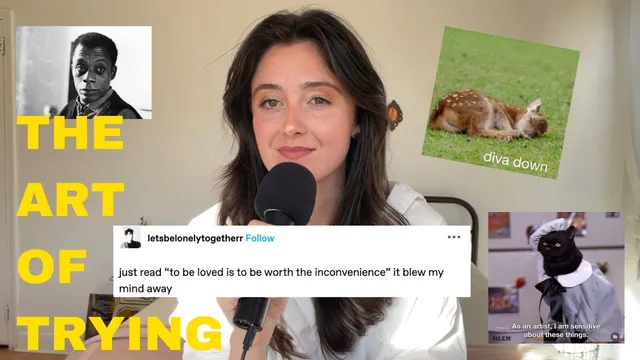
convenience culture is killing our creative impulses
Based on Anna Howard's video on YouTube. If you like this content, support the original creators by watching, liking and subscribing to their content.
Convenience culture can weaken creative impulses by removing the friction that turns output into personal ownership.
Briefing
Convenience culture is eroding the very conditions that make art feel personal—slow, messy, and sometimes boring work that builds self-respect. Leaning on instant answers, including AI, may produce something others can consume, but it often bypasses the inconvenient process that turns output into ownership. The result is a hollowing out: less integrity, fewer internal “I kept my word” moments, and weaker creative impulses over time.
The argument starts with a broader social critique. When shopping, problem-solving, and information consumption become frictionless—overnight shipping, algorithm-fed recommendations, and “tell me the answer now” expectations—people lose the muscle of figuring things out for themselves. That same pattern shows up in creative life. Marketing tends to optimize for simplicity and immediate payoff, but art is different: creation and consumption both involve wasted time, fatigue, and the discomfort of searching for what actually resonates. If a reader expects the “answer” on the first page, they may never open the book again; if a viewer expects entertainment on demand, they may miss the genius that requires commitment.
To ground the point, the transcript draws on Rain Fisher Quan’s Substack essay “Choosing to Walk,” which frames writing as walking: rarely the most efficient route, often boring or tiring, yet uniquely capable of producing unexpected rewards. Walking expands the range of possible experiences with little promise of tangible gain—“something like being alive.” That logic becomes a direct warning about AI. Used occasionally, AI can help; relied on too heavily, it prevents artists from making something that is truly theirs. Cutting out the inconvenience removes the accumulation of evidence that someone is showing up for themselves, building self-respect through follow-through.
The discussion then pivots to self-respect versus self-love, citing Zara’s Substack piece “They convinced you to love yourself so you’d forget to respect yourself.” Self-love, the quote suggests, can encourage acceptance without challenge or accountability, while self-respect demands integrity, discipline, and alignment with values. Feeling good is treated as peripheral; dignity, resilience, and the ability to rely on oneself become central. The internal “quiet observer” registers whether promises are honored, and repeated neglect erodes self-esteem.
From there, the transcript argues that pushing against convenience is also where creative surprise lives. There’s “fertile creative ground” at the edge of comfort—between repetition and boredom and the unknown beyond it. Consumption works similarly: committing to something that doesn’t instantly gratify can reveal depth later, as with the example of watching “Succession” after initially dismissing it. The transcript also invokes James Baldwin’s “The Artist’s Struggle for Integrity,” emphasizing that pain and struggle can connect people and that responsibility ultimately belongs to oneself. The takeaway is not to romanticize suffering, but to treat creative practice as a place to play out values and choose integrity.
Finally, a practical exercise is offered to rebuild taste and agency against algorithmic shaping: a self-guided library day inspired by a TikTok creator named ruie. The method is to pick 5–8 books quickly, then decide in short-form (3-second interest) and long-form (whether to continue) whether each earns more attention—putting down what doesn’t. The creator closes by noting that their own production process is intentionally inefficient and inconvenient in parts, reinforcing the episode’s core claim: the work that isn’t optimized for ease is often the work that becomes genuinely yours.
Cornell Notes
The transcript argues that convenience culture weakens creative impulses by replacing the inconvenient process of making and choosing with instant gratification. Heavy reliance on AI and algorithmic answers can produce content for others to enjoy, but it often prevents artists from creating something truly owned—something that builds self-respect through follow-through. Self-respect is framed as integrity and accountability to one’s values, not just self-acceptance; the “quiet observer” inside registers whether commitments are honored. The episode also claims that creative surprise and deeper consumption require pushing to the edge of comfort, where boredom and repetition give way to the unknown. A concrete countermeasure is a library exercise: select 5–8 books quickly, then decide in short- and long-form whether to continue, documenting what you choose.
How does the transcript distinguish “product” from “art” in a way that connects to convenience?
Why does the transcript treat self-respect as central to creativity rather than motivation or talent?
What role does AI play in the argument, and what’s the line between helpful tool use and creative bypass?
How does “Choosing to Walk” support the episode’s view of creative work and consumption?
What does the episode claim about pushing to the edge of comfort?
What is the library exercise, and how does it counter algorithmic influence?
Review Questions
- Where does the transcript place the “line” between using AI as a tool and using it in a way that undermines ownership and self-respect?
- What does the episode suggest is lost when consumption is optimized for immediate gratification, and how does the “walking” metaphor explain why?
- How does the library exercise rebuild taste differently from relying on recommendations, and what decisions happen in short-form versus long-form?
Key Points
- 1
Convenience culture can weaken creative impulses by removing the friction that turns output into personal ownership.
- 2
Relying on instant answers (including AI) may produce content others enjoy, but it can bypass the inconvenient process that builds self-respect.
- 3
Art-making and art-consuming both involve fatigue, wasted time, and searching for resonance—conditions that convenience tends to eliminate.
- 4
Self-respect is framed as integrity and accountability to values, reinforced by keeping small commitments over time.
- 5
Creative surprise often appears at the edge of comfort, where repetition and boredom meet the unknown.
- 6
Consumption should include deliberate encounters with things that don’t instantly gratify, since depth can emerge after commitment.
- 7
A practical countermeasure is a library-based taste exercise: pick 5–8 books quickly, then decide in long-form whether to continue, documenting what you choose.