Copenhagen is Great ... but it's not Amsterdam
Based on Not Just Bikes's video on YouTube. If you like this content, support the original creators by watching, liking and subscribing to their content.
Copenhagen’s cycling reputation is tempered by concerns about cyclist protection, especially where wide roads and intersection layouts create conflict with turning vehicles.
Briefing
Copenhagen earns global praise for cycling and walkable neighborhoods—but the city’s design falls short of the Netherlands standard in ways that matter most to day-to-day safety and comfort. Wide, car-friendly streets, under-protected bicycle lanes, and intersection layouts that dump cyclists into conflict zones keep Copenhagen from matching the “fully people-first” feel found in Dutch cities.
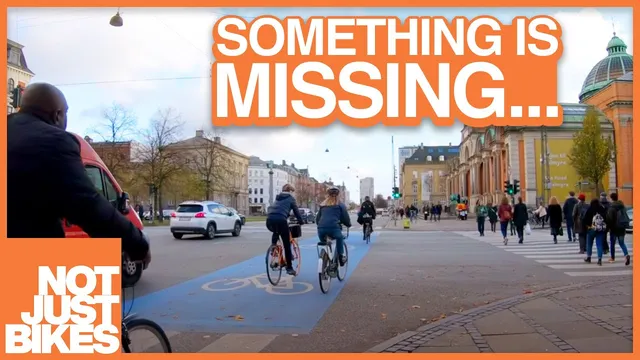
The contrast starts with street form. Copenhagen has stretches of extremely wide roadway in the city center, often with little physical separation—no median, minimal landscaping, and bicycle lanes that can feel unprotected. Even when traffic is lighter than in many places, the infrastructure still invites higher speeds, and the lack of consistent safety design stands out against the Netherlands’ more uniform approach. Trees are also noticeably scarce along major corridors, with Copenhagen’s streets sometimes feeling more like asphalt corridors than shaded, human-scaled streets.
Public transit adds another layer of difference. Copenhagen has frequent bus service, but buses often get stuck in traffic because dedicated bus lanes are limited. Heavy rail coverage is strong, and the metro-like frequency is a plus, yet the absence of trams—removed in the 1970s and never replaced—means the system doesn’t deliver the same street-level transit experience found in many European cities.
Cycling infrastructure is where the praise and criticism collide. Copenhagen has a lot of cycling ridership and impressive facilities, including major bike bridges and extensive networks. But some elements feel retrofitted or overly basic, with confusing pavement treatments and “paint-and-blob” fixes that don’t always read as a mature, integrated system. A standout example is a major cycling bridge whose two-way design funnels into one-way routing at a junction, requiring signage to make the flow understandable. At rush hour, the intersection behavior can become chaotic, with cyclists sometimes choosing to ride on the “wrong” side rather than follow the confusing layout.
The most serious concern is intersection safety. Copenhagen’s junctions are described as frequently lacking the protective islands and layered safeguards common in the Netherlands. Cyclists can be forced into combined bicycle-and-turn lanes where turning vehicles—especially buses—sit adjacent at the same time. The result is described as genuinely nerve-wracking, particularly when vehicles are large and unpredictable.
Even bicycle parking is criticized as lagging behind Dutch expectations, with few indoor facilities at major stations and metro hubs. And once cyclists leave Copenhagen for other Danish cities, the quality becomes inconsistent.
So why does Copenhagen still win planners’ admiration? The transcript argues that Copenhagen is “achievable” for outsiders: it delivers strong walking, cycling, and transit outcomes without requiring the most politically difficult moves—like removing car lanes everywhere or building new light rail. That makes it a believable first step for car-dependent cities. The Netherlands, by contrast, is framed as the next lesson: after cities adopt Copenhagen-like priorities, they can look to Dutch design for the more comprehensive, people-centric safety and network integration that Copenhagen still lacks.
Cornell Notes
Copenhagen is widely admired for cycling and walkability, but its infrastructure doesn’t consistently match the Netherlands’ level of cyclist protection—especially at intersections. The city’s very wide roads, limited physical separation in some places, and junction designs that rely heavily on paint can place cyclists in conflict with turning vehicles. Transit is strong on buses and heavy rail, yet the lack of trams and limited dedicated bus lanes can reduce reliability. Cycling facilities are extensive, including major bridges, but some retrofitted or confusing connections and weaker bicycle parking reduce the overall “seamless” feel. Copenhagen’s real value to planners is that it’s an achievable model: it shows how cities can prioritize people without immediately making the most extreme changes.
What specific street-design differences make Copenhagen feel less safe for cyclists than Dutch cities?
How do Copenhagen’s intersection designs affect cyclists in practice?
What’s the criticism of Copenhagen’s cycling infrastructure details, beyond the overall network size?
How does Copenhagen’s transit setup compare with what cyclists might expect from other European systems?
Why do urban planners still hold Copenhagen up as a model despite these shortcomings?
Review Questions
- Which Copenhagen design elements most directly increase cyclist risk at intersections, and how do they differ from Dutch junction treatments?
- Why does the transcript claim Copenhagen is “achievable” for planners from car-dependent cities, and what does that imply about the next steps toward Dutch-style design?
- What are the main criticisms of Copenhagen’s cycling infrastructure details (e.g., bridge connections, pavement cues, or bicycle parking), and how do they affect rider experience?
Key Points
- 1
Copenhagen’s cycling reputation is tempered by concerns about cyclist protection, especially where wide roads and intersection layouts create conflict with turning vehicles.
- 2
Extremely wide city-center roadways in Copenhagen can encourage higher speeds and provide less physical separation than the Netherlands’ more consistent safety design.
- 3
Copenhagen’s transit relies heavily on buses and heavy rail; limited dedicated bus lanes can cause buses to stall in traffic, and trams are absent.
- 4
Cycling infrastructure in Copenhagen includes major assets like bike bridges, but some connections and surface treatments can be confusing or feel retrofitted.
- 5
Intersection safety is the biggest gap: Copenhagen junctions often use paint-based separation rather than the protective islands and layered safeguards common in Dutch cities.
- 6
Bicycle parking is described as weaker than Dutch expectations, with few indoor facilities at major stations and metro hubs.
- 7
Copenhagen’s global appeal for planners comes from its “sellable” middle path—strong people-first outcomes without requiring the most politically difficult changes immediately.